
World media spotlight Thailand’s deepening political crisis
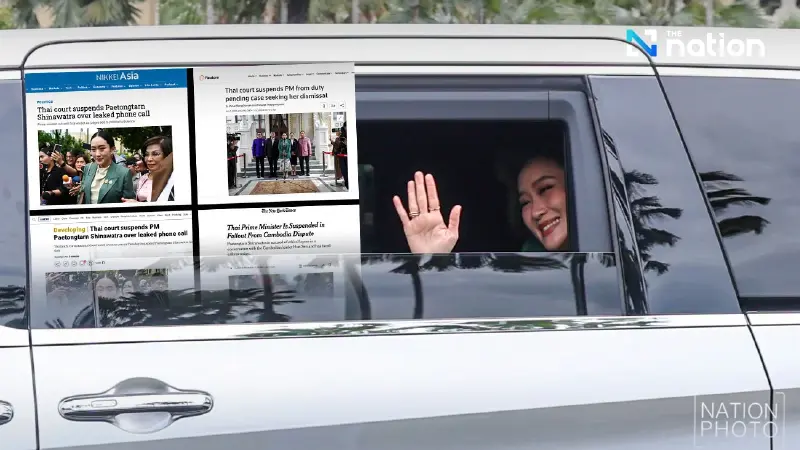


Foreign media report on Paetongtarn’s suspension, warn of growing political turmoil and fragile government stability in Thailand.
Thailand’s Constitutional Court has suspended Prime Minister Paetongtarn Shinawatra from her duties pending a ruling on whether she breached ethical standards in violation of the constitution, following a controversial phone call with Cambodia’s former leader, Hun Sen.
The petition, filed by 36 senators, accuses the 38-year-old premier of dishonesty over the leaked call, which appeared to show her currying favour with Hun Sen while disparaging a Thai military commander.
Deputy Prime Minister Suriya Juangroongruangkit, who also serves as transport minister, will act as caretaker leader during Paetongtarn’s suspension. Suriya, 70, is a political veteran who has served in various cabinets since the 1990s.
The court has given Paetongtarn 15 days to respond to the allegations. A decision will be made following further proceedings.
Cabinet shuffle and continued presence
Despite her suspension, Paetongtarn will remain in government. On the same day the court issued its ruling, she was appointed Minister of Culture. Once she is officially sworn in on July 3, she will be permitted to attend cabinet meetings in her new capacity.
Parliamentary implications
According to Reuters, Parliament is scheduled to reconvene on July 3. Bhumjaithai, a key coalition partner that withdrew from the government following the call’s leak, had planned to table a no-confidence motion. However, with Paetongtarn now suspended, such a motion cannot proceed.
Bhumjaithai would also require the backing of the opposition People’s Party to bring down the government, support that is not yet guaranteed.
Further legal risks
In addition to the Constitutional Court case, the National Anti-Corruption Commission (NACC) is investigating Paetongtarn over the same phone call. If the commission finds grounds for further legal action, it could result in a separate case in the Supreme Court, potentially leading to a political ban.
Rising protests
Public discontent has been building. On Saturday, several thousand demonstrators braved monsoon rains in Bangkok in the largest anti-government protest since the Pheu Thai party returned to power in 2023. Protesters, some of whom previously helped oust Paetongtarn’s father and aunt from power, demanded her resignation.
If Paetongtarn does not step down, organisers have vowed to escalate the protests.
A family under pressure
The crisis comes as her father, former Prime Minister Thaksin Shinawatra, faces mounting legal pressure. He is currently on trial for alleged lèse majesté offences over a 2015 interview and is also under scrutiny for his extended hospital stay since returning from exile last year.
Should the courts issue an adverse ruling, Thaksin, 75, could face prison time.
A career shaped by legacy
Paetongtarn’s rise to the premiership last year followed the dismissal of her predecessor, Srettha Thavisin, by a court ruling. It was her first time in government.
Educated at Chulalongkorn University and the University of Surrey, Paetongtarn spent most of her career in the Shinawatra family’s business empire before entering politics. Her brief tenure as prime minister has been overshadowed by her family legacy and Thailand’s deep political divisions.
In March, she described herself before parliament as “a daddy’s girl, 100%.”
According to Nikkei Asia, the Constitutional Court’s decision to suspend Prime Minister Paetongtarn has further exacerbated Thailand’s political instability. The report notes that the leaked audio clip placed Paetongtarn in an increasingly untenable position.
Meanwhile, the South China Morning Post cited political scientist Purawich Watanasukh from Thammasat University as saying that “in the long term, the stability of the government is likely to become even more fragile due to the uncertainty surrounding Paetongtarn’s situation.”
Purawich also pointed out that the petition submitted to the Constitutional Court against Paetongtarn is based on the same ethical standards used in the court’s ruling last year that removed Srettha Thavisin from the premiership.
The New York Times described the court’s decision as the latest disruption in Thailand’s prolonged period of political uncertainty.
The ruling has left Thailand — Southeast Asia’s second-largest economy — in a leadership vacuum at a time of economic slowdown. The Times also warned that the situation has raised fears of a potential military intervention, as the armed forces have historically played a recurring role in Thai political crises.
