
One year of Paetongtarn: government at risk, policies at breaking point
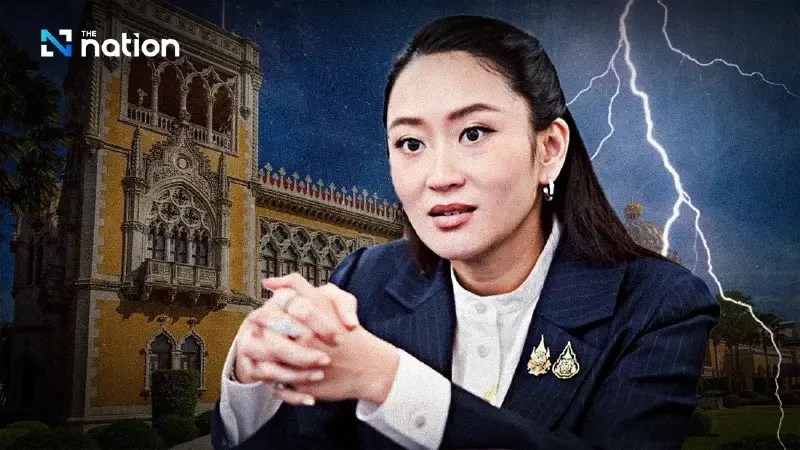


After one year in office, Paetongtarn’s government faces a “legal war,” with the Constitutional Court set to rule on August 29 in the audio clip case, a verdict that could mark both the government’s risk point and the end of its policies, with wide political and economic repercussions.
On August 16, 2024, the House of Representatives voted 319 to 145 to endorse Paetongtarn Shinawatra as Thailand’s 31st prime minister, succeeding Srettha Thavisin, who was disqualified by the Constitutional Court over the appointment of Pichit Chuenban as a minister attached to the Prime Minister’s Office.
But a year on, Paetongtarn’s administration is engulfed in legal battles. The so-called “audio clip case”, involving a leaked conversation between the prime minister and Hun Sen, president of Cambodia’s Senate, has triggered petitions questioning her qualifications and ethical standards.
The Constitutional Court has ordered Paetongtarn to suspend her duties pending a ruling on her premiership, scheduled for August 29. In parallel, the National Anti-Corruption Commission (NACC) is pursuing its own inquiry into the same case after formally accepting it in June 2025. A decision is expected within six months.
These legal challenges have thrown the government into a political vacuum, paralysing its leadership at a critical time.
Meanwhile, the 11-party coalition is grappling with internal conflict, particularly between Pheu Thai and Bhumjaithai, which has further delayed the rollout of key policies.

Over the past year, Paetongtarn’s government has struggled to deliver on its flagship policies despite periodic attempts to showcase achievements. Instead, it has faced no-confidence debates that highlighted policy shortcomings across multiple sectors.
Public sentiment has shifted dramatically. According to the latest quarterly survey by Nida Poll, released on June 29, 2025, opposition leader Natthaphong Ruengpanyawut of the People’s Party emerged as the top choice for prime minister, backed by 31.48% of respondents. Second place went to voters who said “no suitable candidate” (19.88%), followed by former prime minister Gen Prayut Chan-o-cha (12.72%).
Paetongtarn, once riding high in the polls, slumped to fifth place with just 9.20% support, a sharp drop from March 2025, when she held 30.90%, representing a loss of more than 20 percentage points.

A review of earlier Nida surveys shows the decline in her popularity began soon after she took office in August 2024. In the third quarter of 2024 (surveyed September 16–23), Paetongtarn ranked first with 31.35%. But by the fourth quarter, opposition leader Natthaphong had overtaken her with 29.85%, while her support slipped to 28.80%.
Pheu Thai’s flagship policies falter as legal risks mount
More than halfway through the terms of two successive prime ministers, the Pheu Thai-led government has yet to deliver on its key policy pledges, raising fears of a domino-style collapse.
In an attempt to shift momentum, new initiatives such as the 20-baht flat-fare electric train policy have been pushed forward. But the centrepiece economic stimulus, the digital wallet scheme, intended to act as a “whirlwind” to boost the economy, has instead turned into a political “tornado” battering the government itself.
The programme has now become the subject of a political-legal battle after petitions were filed with the NACC. The complaints allege that when MPs, senators and the cabinet approved the 2025 budget bill, funds were reallocated to finance the digital wallet scheme in possible violation of Article 144 of the Constitution, which prohibits direct or indirect benefits in budgetary spending.
The NACC accepted the case in June 2025. Should it find grounds for wrongdoing, the matter would be referred to the Constitutional Court for a ruling on its legality.
The case carries particular weight as it mirrors a precedent involving Pichet Chuamuangphan, a former deputy House speaker. He was disqualified from office and banned from contesting elections for 10 years after the Constitutional Court ruled he approved budget allocations for three parliamentary secretariat projects in the 2026 budget that amounted to personal political gain, a breach of Article 144.
With such risks, the government’s fate hangs not only on the Constitutional Court’s pending August 29 ruling in Paetongtarn Shinawatra’s “audio clip case,” but also on a series of unresolved investigations that could yet decide its survival.
Political turmoil deepens risks for Thai economy as growth outlook cut to 1.7%
Thailand’s worsening political uncertainty is spilling over into the economy, with the University of the Thai Chamber of Commerce’s Centre for Economic and Business Forecasting lowering its 2025 growth projection in June to 1.7% (range 1.5–2.0%), down from the 3.0% forecast issued last November.
The revised outlook highlights the fragile state of the economy, with growth prospects hinging on the severity of five key scenarios:
- US tariff policy – Thailand currently faces a 19% tariff rate, with further changes potentially reshaping trade competitiveness.
- Israel–Iran conflict – Any escalation could push up global oil prices, inflation and monetary policy pressures.
- Thai–Cambodian border tensions – Continued clashes risk disrupting trade and regional stability.
- Effectiveness of stimulus measures – The government’s 157-billion-baht stimulus programme depends heavily on budget disbursement.
- Political stability – The Constitutional Court’s ruling on the “audio clip” case involving Paetongtarn, due on August 29, will determine the government’s survival.
Analysts warn that the August 29 verdict is not only a turning point for the prime minister but also a potential breaking point for government policies, with unavoidable consequences for both Thailand’s political landscape and its economic direction.
