
Anutin’s quick-win plan: co-payment, cheaper train fares, farm debt relief
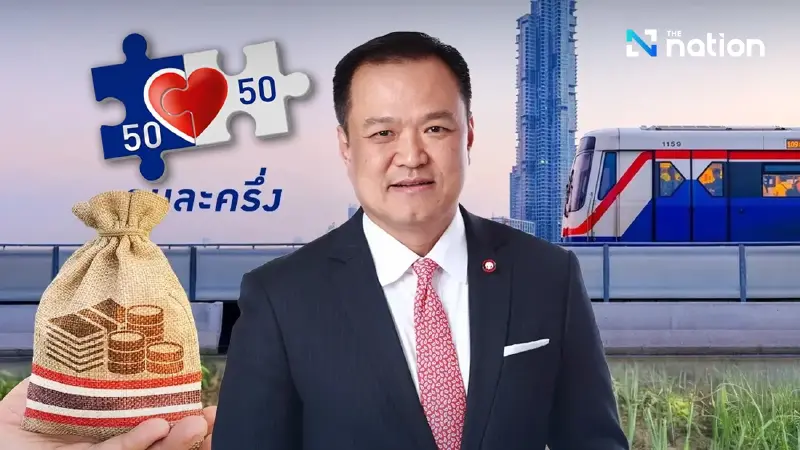


Anutin’s government sets quick-win policies, tasking Ekniti to design budget-based measures with co-payment as the key economic stimulus.
- The government plans to revive the "Khon La Khrueng" co-payment scheme as its main economic stimulus, with a larger budget and varied support levels for taxpayers (60%) and non-taxpayers (50%).
- Electric train fares are set to be reduced by 30-40% by using the Joint Ticket Act to negotiate the reduction or waiver of overlapping entry fees between lines, avoiding a more costly flat-fare policy.
- To address farm debt, the administration is considering special low-interest credit lines (soft loans) to support farmers affected by falling crop prices.
- These policies are designed for immediate implementation due to the government's limited four-month term, aiming to quickly ease the cost of living and boost short-term purchasing power.
The government of Anutin Charnvirakul, leader of the Bhumjaithai Party, faces a limited term under a political agreement with the People’s Party requiring the House to be dissolved within four months after its policy statement to parliament.
As a result, its policy design focuses on measures that can be implemented immediately, aimed at reviving the economy and boosting short-term purchasing power to ease economic pressures in the final months of 2025. Politically, the administration also hopes to leverage these measures to win the next general election and form a full four-year government.
Anutin has earlier outlined four urgent priorities. On the economic front, the government will seek to reduce household and business expenses by cutting living costs, energy bills, travel and transport costs. It will also address debt burdens among farmers and low-income earners, while introducing initiatives to increase income for businesses and strengthen local community economies.
Siripong Angkasakulkiat, Bhumjaithai’s deputy leader, said the party has already prepared a comprehensive economic package to be presented in parliament. The plan, assigned to incoming deputy prime minister and finance minister Ekniti Nitithanprapas, is designed for immediate rollout.
The measures will include cost-of-living reductions and economic stimulus, expanding beyond the existing co-payment scheme to cover tourism-related support and farmer assistance. Siripong stressed that the package would be aligned with available budget resources, and once delivered to parliament, would be ready for implementation without delay.
A senior Bhumjaithai source added that the draft policy statement is already complete, with only minor revisions left before submission. The party’s approach emphasises practical, popular and accessible measures that make effective use of the budget while avoiding an excessive fiscal burden.

New government set to revive ‘Khon La Khrueng’ co-payment scheme
The upcoming package of economic measures may revive past schemes that proved successful, adjusted with new features to suit current conditions. The approach has backing from the party’s economic advisers and government agencies involved in drafting policies. Bhumjaithai began designing its economic framework at the party’s policy meeting in August 2025, incorporating external perspectives, with the co-payment scheme set as a key driver.
According to party sources, the government’s policy framework will focus on stimulating the economy, easing the cost of living, raising grassroots community income, and providing initial relief for farmers.
The revamped Khon La Khrueng (“Half-Half”) co-payment programme is expected to be the centrepiece of the stimulus. The new version will allocate a larger budget and cover both taxpayers and non-taxpayers. Around 11 million registered taxpayers would receive 60% support from the state for purchases, contributing 40% themselves, while non-taxpayers would continue under the original 50:50 arrangement.
Proposals to raise the daily spending limit from 150 to 200 baht are still under review.
Previously, the Finance Ministry’s third phase of the co-payment scheme was the largest, involving 31 million participants, each receiving up to 3,000 baht in state subsidies, with a total budget of 93 billion baht for September–December. The new government plans to adapt and relaunch the scheme as its flagship economic stimulus.

Government eyes rapid community funding
Beyond the co-payment scheme, the new government is preparing additional stimulus policies aimed at quickly injecting money into local economies.
One option under review is the revival of the Village and Urban Community Fund, which can be implemented swiftly through existing mechanisms. Funds would be allocated to villages under the SML model. A budget of 12 billion baht had already been set aside by the previous government but was never disbursed. The new administration is now considering using this channel to accelerate grassroots stimulus.
Tourism promotion is also regarded as an urgent priority, particularly domestic tourism. Plans are being drawn up to revive a scheme similar to the earlier We Travel Together programme, with the aim of boosting travel before the year-end high season.
In addition, the government is considering special low-interest credit lines (soft loans) to support farmers hit by falling crop prices. Incoming deputy prime minister and finance minister Ekniti is in discussions with state-owned specialised financial institutions to design the loan packages, with details still under consideration.
Government plans 30–40% cut in electric train fares using joint-ticketing law
As part of its cost-of-living relief measures, the new government is preparing to reduce electric train fares by 30–40%. Officials have ruled out the flat 20-baht fare policy, calling it unsustainable and too heavy a burden on the budget, which would require annual subsidies of 8–9 billion baht.
With the network now extending deep into the suburbs, subsidies under the 20-baht policy would sometimes exceed 50 baht per trip, making it impractical in the long term.
Instead, the government intends to use provisions in the newly passed Joint Ticket Act, which allows negotiations with concessionaires to lower fares. The law enables revenue sharing between operators and addresses overlapping entry fees when passengers change lines, a key driver of high costs.
“The entry fee of 15–17 baht per line is the main issue. If negotiations can waive or cut this charge, fares could be reduced significantly—by about 35–40 baht for end-to-end travel,” an official source said.
While limited subsidies may still be required, the government stressed that the amount would be far lower than the funding needed to sustain the 20-baht flat fare scheme.

Government tasks energy ministry with lowering electricity bills
As part of its cost-of-living measures, the new government is exploring ways to cut electricity tariffs from the current 3.98 baht per unit. The price had been scheduled to remain fixed until December 2025, but the administration aims to reduce rates during the remainder of this year and maintain lower charges from January to April 2026.
Incoming energy minister Auttapol Rerkpiboon has been assigned to study options to bring down power costs to ease the financial burden on households.
For long-term policy, the government reaffirmed its commitment to the Southern Economic Corridor’s Land Bridge project, which will connect the Gulf of Thailand and the Andaman Sea through new transport infrastructure.
Although the administration has only a four-month mandate, the Office of Transport and Traffic Policy and Planning (OTP) under the Transport Ministry has continued to drive forward the necessary legislation and has already held seminars to conclude feasibility studies for the project.
