
Natthaphong insists People’s Party will hold Anutin government accountable under MOA
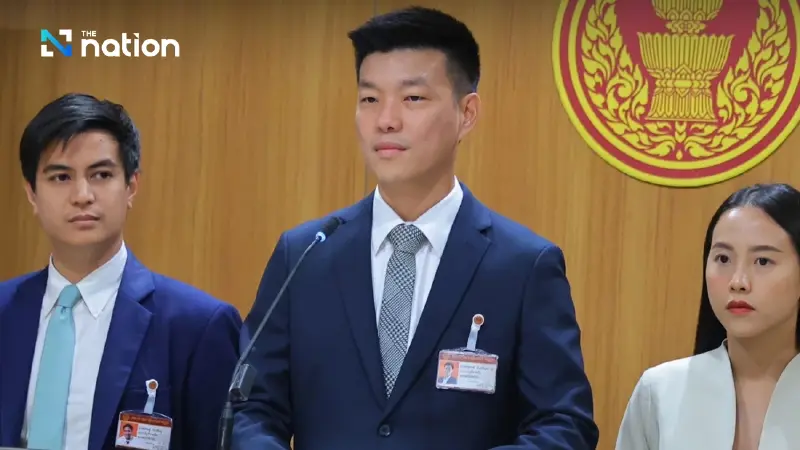


Leader of the Opposition Natthaphong Ruengpanyawut pledges to use all parliamentary tools to ensure Anutin government complies with the MOA agreement.
Natthaphong Ruengpanyawut, Leader of the Opposition, on Thursday addressed the Memorandum of Agreement (MOA) between the People’s Party and Bhumjaithai Party, stating that despite Bhumjaithai's efforts to form a majority government, the People’s Party will not serve as a mere “stepping stone” for their political agenda.
Natthaphong said, “We are not a stepping stone for anyone, including the Bhumjaithai Party. If Anutin Charnvirakul becomes Prime Minister, we will scrutinise everything—both in parliamentary debates and using the 151 mechanism. If we find that the Anutin government is violating the MOA, we will use every mechanism available to investigate and hold them accountable.”
When asked if the MOA has strengthened Bhumjaithai’s position, Natthaphong replied, “It may seem too early to assess, but the real test will be when the House of Representatives votes. That will indicate whether the Bhumjaithai Party has violated the MOA.”

On whether the People’s Party plans to wait for a no-confidence debate, Natthaphong explained, “At the moment, we’re not sure if we need to trigger one, but we will use every available parliamentary tool to scrutinise the government’s actions. If necessary, we’ll push for a no-confidence motion.”
Regarding the alleged pressure on authorities to avoid investigating the Khao Kradong case or the Senate collusion case, Natthaphong said, “Our first platform is to debate the policy statement in Parliament. If that doesn’t stop the wrongdoing or if there is abuse of power, we will take further action, including no-confidence motions.”
He continued, “The MOA also includes provisions for constitutional amendments. If there are concerns over the Senate’s votes, I believe MPs and the public will recognise attempts to obstruct progress. If there is any disruption, we will use parliamentary mechanisms to hold the government to account.”
On the issue of constitutional amendments, Natthaphong emphasised that all MPs should be ready to pass laws that benefit the people. "I believe every party understands that elections are coming soon, and under the four-month deadline, every party will want to push through their policies without losing public support."
Natthaphong also clarified that discussions with senators are ongoing, as it is normal for MPs to coordinate within Parliament. He added, "If the Senate disagrees with the MPs, the public will understand that it’s part of the process to obstruct constitutional amendments, but if that happens, we will hold the government accountable using the parliamentary tools at our disposal."
