
Abhisit to take helm of Democrat Party with task of reviving ratings and reshaping power
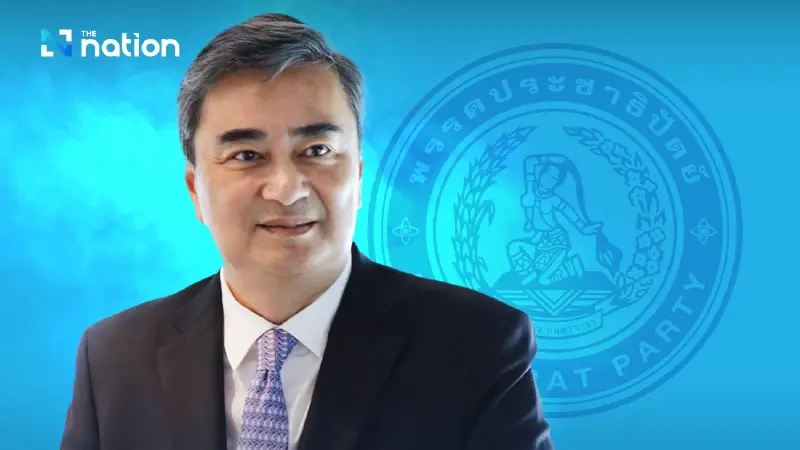


Former PM Abhisit Vejjajiva to assume leadership of Thailand’s Democrat Party, facing the challenge of restoring party popularity and managing internal power dynamics.
It is now fairly certain that Abhisit Vejjajiva, former leader of the Democrat Party, will return as party head, drawing attention to the party’s next political moves under the key challenge of restoring its sharply declined popularity.
During Abhisit’s previous leadership, the party won 159 seats in 2011. By 2019, after a five-year political freeze, the party secured only 53 seats, losing its status as the leading force in the conservative bloc. Despite this, it retained bargaining power as the second-largest party in Prime Minister Gen Prayut Chan-o-cha’s government, compared with the current 25 MPs.

The major challenge is to restore the Democrat Party’s standing as Thailand’s oldest political institution. Beyond Abhisit himself, attention now turns to the new management team to support him.
Abhisit has reportedly held meetings with Korn Chatikavanij and other political strategists, including Santitarn Sathirathai, a future-oriented strategist, and Suvit Maesincee, former Minister of Higher Education, Science, Research and Innovation. Korn described these figures as part of “the country’s future that all generations desire.”

Internal party dynamics also remain complex. There have been reports that former leader Chalermchai Srion may step back, taking a purely advisory role, or that he may leave the party entirely after October 18, 2025.
The Democrat Party also maintains a senior advisory layer, particularly for allocating party-list candidate slots, where tradition honours former leaders by reserving the top positions.
Currently, there are five former party leaders: Abhisit, Chuan Leekpai, Banyat Bantadtan, Jurin Laksanawisit, and Chalermchai. Since Chalermchai previously waived his eligibility to allow other members to contest seats, the top four slots are effectively reserved for former leaders.
In the last election, the Democrat Party won only three party-list seats, highlighting the importance of regional leadership representation and female quotas, which require positions at 5, 10, 15, etc.
This system has created conditions affecting Abhisit’s recruitment of team members. Some prospective candidates have delayed committing, awaiting clarity after October 18, on the extent of the new leader’s decision-making authority over party management.
Attention also turns to the position of party secretary, which functions like a housekeeper, overseeing internal party affairs. Traditionally, once the party leader candidate is confirmed, the candidate for secretary is usually announced at the same time.
As is well known, within the “Blue Camp”, tradition dictates that either the leader or the party secretary also acts as the party treasurer, a critical role necessary for political operations.
In previous eras, when Abhisit led the party, the secretary was Suthep Thaugsuban, later replaced by Chalermchai. Similarly, during Jurin’s leadership, Chalermchai served as secretary.

Recent reports indicate that Chaiwuti Bannawat, former deputy party leader, will become the new party secretary, having been a long-trusted and close associate of Abhisit.
The remainder of the team has already been formed by Abhisit. Korn, previously expected to be secretary, will now serve as deputy leader instead.
Other positions include:
- Sakoltee Phattiyakul – deputy party leader
- Songkran Jitsutthipakorn, former MP for Nakhon Sawan – deputy party leader for the North
- Satit Pitutacha – deputy party leader for the Central region
- Chaichana Detdecho, acting deputy party leader for the South, previously considered for secretary, remains in his current position.
It remains to be seen how the balance of power within the Blue Camp will be managed going forward, and how it will be structured to face upcoming political challenges amid efforts to recover from the party’s crisis.
