
Pheu Thai Signals No-Confidence Vote Over 'Grey Capital' and Foreign Policy Failures
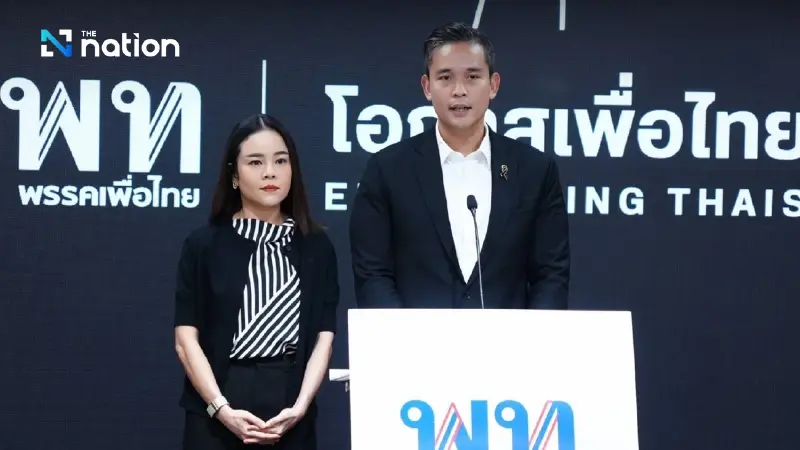


The opposition is compiling evidence of government mismanagement, alleging staff links to illicit funds and criticising the PM's slow diplomatic response to border disputes and US trade pressures
- The opposition Pheu Thai Party is preparing to file a no-confidence motion against the government, primarily targeting the Prime Minister.
- The motion is based on allegations of government mismanagement and corruption, including staff links to illicit funds known as "grey capital."
- A central criticism is the government's foreign policy failures, specifically a slow diplomatic response to border disputes and US trade pressures.
The opposition is compiling evidence of government mismanagement, alleging staff links to illicit funds and criticising the PM's slow diplomatic response to border disputes and US trade pressures.
The opposition Pheu Thai Party has announced its readiness to submit a no-confidence motion against the Thai government, citing alleged mismanagement, corruption linked to "grey capital," and a slow, indecisive foreign policy approach that they claim jeopardises national sovereignty.
Suksit Srichomkwan, Pheu Thai spokesperson, confirmed on Sunday that the party is compiling data and expects to be prepared to file the motion when the next parliamentary session opens.

While consultations are ongoing with other opposition parties, Suksit made it clear that the motion would, at the very least, target the Prime Minister as the ultimate figure responsible for the government's perceived failures.
He stressed that cooperation among opposition parties is crucial to achieving the objective of removing the government, noting that numerical strength is sufficient but that the parties must act sincerely on their public criticisms.
"We have seen relatively clear evidence that this government has genuinely mismanaged affairs," Suksit said, urging coalition partners to demonstrate sincerity in their actions when the confidence vote takes place.
He confirmed that Pheu Thai has held preliminary, informal discussions with the People's Party, expressing confidence that they share a common view on the government's failings.

Foreign Policy Failure and Territorial Risk
A central focus of the impending motion is the government’s handling of a recent border dispute that has spilled onto the global stage.
Suksit accused the Prime Minister of showing "confused and immature remarks" that have damaged Thailand's credibility and risked territorial loss.
He criticised the administration for failing to actively engage in high-level diplomacy following the border incident, specifically urging the Prime Minister to hold urgent talks with the United States, China, and Malaysia—the key guarantors and witnesses to the relevant peace declarations.
"Our side sat waiting for them to contact us," Suksit claimed.
He argued that the previous PT government successfully used a "world encircles" strategy to pressure counterparts by leveraging international alliances, a necessary approach that the current government has neglected, leaving Thailand disadvantaged in multilateral frameworks.

Constitutional Reform Push
Separately, Khattiya Swasdiphol, Pheu Thai List MP and Deputy Secretary-General, provided an update on the progress of the constitutional amendment bill.
She affirmed PT's full commitment to the process, which aims to pave the way for a public referendum and the drafting of a new, people-led charter.
Khattiya dismissed accusations that PT members were deliberately delaying proceedings.
"That is a clear distortion of the facts," she said, pointing to PT’s long history of advocating for constitutional change.
She expressed disappointment that the committee majority rejected PT’s proposal for a Constitution Drafting Assembly (CDA), a mechanism used successfully in 1997 to ensure broad public involvement.
Instead, the committee opted for a single-tier drafting body chosen by Parliament—not the public—a structure . Khattiya warned could undermine public confidence and fail to reflect true societal diversity.
Pheu Thai is now working to introduce measures to link the chosen committee members to the public as much as possible, urging all MPs and Senators—particularly those who signed the MoA pledging to support constitutional reform—to uphold their commitment and not allow the process to become "futile."
