
112 case and 17.6bn-baht tax ruling seen as moves to weaken Thaksin and curb Pheu Thai ahead of 2026 election
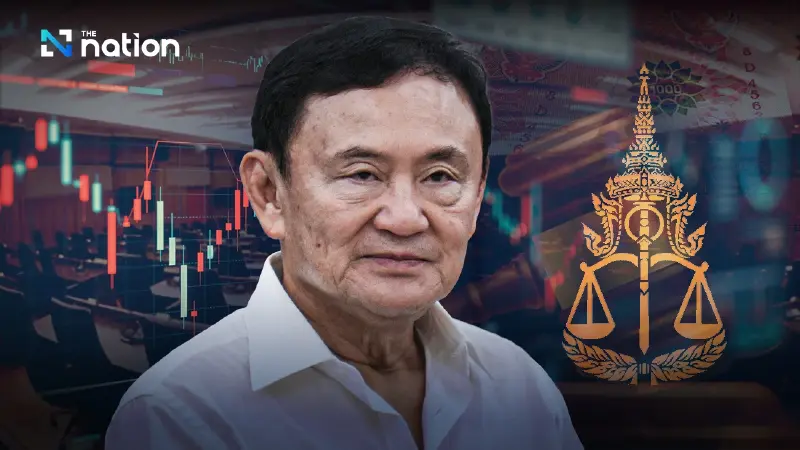


Legal setbacks in the 112 appeal and the 17.6bn-baht tax ruling are seen by analysts as moves that could limit Thaksin’s influence and weaken Pheu Thai ahead of the 2026 election
• Former prime minister Thaksin Shinawatra faces renewed legal pressure after the OAG appealed his Section 112 case and the Supreme Court reinstated a 17.6-billion-baht tax bill linked to the Shin Corp share sale.
• Analysts say the twin legal battles are viewed by some political observers as mechanisms used by the “deep state” to block Thaksin’s early release and limit his political influence ahead of the next general election.
• Thaksin’s one-year prison term is seen as diminishing Pheu Thai’s organisational strength, reducing its chances of returning as the leading party in forming the next government.
The latest developments surrounding Thaksin Shinawatra came shortly after Itthiporn Kaewthip assumed office as the new attorney-general. Reports suggest he approved the OAG’s decision to appeal the criminal court’s acquittal in Thaksin’s Section 112 and Computer Crime Act case.
The Criminal Court had dismissed the charges on August 22, 2025, but on September 9, 2025, Thaksin was ordered back into prison to serve his one-year sentence after earlier receiving a royal pardon that reduced his sentence from eight years to one.
This legal development coincided with a major political shift: the fall of the Pheu Thai-led administration and the rise of Anutin Charnvirakul as the new prime minister under a blue-camp coalition — Pheu Thai’s main rival.
Although the OAG’s Section 112 review committee had earlier voted 8–2 not to appeal, it was later clarified that the attorney-general alone has the statutory authority to decide.
Early-release speculation and the political clock
The dispute comes amid growing speculation that Thaksin may become eligible for early release under corrections regulations.
Former justice minister Pol Col Tawee Sodsong had earlier supported allowing Thaksin to petition for a second royal pardon — a right any inmate is entitled to — after his sentence was significantly reduced in 2023.
Given his age (over 70) and the length of time already served, Thaksin could theoretically qualify for release after serving one-fifth of his remaining sentence, which would fall on November 20, 2025.
Another possible pathway is under the Corrections Act, which allows sentence reductions after serving one-third of a term — which for Thaksin would be January 8, 2026.
Analysts note that if Thaksin were released, even symbolically, his political influence could strengthen Pheu Thai’s machinery ahead of the early-2026 general election, where the party aims to secure at least 200 seats, though even retaining 100 seats is described as an uphill struggle.
Tax case ruling adds further pressure
On top of the 112 appeal, the Supreme Court last week overturned earlier rulings and ordered Thaksin to pay 17.6 billion baht in taxes, penalties and surcharges arising from the Shin Corp share sale.
The enforcement process will require issuance of an execution order, expected to take 1–2 months.
The ruling reverses both the Central Tax Court and the Specialised Appeal Court, which previously found the Revenue Department’s tax assessment unlawful.
Impact on Pheu Thai and the Shinawatra family
The Shinawatra family — including Panthongtae and Pintongta Kunakornwong — have said they will continue to fight the cases to seek justice. Panthongtae admitted the appeal order was an emotional blow:
“Our father entered the justice process, and yet the appeal continues to return to him.”
Observers note that the legal setbacks come after two consecutive Shinawatra-linked prime ministers were removed between 2024 and 2025, eroding Pheu Thai’s power base and limiting the party’s manoeuvring space.
With a crucial election looming, some analysts argue the legal actions appear aligned with an attempt by entrenched state actors — often labelled the “deep state” — to ensure Pheu Thai does not re-emerge as the leading governing party.
Furthermore, political commentators say the post-election coalition calculus is already being shaped, with speculation that the next government could be led by Bhumjaithai, with Kla Tham as the second anchor party, leaving Pheu Thai or the People’s Party as potential junior partners.
A long game of attrition
Thaksin’s imprisonment, the revived 112 case, and the 17.6-billion-baht tax order collectively signal a prolonged political struggle that could confine his influence well beyond 2026.
The controversies surrounding the leaked border-conflict audio involving Paetongtarn Shinawatra and Hun Sen, followed by Paetongtarn’s removal as prime minister, have already weakened Pheu Thai’s footing.
Political analysts from both inside and outside the red camp increasingly interpret the latest legal setbacks as part of a larger strategy: a coordinated attempt to ensure Thaksin does not regain political prominence easily.
