
People’s party PM candidates meet Keidanren to present economic vision for stable growth
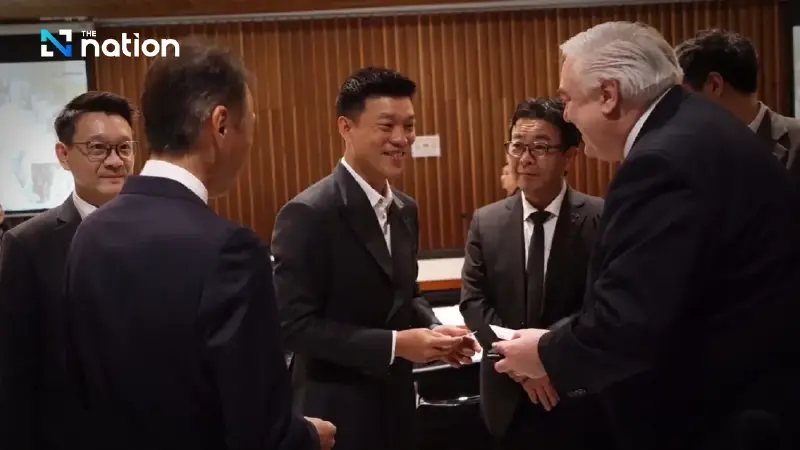


Three People’s Party PM candidates met Japan’s Keidanren to outline plans for transparent governance, regulatory reform and major infrastructure projects to strengthen high-tech investment
• Three prime ministerial candidates from the People’s Party met with the Japan Business Federation (Keidanren) to outline their economic vision and investment-promotion policies.
• The party emphasised transparent governance, regulatory reform and large-scale infrastructure investment (“Orange Megaprojects”) to attract high-tech industries to Thailand.
• Japanese business leaders stressed the need for a stable business environment, political stability and deeper cooperation in green and digital industries — particularly battery energy storage systems (BESS).
On November 24, 2025 at the Parliament Complex, Natthaphong Ruengpanyawut, leader of the People’s Party and its No.1 prime ministerial candidate, together with Sirikanya Tansakun, deputy leader for policy and PM candidate No.2, and Dr Veerayooth Kanchoochat, deputy leader for strategy and PM candidate No.3, met with Keidanren, the Japan Business Federation — Japan’s most influential private-sector economic organisation, representing more than 1,500 leading corporations, industrial associations and regional business groups.
Keidanren plays a major role in advising the Japanese government on economic and trade policy.
Natthaphong opened the meeting by greeting the delegates in Japanese, drawing applause from the more than 40 Japanese executives in attendance. He said the People’s Party recognises Japan as one of Thailand’s most important long-standing partners, particularly in trade and investment, creating stable jobs and incomes for Thai people.
With Thailand heading towards a general election in the coming months, he said the People’s Party — currently the country’s leading political force — intends to form the next government and begin governing early next year. One of the party’s core policies is positioning Thailand strategically within the global supply chain, and he stressed that Japan will be a key partner in developing advanced-technology industries, high-value manufacturing and quality job creation for Thais.
The People’s Party also aims to create a business-friendly environment for both domestic and foreign investors by ensuring transparent governance and removing outdated or burdensome regulations. The party seeks to bring new industries and expand foreign investment, encouraging innovation-sharing with Thailand.
Jun Suzuki, representing Keidanren, said Japanese businesses’ top priority is maintaining their long-established supply chain presence in Thailand amid rapid shifts in global industry. He added that an open, transparent and predictable business environment is the most important determinant for Japanese investment, and called for strong assurances from the future Thai government on this front.
Suzuki also urged both countries to deepen bilateral cooperation in emerging sectors, particularly green and digital industries. He said one area where Japan is confident it can bring world-leading innovation to invest in Thailand is BESS (Battery Energy Storage Systems) — technology that stores electricity during periods of excess production and releases it when demand is high or supply is insufficient.
He further encouraged Thailand to maximise existing cooperation frameworks with Japan, such as the Economic Partnership Agreement (EPA) and the Regional Comprehensive Economic Partnership (RCEP).
Natthaphong reaffirmed the party’s commitment to governing Thailand under the principle of “Lean and Clean Thailand”, saying Japanese investors can be confident that a People’s Party government would create an economic ecosystem that is transparent, open and fair to all businesses.
Dr Veerayooth then presented the People’s Party’s economic strategy, centred on “Look North”, a policy direction aimed at attracting investment and innovation partnerships from East Asian economies, including Japan.
He outlined the party’s Orange Megaprojects, focusing on major infrastructure investments to improve quality of life while stimulating the broader economy — including nationwide smart grid systems, waste management infrastructure and mass-transit expansion. These projects, he said, could provide new opportunities for Japanese companies to build fresh supply chains in Thailand.
Japanese representatives praised the party’s strategic economic framework as “excellent”, but voiced concerns about its feasibility, noting Japan’s unease about Thailand’s political stability and its inconsistent approach to balancing relations among major global powers.
Chaiwat Sathawornwichit, deputy leader for foreign affairs, assured the delegation that if the People’s Party forms the next government, it will govern with transparency, integrity and fairness for businesses of all nationalities. He also vowed to recalibrate Thailand’s foreign relations to achieve greater balance and strategic steadiness.
The meeting marks an important step in strengthening cooperation between the People’s Party and Japan’s business community. Both sides agreed to explore opportunities for sector-specific consultations in the future to reinforce and expand the long-standing relationship between Thailand and Japan.
