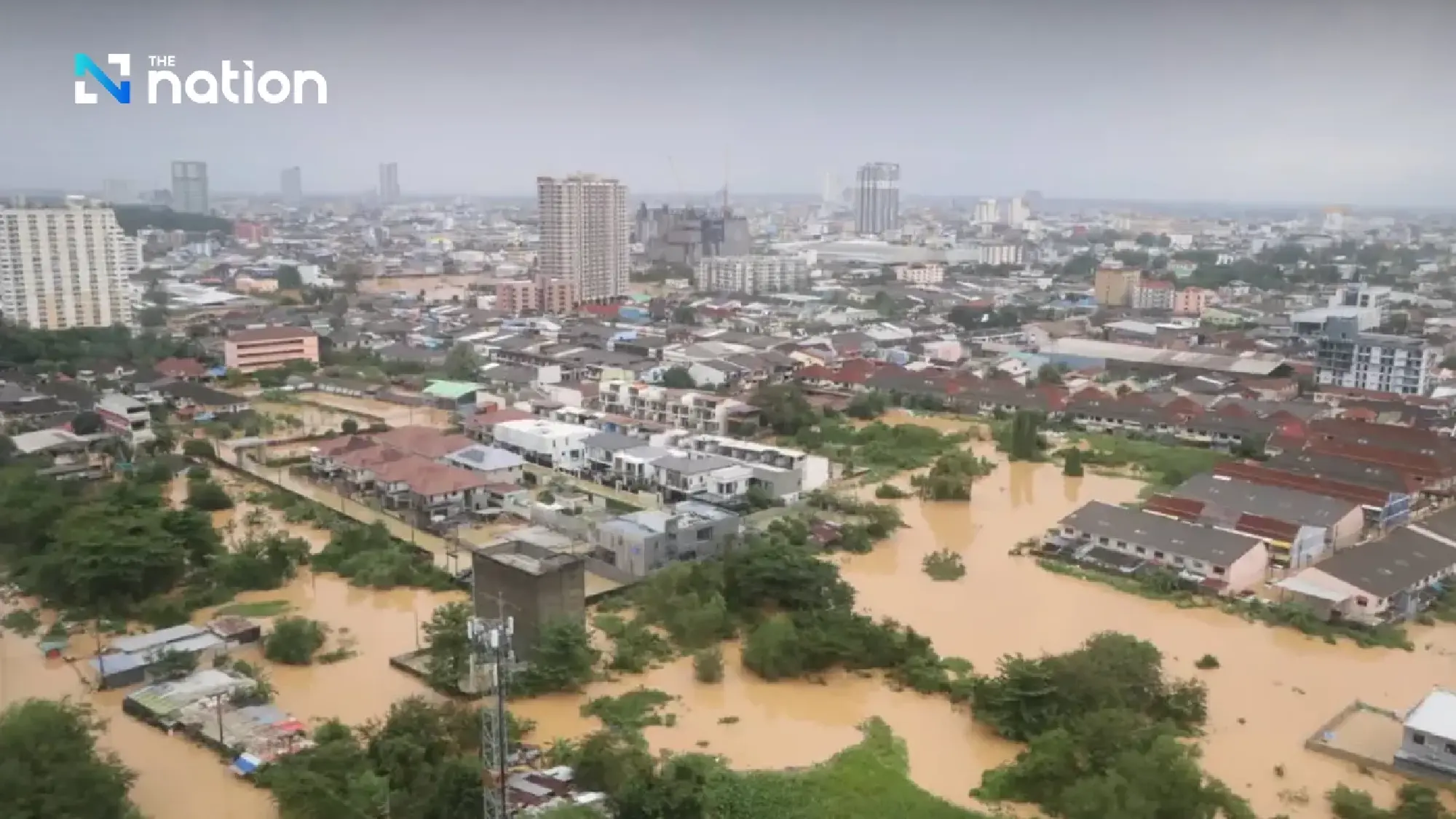
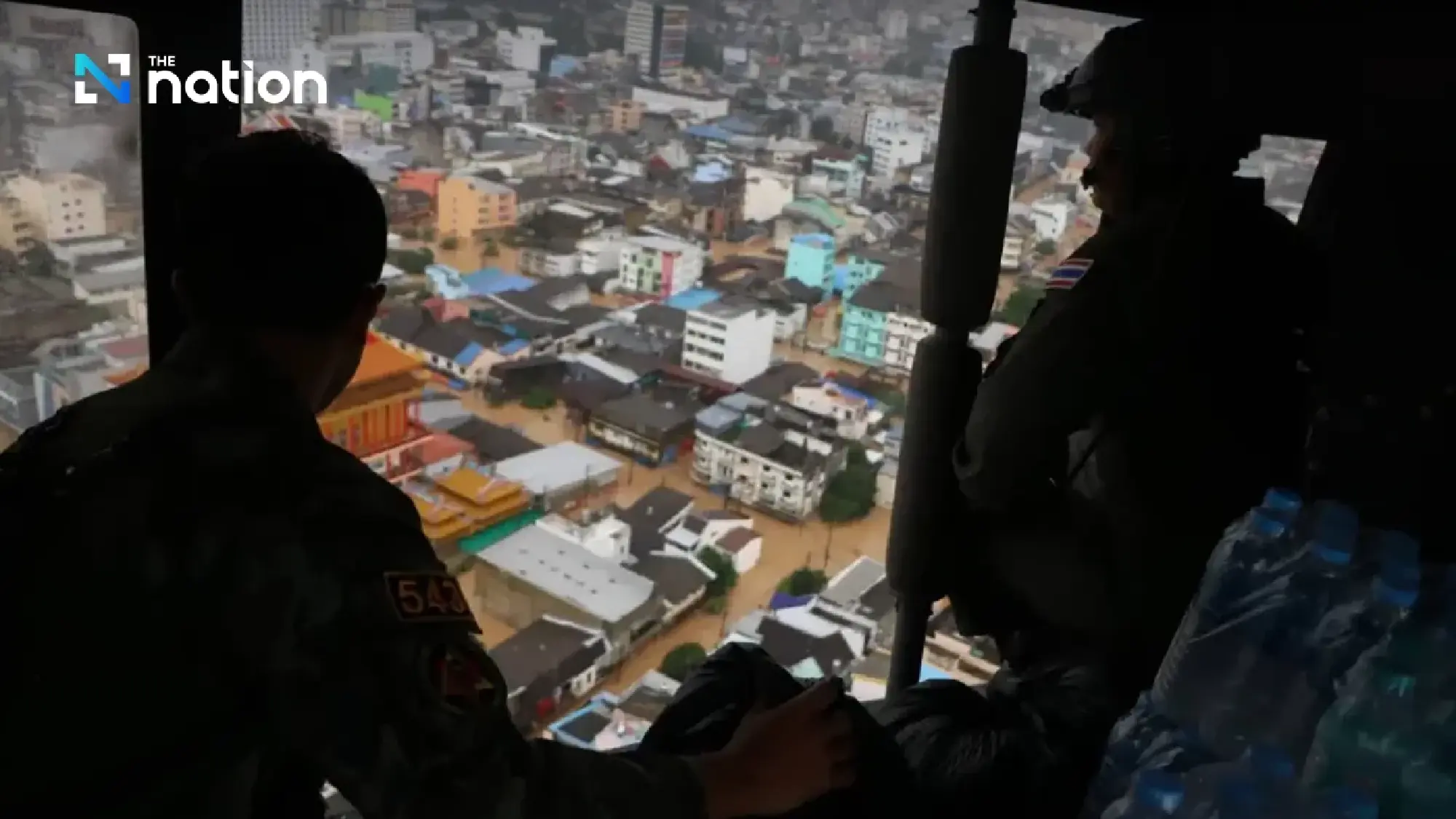
"Flood crisis in Hat Yai": Bhumjaithai party faces political repercussions; natural disaster vs. election crisis
THURSDAY, NOVEMBER 27, 2025
Play
The Bhumjaithai Party's handling of the Hat Yai flood crisis raises questions, with PM Anutin consolidating power. The party’s approval ratings may drop due to the disaster.
The government’s handling of the flood crisis in Hat Yai, led by the Bhumjaithai Party (BJP), faces heavy criticism, which could affect the party's political approval ratings.
The flooding disaster is seen as a test for the government, especially Bhumjaithai, as its ministers are responsible for the agencies directly in charge.
This flood may be a significant turning point for Bhumjaithai, as it could lower the party’s approval ratings, especially in the Southern region, a key target.
The article suggests that failure to manage "natural disasters" could become a "disaster in the election field" for Bhumjaithai in the end.
When it comes to “floods,” everyone knows they are caused by natural disasters that are beyond human control.
However, what should not be forgotten is the importance of management and the integration of efforts to resolve the situation quickly and effectively.
The situation at Hat Yai Hospital:
Recently, there was a report from medical personnel at Hat Yai Hospital, Songkhla Province, who posted a picture of the ICU room, showing that the floodwaters had reached the generator room, causing a complete power outage in the ICU for up to 5 hours, affecting patients relying on life support.
In addition, reports indicate that several critical patients lost their lives, although some statements from relevant agencies have denied this, suggesting the numbers may have been exaggerated, and the exact figures remain unclear.
Questions on government action and flood relief
The recent events have raised significant concerns regarding the government’s response, particularly its ability to act swiftly and integrate efforts to assist the public.
On November 25, Prime Minister Anutin Charnvirakul declared the Emergency Decree and took direct control of the situation in Songkhla, delegating authority to the Supreme Commander. This raised questions about the role of Thammanat Prompao, who is already responsible for managing water-related disasters as the Director of the National Disaster Water Management Center.
The following day, November 26, PM Anutin signed an emergency order consolidating powers temporarily under the Prime Minister’s office, taking over responsibilities from relevant ministers through the Emergency Decree.
The historical context: Recurring flooding since 2010
The Hat Yai flood is not the first major flood to strike the region, especially since the 2010 flood during the Yingluck Shinawatra administration. After that, there were similar flood events in many regions across the country. Some areas are still in the process of receiving compensation.
If we go back to the 2010 flood, under the Yingluck Shinawatra government and the Phue Thai Party, there was a massive flood that affected the Central region before it reached the heart of Bangkok, where many political slogans like “We have it under control” were used, followed by questions about the government's water management and how well it was integrated to provide timely assistance to citizens.
It is true that “natural disasters” are beyond control, but events like this show that repeated occurrences provide valuable lessons in management and offer opportunities to build an integrated approach, especially when preparing policies to tackle such challenges.
In the midst of the growing political campaign season, each political party is focusing on preparing a wide range of policies for the upcoming elections.
Currently, the Bhumjaithai Party (BJP), as the leading government party, has sent strong signals of preparation for the election, as seen from its public announcements of various “large houses”, populist measures, and restructuring within the Election Commission (EC), with the Senate giving their consent.
Even the reshuffle that occurred within the Ministry of Interior, seen as a key mechanism for the iupcoming election. It is clear that this is strategic move is aimed at forming the government and positioning ‘PM Nu’ for a second term in the ‘Number One’ chair at the Thai Koo Fah Building.
"While the 'blue camp' is busy negotiating the ‘MP ticket’ deals to enter the parliament, the current flood crisis might be a critical turning point that causes the 'approval ratings' of the Bhumjaithai Party—which it has been promoting for over two months—to possibly ‘drop away’ with the floodwaters.
Especially in the Southern region, where Bhumjaithai is showcasing its image as the ‘rising power’ in the area. Previously, Phiphat Ratchakitprakarn, the Southern leader of Bhumjaithai, spoke about the goal of securing 30 seats out of 54 in the region.
For Songkhla Province, where Bhumjaithai already holds seats, plus 4 new MPs transferring from other parties, the breakdown is as follows: District 1: Sanphet Boonyamanee, District 2: Sarttra Sripan, District 3: Somyot Plaiduang, District 7: Nutchanon Srikokuea, former Bhumjaithai MP).
"This situation must be closely monitored. While the flood is a natural disaster beyond control, some 'politicians' may argue that this is not the time to place blame but rather to work together to solve the problem. However, it should not be forgotten that the agencies responsible for water management and disaster response are all under the command of ministers from the Bhumjaithai Party.
This includes Prime Minister Anutin Charnvirakul as the Minister of the Interior, overseeing the Department of Disaster Prevention and Mitigation (DDPM), which has direct responsibility, as well as the Department of Local Administration, and Deputy Prime Minister Sophon Sarum, who oversees the Office of the National Water Resources (ONWR). Additionally, Paradorn Prissananantakul, the Minister Attached to the Prime Minister’s Office, supervises the ONWR.
All of these are considered the "test of competence" for the government, particularly for Bhumjaithai Party as the leading party, to see whether they can "show their strength" and recover their ratings from this crisis."
If the government’s flood management fails to impress, this “natural disaster” may turn into an “election disaster” for the party.