
Border Conflict Threatens Thailand's Political Timetable as PM Seeks Full War Powers
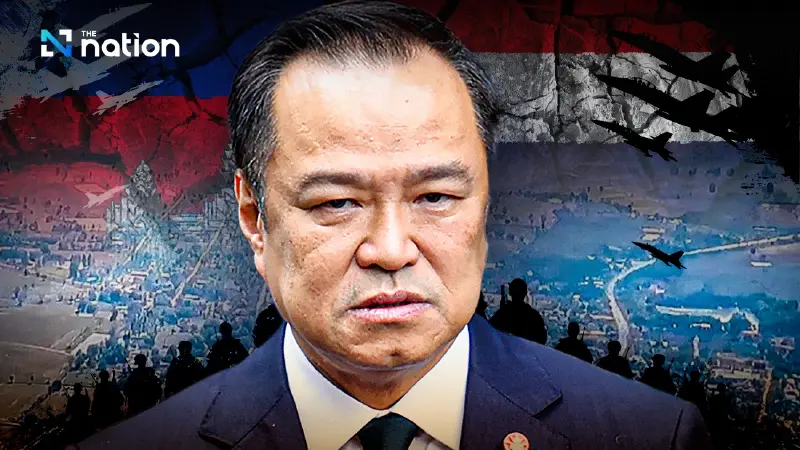


New military clashes force Premier Anutin to delay crucial House dissolution, capitalising on nationalist fervour to rebuild political support lost after flood disaster
- The border conflict with Cambodia is forcing Prime Minister Anutin to delay the planned dissolution of Thailand's Parliament, altering the country's political timetable.
- By postponing the dissolution, the government retains the full executive authority necessary to manage a state of war, which a caretaker government would lack.
- The Prime Minister is capitalizing on the conflict to generate nationalist fervour and rebuild political support that was damaged by the government's handling of a recent flood disaster.
- This delay allows the Anutin government to avoid a looming censure motion from the opposition, which he was previously expected to pre-empt by dissolving the House.
New military clashes force Premier Anutin to delay crucial House dissolution, capitalising on nationalist fervour to rebuild political support lost after flood disaster.
The renewed eruption of conflict along the Thai-Cambodian border is poised to redraw Thailand’s domestic political timeline, placing significant pressure on Prime Minister Anutin Charnvirakul and his government's tenure.
The hostilities may compel the government to postpone the dissolution of Parliament, ensuring it retains the full executive authority necessary to manage a state of war and potentially leverage a wave of nationalist fervour to recoup political popularity diminished by recent flooding crises.
The "Second Round" of the Thai-Cambodian conflict has seen an escalation to full-scale exchanges of heavy weaponry across the entire frontier.
This military action has necessitated the immediate evacuation of civilians across seven provinces, including Ubon Ratchathani, Sisaket, Surin, and Trat.
The Constitutional Imperative
Entering a state of war creates an undeniable political imperative within Thailand, directly affecting the PM’s long-anticipated "House Dissolution" timeline.
For the "Anutin Government," engaging in conflict with Cambodia makes it essential to maintain full executive power for the duration of the fighting.
Dissolving Parliament during hostilities would risk complicating the chain of command and the scope of a caretaker government’s authority to issue critical operational orders.
Previously, Anutin was rumoured to be considering a dissolution before the ordinary parliamentary session commenced on 12 December 2025.
This move was intended to pre-empt a censure motion from the opposition Pheu Thai Party—a non-binding scrutiny under Section 151—following significant political damage incurred after the "Hat Yai flood" incident.
The opposition, wary of being accused of playing political games amidst a crisis, had signalled its intention to submit the censure motion after a key constitutional amendment vote, likely around 26-27 December.
Facing the high possibility of being voted down due to the government's fragile majority, Anutin had been widely expected to dissolve the House just ahead of this date.
Anutin's Conservative Lineage and Military Ties
However, the military flare-up has made a further postponement of the dissolution highly probable.
The second round of fighting is viewed as likely to be protracted, especially given the difficulties in securing external mediation.
Unlike the first conflict, which saw swift intervention by Donald Trump, diplomatic mechanisms are now proving harder to activate.
This is partly due to the Anutin government’s political character: it maintains significantly closer ties with the military and top brass and possesses a much stronger conservative lineage than the previous Paetongtarn administration.
PM Anutin has signalled a hardline, non-negotiating stance: "There will be no more talks if they act against us to this extent... Our retaliation is to show them that they should not violate Thailand's sovereignty. Therefore, there will be no more talks. From now on, if Cambodia wants to stop the fighting, it must comply with what Thailand dictates."
Reports suggest Anutin has assured military chiefs that there will be no "ceasefire" order and that he is committed to providing full support for all military operations.
Weaponising Nationalism
The prominence of the military in operations against Cambodia is expected to benefit Anutin directly, given their long-standing relationship.
This differs from the previous administration, whose military operations were often perceived as uncoordinated, leading to higher political resistance.
The ruling "Blue Camp Government" is keenly aware that the "nationalist fervour" generated by the conflict is intense and widespread.
By effectively managing the crisis, there is a clear opportunity to harness this sentiment, recovering lost political ground—particularly in the Southern region where popularity slumped after the Hat Yai floods—and directing support towards the Bhumjaithai Party ahead of the next election.
The ongoing Thai-Cambodia dispute thus presents a critical twin challenge for the Anutin government: managing external military conflict while simultaneously cultivating domestic political support to sustain its momentum toward the next election cycle.
Attention will now be focused equally on both the military operations and the underlying political manoeuvres, with PM Anutin acting as the central figure for the "conservative network" seeking to secure its domestic power base.
