
Five parties’ military policies: “why do we need troops?”
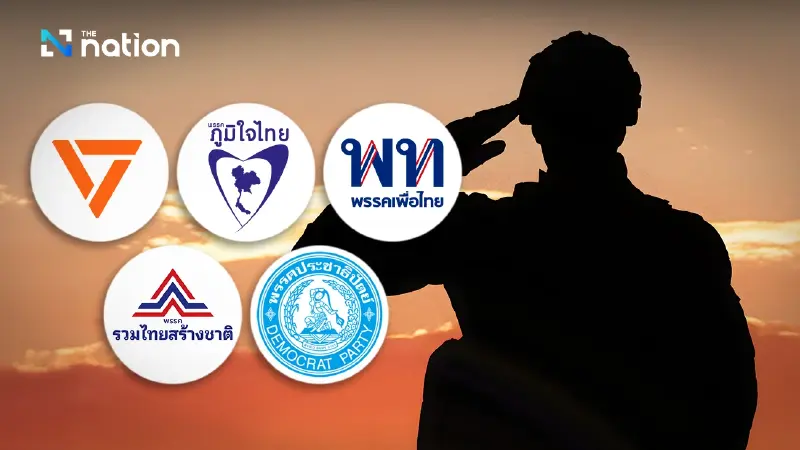


Five parties set out military policies as “why do we need troops?”, with plans covering conscription, volunteers, welfare, budgets and defence reform
- Democrat Party: Promotes a “volunteer soldier” policy with four-year service, benefits equal to career soldiers, education support, and special quotas for post-service entry into state jobs.
- Pheu Thai Party: Proposes four security policies, including cutting the number of generals to redirect budgets to modern weapons, transitioning to a voluntary system, and upgrading the defence industry.
- United Thai Nation Party: Focuses on voluntary service with higher welfare and pay, including conscripts receiving a combined 15,000 baht per month, and support for families of personnel who sacrifice in national defence.
- Bhumjaithai Party: Proposes recruiting 100,000 volunteer soldiers over four years, with monthly pay of 12,000 baht, to build a strong and professional force.
- People’s Party: Proposes a modern armed forces model under civilian government. It would end compulsory conscription and shift to a 100% voluntary system, dissolve ISOC, and amend the Defence Ministry Act.
The ‘why do we need troops?’ narrative has resurfaced amid the Thai–Cambodian border situation, which may look calm for now but is seen by the armed forces as “tactically quiet, but strategically tense”.
The issue has also become part of election politics, as parties compete for momentum ahead of the general election on Saturday, February 8, 2026 — a period in which the situation on the border is being framed as “creating heroes”, feeding nationalist campaign narratives.
The People’s Party — the successor to Move Forward — has faced renewed attacks over the old campaign line associated with its former leader, even as it tries to reframe its position as a plan for a modern, professional military under civilian government.
The debate has been sharpened by a public exchange after a Facebook post by Army Intelligence Chief Lt Gen Teeranan Nandhakwang, who wrote that this New Year had seen three narratives that “belittled the military” collapse: (1) “Why do we need troops?”, (2) “the Thai army always loses”, and (3) narratives that create division between junior ranks and senior officers.
The People’s Party’s official page later responded by saying troops are needed to defend the country — not to raise chickens, cut grass, wash a commander’s wife’s underwear, or run golf courses, boxing stadiums and a TV station. It said a “people’s government” would push a “modern armed forces” package to strengthen combat capability, respond to new threats, promote professional soldiers, protect welfare for junior personnel, and build a defence industry.
The party also said it had previously supported necessary weapons procurement, including Gripen fighter jets and frigates. It argued that it cut defence budgets in the 25th House of Representatives because Thailand was in the Covid period and recovery phase, when massive budgets were needed to support the economy and provide relief to the public.
Bhumjaithai leader and prime ministerial candidate Anutin Charnvirakul has also used nationalist messaging, arguing that troops helped ensure people could celebrate the New Year without fear and protected sovereignty through the year-end period.
Meanwhile, Veerayooth Kanchoochat, the People’s Party’s prime ministerial candidate, said the party was ready to explain the issue directly to voters and insisted its leaders and representatives were prepared to address old accusations dating back to the Future Forward and Move Forward eras.
The ‘troops’ discourse continues to haunt the “orange camp”
A look at each party’s policy shows the People’s Party promoting an “armed forces for the people” agenda — transparent and accountable, modern, high-performing and efficient, built around a professional force that uses resources as effectively as possible and moves towards international standards.
Key elements include amending the Defence Ministry Act to turn the Defence Council into an advisory body, abolishing the so-called “seven tigers of the Defence Ministry” system for appointing generals, and dissolving ISOC to end what it describes as a “state within a state”. The party also proposes shifting border responsibilities to the Interior Ministry, and restructuring the southern insurgency framework by putting politics ahead of the military under a civilian government.
It also proposes scrapping outdated security laws and enacting legislation subject to parliamentary scrutiny to protect citizens’ rights and respond to new threats. Another core proposal is to end compulsory conscription and move to a 100% voluntary system, with better welfare and fairer pay to build a professional armed forces that is transparent and accountable.
Bhumjaithai and Democrats push four-year volunteer service
At its policy launch on December 24, 2025, Bhumjaithai leader Anutin Charnvirakul set out a plan to recruit 100,000 volunteer soldiers over four years, paying 12,000 baht a month, to build a force that is voluntary, strong and professional. The plan includes military training, vocational training, and opportunities to continue education or sit promotion exams to become NCOs and advance to higher ranks.
The Democrat Party has proposed a similar “volunteer soldier” scheme, allowing recruits to serve four years with welfare comparable to career soldiers. Volunteers would be able to improve their educational qualifications while serving, with the armed forces expanding opportunities for study alongside service from associate degree level upwards. The party frames it as “one family, one volunteer soldier, one post-service career”.
After completing volunteer service, participants would be able to sit entry examinations to become civil servants or state employees. The armed forces would also seek special job quotas for discharged volunteers, including roles such as army and police NCOs, administrative officials, disaster prevention officers and natural resources officers.
Pheu Thai’s four-point security plan to upgrade the armed forces
Pheu Thai has set out four military-security policies:
- Upgrading the Thai armed forces’ capabilities for both national defence and disaster response through manpower restructuring and more efficient budgeting — including reducing unnecessary generals through an early retirement programme to redirect funds into modern weapons and equipment.
- Upgrading the defence industry.
- Transitioning from conscription to a voluntary system, adjusting conscription numbers to fit the situation and using remaining budgets to strengthen welfare.
- Overhauling the Territorial Defence curriculum, making it easier to access and less dull, with five new tracks: military medicine, operations, engineering, infantry and cyber warfare.
United Thai Nation: voluntary service and cost-of-living support
United Thai Nation has promoted security policies that raise welfare and strengthen national capacity. It proposes packages such as 200,000 baht for combat deployment, 30,000 baht for voluntary conscription, and conscripts receiving combined “salary plus allowance” totalling 15,000 baht a month to help with living costs. It also proposes weapons development and building a domestic defence industry, alongside urgent support for families of personnel who die in national defence — including allowing children to stay in military housing and continue service.
With the situation being framed as “creating heroes”, and political competition intensifying ahead of the February 8 election, parties are clearly seeking to use the issue to build political momentum and win votes.
