
KPI Poll: Thais ready to vote, but trust in fairness lags


Thais are ready for the Feb 8 election (7.81/10) but confidence in fairness is uneven, with the South and Northeast scoring lowest
A KPI Poll by King Prajadhipok’s Institute has found Thai voters broadly feel ready for the February 8, 2026 general election, but many remain unconvinced the process will be fair—especially in the South and the Northeast.
The poll, titled “Public readiness for the February 8, 2026 election”, is KPI Poll’s third wave and was conducted December 26–29, 2025 among 2,000 respondents aged 18 and above nationwide.
1) Overall: “ready to vote”, but trust still weak
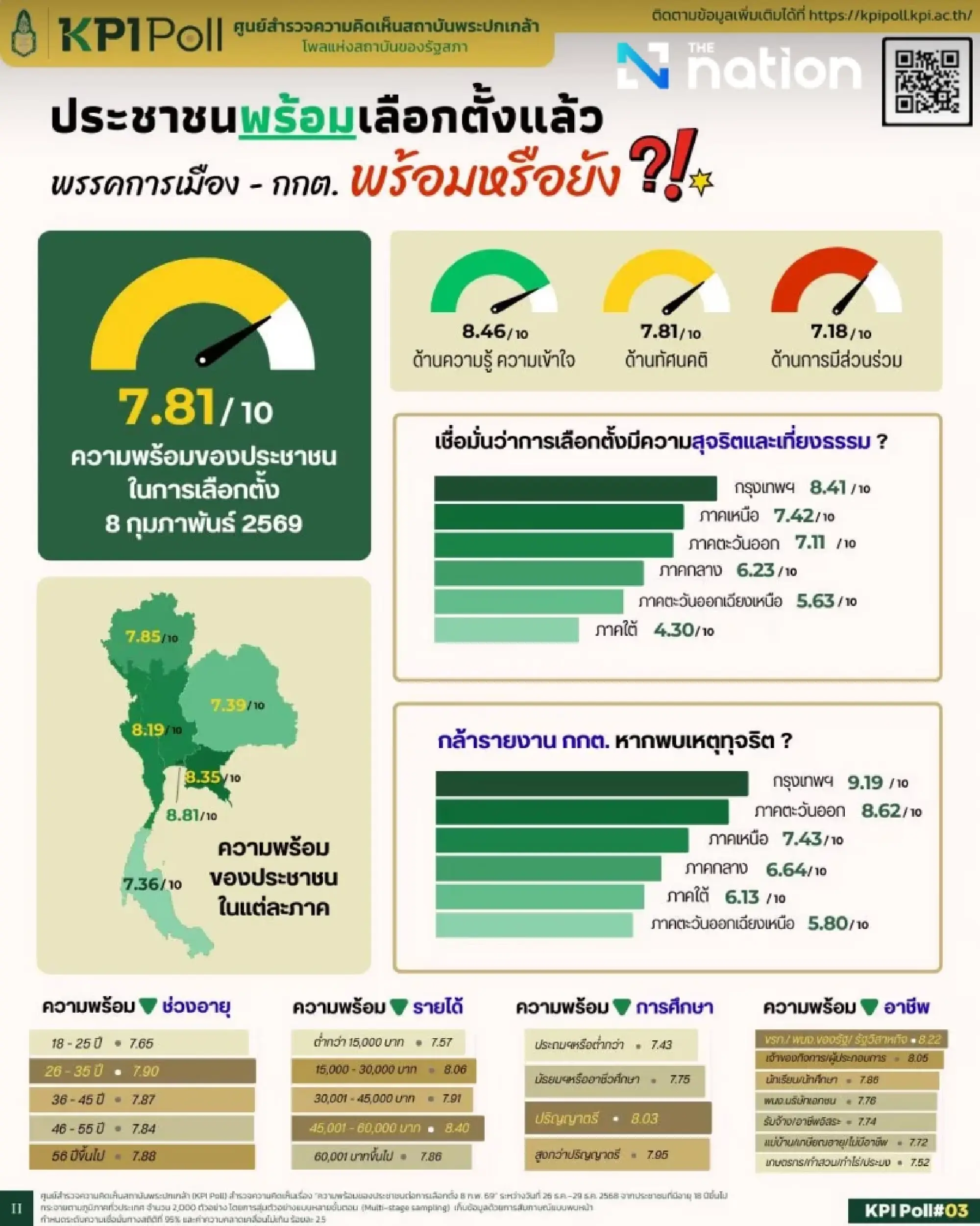
The survey put overall readiness at an average of 7.81 out of 10.
- Election knowledge/understanding: 8.46 (relatively high)
- Attitudes towards elections: 7.81, with integrity/fairness scoring relatively low within this dimension
- Participation: 7.18 (the lowest category)
The results suggest people understand the election process and feel “ready to proceed”, but trust in integrity and a sense of ownership of politics remain limited.
2) Readiness varies by region
Readiness was rated “fairly high to very high” across regions, but unevenly:
- Bangkok: 8.81
- East: 8.35
- Central: 8.19
- North: 7.85
- Northeast: 7.39
- South: 7.36
The findings were interpreted as reflecting stronger political awareness in major urban and economic centres, while structural and social context may weigh on readiness and trust in some regions.

3) Confidence in election integrity shows a sharp gap
Confidence in election integrity was described as clearly “unequal by area”:
- Bangkok: 8.41 (highest)
- Northeast: 5.63 (significantly below the national average)
- South: 4.30 (lowest)
The pattern suggests confidence is not driven only by readiness to vote, but by local experience and perceptions of fairness.
4) Willingness to report wrongdoing is higher than trust—except in some areas
Willingness to report election fraud was higher than integrity confidence overall, but still concentrated:
- Bangkok: 9.19 (highest)
- South: 6.13 (lowest)
- Northeast: 5.80
The poll interpretation suggests some areas may worry complaints will not lead to results or may not feel safe.
Recommendations: targeted trust-building, not repeat civic lessons
The poll summary urged the Election Commission and related agencies to prioritise rebuilding confidence in “integrity and fairness”, especially in the South and Northeast. The focus should move beyond general voter education towards showing that reporting wrongdoing is safe and produces real outcomes, with outreach aimed at groups such as farmers and low-income households to lift participation and narrow political inequality.
Assoc Prof Dr Issara Sereewatthanawut, secretary-general of King Prajadhipok’s Institute and chair of KPI Poll, described the survey as an academically designed poll intended to reflect political realities neutrally and serve as a “democratic knowledge bank” for parties, politicians, academics and the public.
