
Thai Political Rivals Duel Over Ambitious 5% Growth Targets for 2026
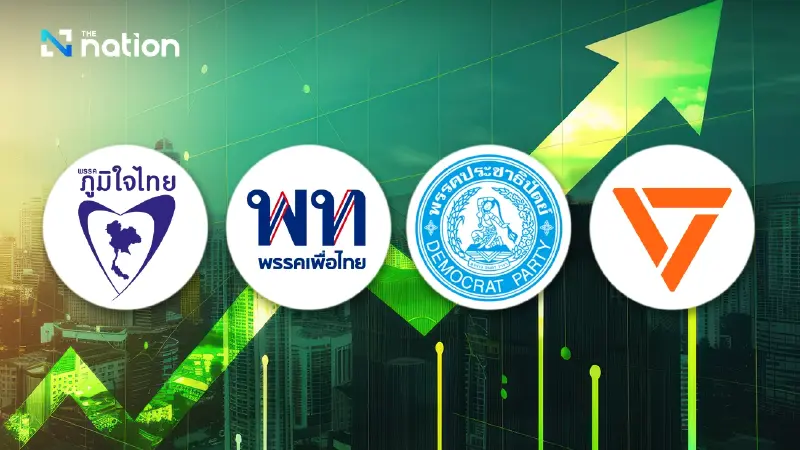


Four major parties challenge bleak 1.5% growth forecasts for 2026, promising a mix of industrial reform and debt reduction to revitalise the Thai economy
- Four major Thai political parties are challenging the official 1.5-1.7% economic growth forecast for 2026, setting their own ambitious targets ranging from 3% to 5%.
- The Pheu Thai and Democrat parties are both promising the highest target of 5% annual growth, proposing different strategies focused on a high-tech economy and reducing household debt, respectively.
- Other rivals, the People’s Party and Bhumjaithai Party, have set competing targets of 4-5% and "3% Plus," with plans centered on economic restructuring and supply chain integration.
- Economists warn that these targets are incredibly steep and will require the next government to overcome deep-seated structural issues that have long hampered the Thai economy.
Four major parties challenge bleak 1.5% growth forecasts for 2026, promising a mix of industrial reform and debt reduction to revitalise the Thai economy.
As the 2026 election cycle gains momentum, Thailand’s four principal political factions have launched a series of high-stakes economic manifestos.
Each aims to "pump" the nation’s Gross Domestic Product (GDP) back to growth levels of 3–5%, directly challenging the sober forecasts of the country’s central financial institutions.
The "numbers war" arrives at a critical juncture for the Southeast Asian nation. Once a regional tiger with 7% growth, Thailand’s economy has cooled significantly.
For the 2026 fiscal year, the Bank of Thailand and the National Economic and Social Development Council (NESDC) have projected a mere 1.5–1.7% expansion—a figure many analysts suggest is insufficient to sustain the country’s development.
To bridge this gap, the leading parties have proposed distinct, and often competing, visions:
The 5% Club: Pheu Thai and the Democrats
The incumbent Pheu Thai Party has staked its reputation on a "National GPS" strategy, promising a minimum annual growth of 5%.
Their focus is a transition to a "High Value-Added Economy," prioritising technological productivity—specifically Artificial Intelligence—to offset the challenges of a rapidly ageing workforce.
Crucially, they intend to formalise the "underground economy," bringing informal sectors into the official tax and regulatory net.
Matching this figure is the Democrat Party, which is campaigning under the slogan "Thailand Ends Poverty."
Their strategy couples 5% growth with a radical de-leveraging of the private sector, aiming to slash household debt from a staggering 90% to 60% of GDP within four years.
Restructuring and Supply Chains
The People’s Party has targeted a 4–5% range, arguing that Thailand must at least match the ASEAN average to remain competitive.
Their manifesto focuses on a fundamental "economic restructuring," involving a massive promotion of creative industries and sustainable energy reform.
They intend to use digital transformation to revitalise Small and Medium Enterprises (SMEs), which are the backbone of the domestic economy.
Meanwhile, the Bhumjaithai Party has adopted a "3% Plus" target under its "Economy 10 Plus" banner.
Their approach emphasises immediate execution, pledging to "fast-pass" private investments already approved by the Board of Investment (BOI) to integrate Thai manufacturing more deeply into global supply chains.
While these multi-billion dollar promises are designed to galvanise voters at the hustings, economists warn that the targets are incredibly steep.
Moving the needle from a 1.5% forecast to a 5% reality will require the next administration to dismantle deep-seated structural bottlenecks—including educational gaps and infrastructure delays—that have hampered the Thai system for over a decade.
The success of these manifestos will ultimately depend on whether the winning party can translate ambitious "paper targets" into tangible fiscal results in an increasingly volatile global market.
