
Phetchaburi’s palm sugar: the sweet heart of the “City of Three Flavours”
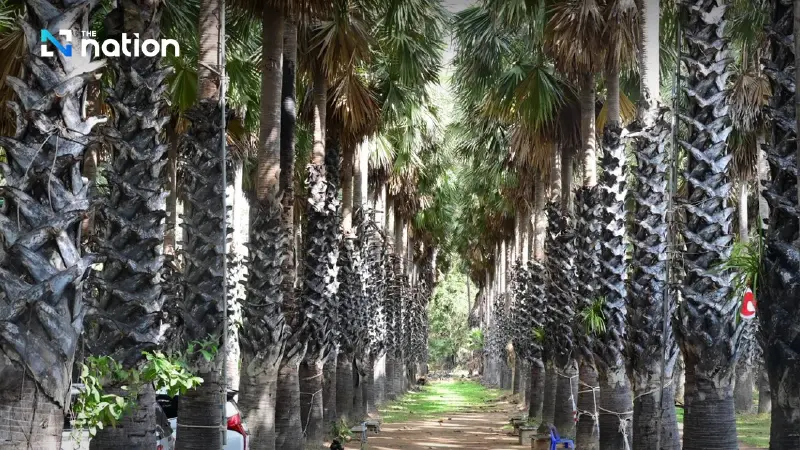


Phetchaburi is Thailand’s largest palm sugar production area, and the toddy palm is recognised as a symbol of the province.
The sweetness found in many Thai desserts in Phetchaburi comes mainly from the toddy palm tree, known in Thai as “Tanot”. These trees are grown in abundance in the province, especially in Ban Lat district.
Toddy palms in Phetchaburi have produced high-quality palm sugar since ancient times. The province’s famous palm sugar is sweet, fragrant and delectable, and it is essential for making a wide range of local delicacies such as Khanom Mo Kaeng Sangkhaya (Thai custard) and Khanom Tan (toddy palm cake).
Beyond palm sugar, toddy palms can also be eaten fresh or turned into popular desserts and dishes, including Look Tan Loi Kaew (palm fruit in syrup), Kaeng Buad Look Tan (palm fruit in coconut milk), and palm fruit pie.
The palm’s leaves are used for thatching roofs and handicrafts, while the trunk can be used for housing structures or furniture.
Phetchaburi is widely seen as Thailand’s largest palm sugar production area, with the toddy palm recognised as a provincial symbol. This also ties into Phetchaburi’s nickname, the “City of Three Flavours”—sweet from palm sugar, salty from sea salt, and sour from Manao Paen Ramphai lime.

Uncle Thanom Palm Orchard: a living palm sugar classroom
“Uncle Thanom Palm Orchard,” also known as the Group of Palm Sugar Preservation, has been developed as a palm sugar learning centre, helping to keep the province’s palm sugar-making tradition alive.
Located in Tham Rong subdistrict, Ban Lat district, the orchard spans 10 rai (about four acres) and has around 450 toddy palm trees. The palms typically begin producing after about 15 years, and they can remain productive for at least 200 years.
The orchard has become one of Thailand’s more captivating tourist attractions. Visitors can explore how palm trees are cultivated and transformed into famous Thai sweets—an experience that is distinctively local and uniquely Thai.
To make palm sugar, workers begin by climbing a toddy palm, around 30–40 metres high. They then cut the flower stalk with a knife so that palm sap can flow into a bamboo cylinder.
Next, fresh sap is filtered through a white cloth into a hot pan, then simmered until it thickens into sugar. The process takes about two hours to produce a semi-sticky sugar. After that, the sugar is spun using a machine until it sets, then poured into a pot.
Fresh palm sap can also be enjoyed as a drink if it is not simmered for sugar.

At Uncle Thanom Palm Orchard, visitors can appreciate the local farming lifestyle through food-origin connections and agritourism experiences. A community market sells agricultural products and farm produce, while villagers demonstrate palm sap collection, boiling sap into palm sugar, and processing palm outputs into various products.
A café at the entrance offers refreshments and snacks among scenic rows of towering palms. It is a popular place to relax, and visitors are welcome to learn about local knowledge and wisdom.
Passing the torch: Amnat keeps the craft alive
Despite the passing of Uncle Thanom, a respected palm expert in Phetchaburi, his son Amnat Phungern has continued the family’s work—sharing knowledge with tourists and interested visitors, from cultivation to processing palm sugar and palm sap.
Amnat explained that in the context of Phetchaburi—especially Tham Rong and Ban Lat—there are toddy palms everywhere. In the past, many people made palm sugar for a living, but fewer do so today because it is hard work, physically demanding, and requires climbing. Yet demand for the product keeps rising every year.
He stressed that Phetchaburi’s palm sugar is especially delicious because the area’s minerals are very rich. He added that palm sugar can be harvested year-round, particularly from January to June, and said the orchard produces around three to four tonnes of palm sugar.

Asked whether the work is exhausting, Amnat admitted it is tiring, but said it is a job that is physically demanding yet mentally comforting. He feels deeply connected to the work because it enables him to support himself and his family, which gives him the motivation to keep going.
“People like us in the community don’t need as many as 450 trees,” he added. “Even about 100 trees, on less than three rai, can comfortably support a family.”
