
Anutin denies ‘grey money’ links, signals openness to People’s Party
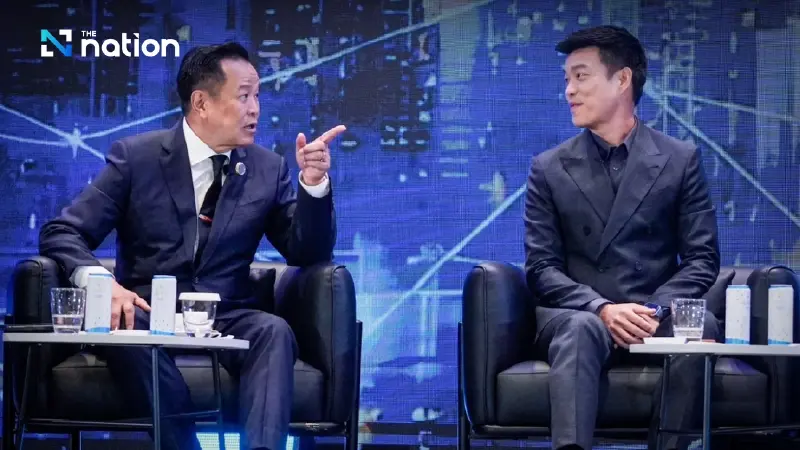


Caretaker Prime Minister Anutin Charnvirakul says his Bhumjaithai-led government has no links to “grey money”, vowing a crackdown on suspicious funds.
Caretaker Prime Minister Anutin Charnvirakul, who also leads the Bhumjaithai Party, set out his “Thailand Vision 2035” platform on Monday, January 12, focusing on three areas: policy, a professional management team and leadership.
He said he understood why voters could feel sceptical, as political promises are often dismissed as castles built on sand ahead of elections, only to stumble in office amid chronic instability. But he argued that, even in just three months in government, his administration had shown it could deliver results.
At one point, Anutin drew laughter by joking that, while some people said “37” had been achieved, his team had already “done 37” in many areas — a reference to Bhumjaithai’s campaign number. He credited cooperation across the board, including officials, the military, the private sector and fellow political parties, insisting his government had “no enemies”.

He said Bhumjaithai did not offer flashy, headline-grabbing pledges, but policies it could actually implement.
Thailand’s stability, he added, required tackling four threats: economic risks, security risks, disasters and social problems. His party’s approach, he said, was not to pour money into populist projects, but to build an effective, continuous system of governance that planned ahead — helping people stand on their own feet.
On security, Anutin said strength did not come from military power alone, but also from smart foreign policy aligned with economic strategy. He said the National Security Council’s work had been structured around three pillars — defence, foreign affairs and the economic ministries — and highlighted border protection against invasion, drug smuggling, illegal labour and contraband.
He also outlined a volunteer military scheme for 100,000 positions, with a monthly salary of 12,000 baht and four-year terms. Participants, he said, would be trained and supported with future career opportunities, describing it as a “win-win” approach that avoided confrontation and focused on improving management methods.
Anutin stressed that the most sustainable security was security without war, and said foreign policy would be given high priority. He cited the nomination of Foreign Minister Sihasak Phuangketkeow as the party’s second prime ministerial candidate.
He said Bhumjaithai’s foreign policy rested on the principle that “Thailand must be free” — free from fear and from perceived limitations about the country’s size or wealth — and grounded in dignity, respect for international rules, non-aggression and a refusal to be threatened.
He argued that, over the past two months, his government had shown Thailand could stand on the world stage with dignity, not merely as an option for others but as an indispensable partner.

Turning to allegations of grey money, Anutin said “don’t talk about grey”, arguing the term created loopholes. Any money with unclear origins or suspicious links should be treated as “black money” and suppressed fully, he said. He insisted a Bhumjaithai-led government had no “grey capital”, adding: “No casinos. No scammers.”
He said he listened to the public constantly and that his party members were closely connected to constituents in every constituency.
If Bhumjaithai led the next government, he said, it would build a “Team Thailand” dream team and deliver a better “Thailand Plus” over the next four years. He described his three months in office as a probation period and said he hoped voters would allow him to “pass” and continue.
Asked whether he was using tensions on the Thai border to boost popularity and gain political advantage, Anutin said the duty of the government and its leader was to safeguard democracy and sovereignty to the fullest extent.
He insisted his administration would not reopen border checkpoints until it was confident territorial integrity was fully secured and no one could threaten Thailand’s sovereignty.

When asked about People’s Party leader Natthaphong Ruengpanyawut saying he would not back Anutin again, Anutin said if the People’s Party came first, it would not need to vote for him — and added that discussions had not reached that point.
He said he believed he and Natthaphong, along with another senior contender, were of a similar age and shared a commitment to putting the national interest first, leaving the final decision to voters.
He added that if the People’s Party won the most seats, Bhumjaithai would still be open to cooperation where it was beneficial, saying the party had never “closed the door” to working with others.
Ultimately, he said, the election outcome — reflected in both constituency and party-list MPs — would be the guide.
