
Abhisit vows ‘clear skies’ in first year of Democrat government, pledges to lift Thailand out of poverty
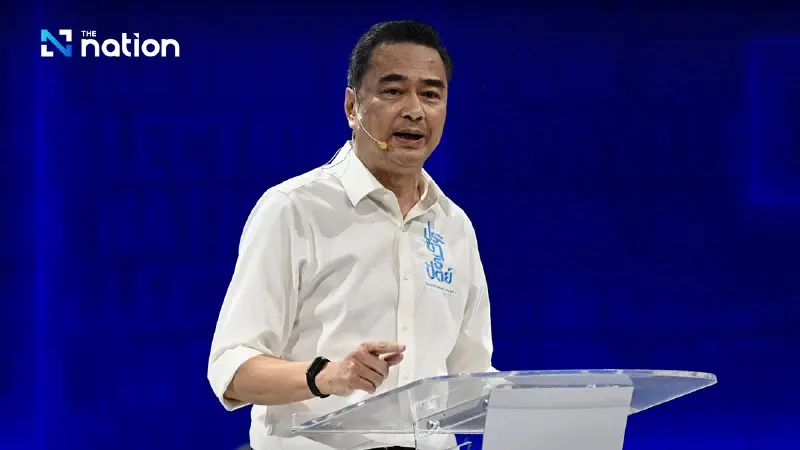


Democrat Party leader Abhisit Vejjajiva says a Democrat-led government would deliver visible change within a year, from clean politics and welfare boosts to cheaper fares and trade deals.
At the Bangkok Youth Center (Thai-Japanese) on the evening of January 17, 2026, Nation Group hosted the “Nation Election 2026 DEBATE: The Crossroads”, bringing together political representatives to present their visions ahead of the February 8 election.
Abhisit Vejjajiva, leader and prime ministerial candidate of the Democrat Party, said the most urgent task to create a tangible “turning point for Thailand” within the first year would be to form a cabinet of honest, professional ministers. If coalition partners are required, he said, those joining the government must meet the same standards of competence and integrity. He pledged to apply political standards higher than the law, as he had done before, and to remove any minister immediately if doubts arise.

Abhisit said the Democrats’ first year in office would lay the foundations for clean governance and a stronger economy, starting with short-term stimulus measures that deliver money quickly and easily so people can make ends meet. He outlined support for vulnerable groups, including 65,000 baht for mothers and newborns in a child’s first year, and a 1,000-baht monthly allowance for senior citizens—both to take effect once the FY2027 budget is passed.
On transport costs, he said the Red Line and Purple Line could immediately reduce fares to 20 baht using a common-ticket fund once funding is approved. Ultimately, all electric rail lines would move to zoned fares of 5-30 baht. The budget would also prioritise core Democrat policies such as farm income guarantees, wage income protection, and other measures to kick-start growth.

On disaster preparedness, Abhisit said the Department of Disaster Prevention and Mitigation would be upgraded to report directly to the prime minister to ensure efficiency, unity and readiness.
Addressing “grey capital”, he said crackdowns must include moving officials who obstruct the work of the Securities and Exchange Commission and the Anti-Money Laundering Office, and issuing an emergency decree to seize assets whose true owners cannot be identified. He added that cryptocurrency and gold transactions would be subject to reporting requirements.

Abhisit also outlined plans to enact two framework laws: one to remove legal barriers that hinder livelihoods and occupations; and another to link all state databases to improve public services and enable businesses to use data in decision-making. Public procurement data would be opened and connected to asset declarations so AI and human auditors can detect corruption more effectively, creating a “state transparency” platform.

Within the first year, he said, a Democrat government would also pursue proactive foreign economic policy, concluding trade talks with the United States and the European Union, appointing economic ambassadors to attract investment into target industries, liberalising solar power, and laying the groundwork for a permanent reduction in electricity costs without relying on taxpayer funds.
Abhisit stressed that the Democrats’ one-year plan is detailed, with clear steps, legal pathways and budgets. The goal, he said, is to restore Thailand’s growth to at least 5% within four years—and in the first year, people will see “new clear skies chasing away grey clouds”, setting the stage to solve problems and lift Thailand out of poverty.

