
Eight parties pitch digital tools, ethics to fight corruption at debate
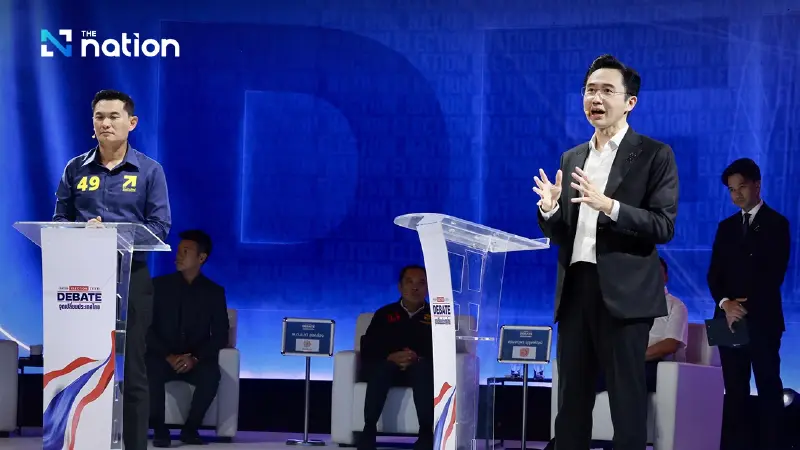


Nation Election 2026: parties back tech-led anti-graft plans—e-government, auto-approvals and tracking—while urging higher ethics, civil service reform and vote-buying curbs
On January 17, 2026, at the Bangkok Youth Centre (Thai–Japan), Din Daeng, in Gymnasium Building 1, Nation Group organised the event “Nation Election 2026 Debate: The Crossroads”, inviting representatives of political parties to present their visions in an effort to win public support ahead of the February 8 election. The programme was moderated by Varavit Chimmanee. Eight party representatives took part, with each party drawing a number to take turns presenting policies.
During the debate, the stage raised the issue of corruption: what anti-corruption policies each party supports, and what they would do if a party member or a government figure is accused of wrongdoing. All participating parties—Pheu Thai, Thai Kao Mai, the People’s Party, Ruam Thai Sang Chart, New Opportunity, the Democrat Party, Prachachat, and Thai Sang Thai—agreed on the need for anti-corruption policies, with an emphasis on using technology to prevent and suppress graft.
Suchatvee promotes “electronic government”, vows to block corrupt figures from becoming ministers
Suchatvee Suwansawat, party leader and prime ministerial candidate of Thai Kao Mai, said the party entered politics to do constructive work and has no blemished record. If people trust the party leader and prime ministerial candidate—if the leader has no tainted history—the party cannot accept truly corrupt officials. He said any allegation must be treated fairly, but if wrongdoing is proven, the individual must be removed and prosecuted immediately.
Suchatvee said corruption has root causes. Even if offenders are jailed—or even executed—people have already died, tax money has already been lost, and tragedies have already occurred. He cited incidents such as the State Audit Office building collapse and accidents where structures fell and killed people. Thai Kao Mai’s policy, he said, is to build an electronic government. He added that AI may be capable, but it cannot “run on paper”. As a technology specialist, he said he would deliver an electronic government within one year, making it impossible for corruption to occur from the outset.
He said this should include land and building administration, where corruption is widespread—adding that “you can see the face of a land title deed and know how much can be done.” He said another key solution is to start from childhood.
“I have children. I’ve seen that when a father does good things, the values are passed on. Teaching children discipline and honesty is building Thailand’s future without corruption. Thai Kao Mai is serious about this and will not disappoint,” Suchatvee said.
He added that as fellow technologists, if Pheu Thai’s prime ministerial candidate is serious, it would be a good thing. But he said it takes more than words: there must be real determination, and teams must be vetted. He said Thailand has talked about tackling corruption for countless generations, yet people still see cranes collapsing day after day and wrongdoers escaping accountability.
He said he had long worked with experts such as Dr Mana since the time he served as president of the Engineering Institute, trying to fight the problem together. He urged voters to choose the best people—those tough and determined enough to solve it—and said he had shown in every role that he follows through. This time, he said, he is offering himself as prime minister and asked for support to do one of the hardest jobs.
Yodchanan outlines two ways to tackle corruption system-wide
Yodchanan Wongsawat, prime ministerial candidate of Pheu Thai, said that if anyone in his party is involved, legal action will be taken with no exceptions. He said corruption must be tackled system-wide in two areas: (1) digital government and (2) building a culture where people do not cheat—starting with good education.
He said Pheu Thai had already pursued a Cloud First policy. What remains unfinished, he said, is the development of auto-approve—approving certain matters automatically based on criteria, without going through a person—reducing corruption opportunities.
He said delivering digital government requires broad groundwork in infrastructure and knowledge. After that, data from all ministries must be integrated—at least 20 ministries, he said—with platforms working together. Once data is integrated, service platforms can be opened so start-ups can help check processes—supporting start-ups and industry at the same time.
After service platforms are in place, he said they can be used for one-stop services for the public, to support people handling business matters, and to serve all travellers, including foreigners. Most importantly, he said, there should be an anti-corruption platform, including corruption tracking, which he said would be an initial step Pheu Thai would implement immediately.
He said the party supports continuing work already in place, noting that the Office of the Civil Service Development Commission (OPDC) is currently working on open government, and Pheu Thai is willing to continue it. He said the threat is not only domestic, and models are needed to identify bad actors. Since the government and OPDC have already done groundwork, he said there is no need to duplicate it. He added that efforts should also focus on tackling grey capital, state procurement, and holding rights in real estate, saying those steps could significantly reduce corruption.

Natthaphong presses for political ethics standards higher than legal standards
Natthaphong Ruengpanyawut, party leader and prime ministerial candidate of the People’s Party, said he agreed digital tools can help, but argued Thailand currently lacks political will. He said the People’s Party stance is that “orange has no grey; if we find grey, we deal with it.” He expressed condolences over an incident involving the party’s MP candidate, but said there was no need to go far ahead to when they form a government. Focusing on the campaign period up to February 8, he asked: if an arrest warrant is issued for a candidate from any party, does the political stance align with the view that political ethics standards and candidate accountability must be higher than legal standards?

Abhisit targets buying and selling positions in the civil service
Abhisit Vejjajiva, party leader and prime ministerial candidate of the Democrat Party, said the party’s executive committee had already resolved that if such issues arise during the election, the party would announce it would not support those involved and would pursue disciplinary investigations—adding that this should be done to remove such practices from the political cycle. On the issue of political responsibility standards being higher than the law, he said he had spoken about it before and had applied it during his time as prime minister.
He said he agreed with the use of technology to detect and monitor wrongdoing, but added another issue the Democrats must pursue is the buying and selling of positions within the civil service. He said the process for transfers and appointments of senior officials across ministries must be more transparent than at present, because corruption can spread throughout the bureaucracy.
Jatuporn says leaders should resign if wrongdoing is found
Jatuporn Buruspat, party leader and prime ministerial candidate of the New Opportunity Party, said he agreed with what had been said, but asked what leaders should do if wrongdoing is found. He said if he were a party leader, he would resign as well to take responsibility—because leaders bring people in; responsibility should not stop at dealing only with the individual. He said the most important thing is selecting good people.
Sudarat urges voters not to elect vote-buyers
Khunying Sudarat Keyuraphan, chair of advisers and prime ministerial candidate of the Thai Sang Thai Party, said corruption today comes from vote-buying, with grey capital used on a massive scale. She said she had just returned from the Northeast, where figures of 50–100 million baht were being talked about. She asked whether society could agree not to buy votes. She said people have the right to accept or reject vote-buying money—because it is money stolen from them through corruption—but urged voters not to choose those “bad people” and allow them to enter office and exploit the public further.
