
Anutin vows Bhumjaithai will top poll, open to ‘orange-red’
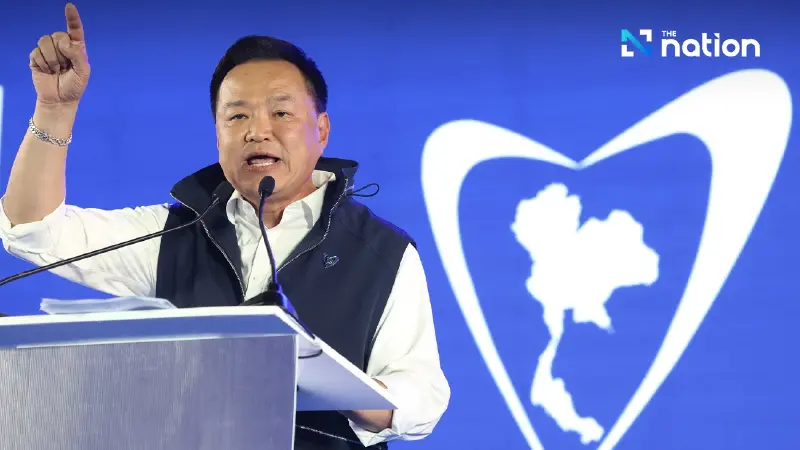


Anutin Charnvirakul says Bhumjaithai could win 130–200 seats and is open to teaming up with “orange” and “red”, with conditions on charters and Section 112
Anutin Charnvirakul, prime minister and interior minister as well as the prime ministerial candidate of the Bhumjaithai Party, gave an interview on the programme Kammakorn Khao Nok Jo about the party’s final-stage campaigning, saying it remains focused largely on “organic” campaigning, while still needing some political symbols such as major rallies in different provinces.
He said that on February 2 he would travel to Suphan Buri for a campaign rally, and on February 3 he would travel to Phitsanulok and Surat Thani, following requests from the party’s candidates.
Asked about the narrative that this election is a contest between the “blue” party and the “orange” party, Anutin said his earlier remarks that the blue camp would not be in a tight race and would win were intended to boost morale within Bhumjaithai. He said the party has worked to the fullest extent of its ability and has concrete results to show the public.
He also pointed to personnel the party has lined up, including Ekniti Nitithanprapas as deputy prime minister and finance minister, Suphajee Suthumpun as commerce minister, and Sihasak Phuangketkeow as foreign minister.
He said the fact that these three figures have travelled widely and gained credit for negotiations on Thailand’s behalf would add weight to the party. He added that Bhumjaithai also has political personnel who would be placed in suitable roles.
On the party’s seat target, Anutin said that based on his private-sector management experience, he has a sense of political momentum. He cited past elections to support his confidence: in 2019 he predicted 52 seats and the party won 51; in 2023 he predicted 73 and the party won 71. He said he relies on calculations, supporting reasons and instinct, and he regularly “proofs” his estimates with the party’s strategy team.
Pressed again on the party’s target, he said he expects “a lot” of seats. He recalled his father’s advice that when competing, one should aim to be number one, not number two, because people forget second place. He added that even if the party does not come first overall, it should still be number one within its bloc under a parliamentary democracy.
Asked who would be in that bloc, Anutin said it could include every side, adding that even the People’s Party should not be considered an outright adversary. He noted that while the People’s Party leader has said he would not vote for Anutin as prime minister, he has not said he would refuse to work with Bhumjaithai.
Asked whether Bhumjaithai’s internal assessment was 180 seats, Anutin said he personally estimates higher but does not want to state a number because he believes Thai society is quick to take offence. He said Bhumjaithai’s record shows readiness on all fronts, with monitoring and evaluation in place. He said the party is fielding candidates in more than 300 constituencies, including around 160 constituencies where candidates are existing MPs who have already won before, and around 70 constituencies where candidates narrowly lost by only hundreds or thousands of votes.
He said since the 2023 election the party has instructed those candidates to act like MPs and stay continuously in their areas. He added that he has also spent extensive time on the ground and that the party has strategies to maintain continuity and address weak points or local dissatisfaction where possible.
He reiterated his long-standing view that the chance of the party falling below 100 seats is lower than the chance of exceeding 100 seats.
On the People’s Party’s momentum, Anutin said that in the 2023 election the surprise area was Bangkok, where the then Move Forward Party won 32 out of 33 seats, exceeding expectations of around 20 seats. He said other areas, especially urban constituencies where Move Forward planted its flag, were known to be difficult contests, which informed his earlier prediction of 73 seats for Bhumjaithai.
For this election, he said Bhumjaithai has people with comparable competence and ideas that it believes can reassure people across all age groups.
He also discussed party-list seats, noting that Bhumjaithai won three party-list MPs last time and saying it should “surely” win at least seven this time. He attributed the previous low party-list tally to the “orange” wave. He said this time the party should do significantly better, helped by having been in government, leading the government, and having served as prime minister for three months. He said the public sees Bhumjaithai as a party that dares to make decisions and understands its position, including how to negotiate with counterparties to seek cooperation and support.
Anutin said he hopes for 10–15 party-list seats. Asked about overall projections, he said the party has “every option”, with a high-end scenario of 200 seats and a low-end scenario of 130 seats.
He also addressed criticism that the party is riding a nationalist wave, and comments made in rallies that referenced “uncle”, saying that before he entered politics the nation was being treated as a subordinate on many issues. He said some critics can say whatever they want without bearing responsibility, while the person who suffers reputational damage is the former prime minister.
On post-election coalition formation after February 8, Anutin said the party that finishes first should have the right to form a government. However, if the leading party cannot form a government because the second- and third-placed parties join forces, that would be their right.
On the possibility of working with the People’s Party, after Natthaphong Ruengpanyawut, the People’s Party leader, said he would not vote for Anutin as prime minister, Anutin said he would need to think about that option further because he still has a certain level of confidence.
He said the clear conditions include no amendments to Constitution Chapters 1 and 2, and no changes to Section 112 of the Criminal Code. Other issues, he said, would require further consideration.
Asked whether he is confident Bhumjaithai will finish first, Anutin replied, “Yes,” adding that he would not boast in advance. If he were to finish second or third, he said he would stay quiet and wait for the first-placed party to act first, including whether they would invite him to talks.
He said Bhumjaithai has always determined the position it will take, adding that in 2023 the party had a chance to be in government and its leader had a chance to become prime minister. He said he has not considered being second because every part of the party must be mobilised to build public confidence.
Asked whether he can still work with the “red” camp, Anutin said he can talk to all sides. He said he has never attacked anyone first, but if he is attacked with false information he must respond. He cited claims related to the Khao Kradong issue, insisting he does not hold even a single square inch of such land and that he has acted straightforwardly on the matter.
In closing, asked about working with the Kla Tham Party and the Democrat Party, Anutin said the outcome depends on the election results. If he leads the government, he would be the one to decide, but he would not name anyone yet. He said the only people he refuses are those who break the law or have dubious backgrounds or dishonest livelihoods — matters, he added, that must be determined by law.
