
Bhumjaithai’s leap to the top: how the blue party paved Anutin’s path to PM
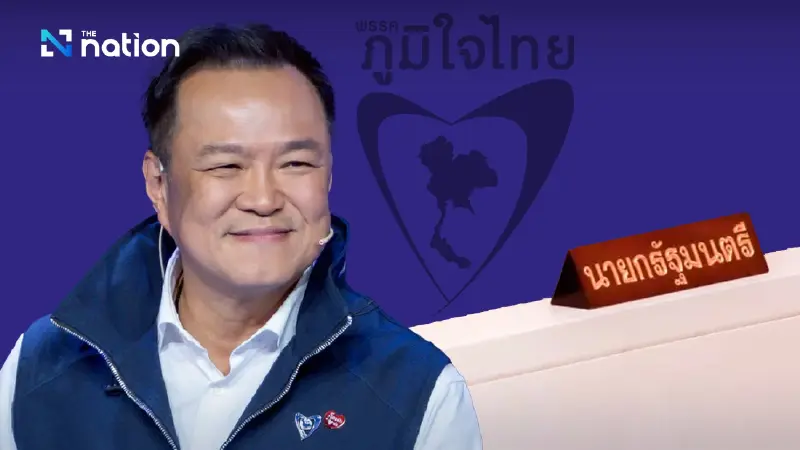


From its 2009 launch under the “blue” political network to becoming a decisive powerbroker, Bhumjaithai’s steady seat gains have propelled Anutin Charnvirakul towards the premiership after the 2026 election.
Since the founding of the Bhumjaithai Party by a leadership circle associated with Newin Chidchob—often dubbed the “blue” camp—the party has grown rapidly from a regional powerbase into a central force in national politics.
Bhumjaithai was officially launched on January 14, 2009, with Newin leading the unveiling. The party soon became a pivotal player in a political realignment, when it—under the leadership of Chavarat Charnvirakul, father of today’s party leader Anutin Charnvirakul—announced it would join a Democrat-led government.
Known as a “local strongman” party that built its strength through influential political networks, the “blue” party has expanded step by step.
In the 2011 election, Bhumjaithai held 34 MPs and remained an important bloc as leadership transitioned from father to son, with Anutin taking over as party leader. However, after the party publicly distanced itself from Thaksin Shinawatra’s camp, it ended up in opposition alongside the Democrat Party, as Pheu Thai—led by Yingluck Shinawatra—made clear before the election that it would not bring Bhumjaithai into government.
By the 2019 election, Bhumjaithai nearly doubled its representation, rising to 51 seats, and entered government under Gen Prayut Chan-o-cha, taking charge of key ministries including Transport and Public Health.
In the 2023 election, Bhumjaithai—sometimes labelled as a party adept at attracting influential local political groups—expanded further to 71 seats, cementing its position as a crucial swing force in coalition arithmetic.
The political landscape then shifted again after Pheu Thai broke with the Move Forward Party, which was unable to secure parliamentary backing for Pita Limjaroenrat as prime minister. That opened the way to a new coalition formula, with Pheu Thai joining hands with Bhumjaithai and a number of medium and smaller parties to form a government.
Towards the end of that administration, tensions flared again between the “red” and “blue” camps, leading to yet another political realignment. Bhumjaithai then announced a minority government arrangement with the People’s Party, governing for four months—ultimately paving the way for Anutin’s prime-ministerial ambition.
With the 2026 election results showing Bhumjaithai emerging as the largest party, attention has turned to coalition prospects. Anutin has publicly said the party is open to working with any party, but his remarks at a major rally on February 6—two days before polling—were widely read as signalling a preference for a leader able to coordinate “in all directions”, maintain many friends and few enemies, and run both the political and civil service machinery smoothly.
That subtext was interpreted by some as a message aimed at the “orange” camp. Combined with post-election positioning—including People’s Party leader Natthaphong Ruengpanyawut saying that if his party finished second it would not accept being in opposition or form a rival government—many observers see the outlines of a government-forming formula that has largely been set in advance, leaving little suspense.
The next phase is to watch what follows the 2026 result: the government that emerges will shape the country’s direction, and the question is whether the new executive will become the turning point the public is hoping for.
