
The low point of the ‘Shin clan’ party: from election champion to third place
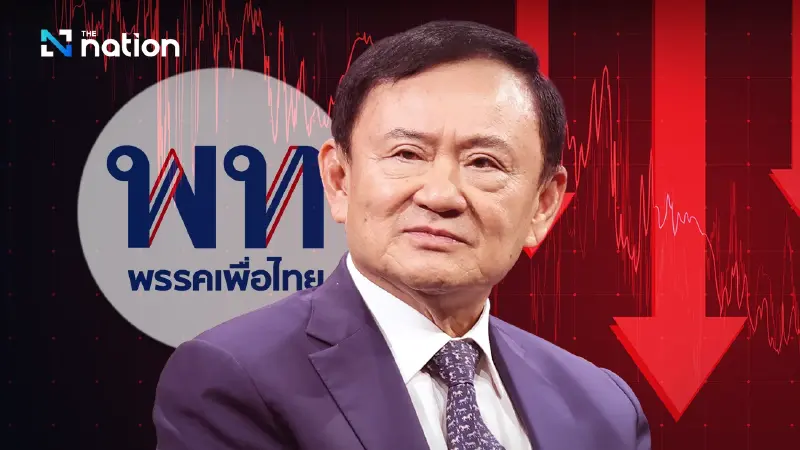


From Thai Rak Thai to Pheu Thai: a once-dominant Shinawatra-aligned bloc faces its lowest point, projected to finish third in 2026
- Shinawatra-aligned parties—Thai Rak Thai, the People Power Party, and later Pheu Thai—won every election from 2001 onwards and made history with multiple landslide victories.
- A major turning point came in the 2023 election, when Pheu Thai lost for the first time, finishing second behind the Move Forward Party.
- The article forecasts that in this election (2026), Pheu Thai will remain on a downward trajectory and fall to third place—its lowest point—reducing its political bargaining power.
Pheu Thai carries the DNA of a “wave” party originating from Thai Rak Thai and the People Power Party. Thai Rak Thai contested its first election in 2001 after being founded on 14 July 1998, running early campaigns such as “Thai Rak Thai: the people are the heart”, and promoting policies presented as its strength—“edible democracy” and tangible, practical policies.
Thai Rak Thai’s first election was held on 6 January 2001 under the leadership of Pol Lt Col Thaksin Shinawatra as party leader. It won a landslide, securing an almost half majority in the House by taking 248 MP seats. This marked Thai Rak Thai’s first election victory, and brought large numbers of “nok lae” MPs—people who were not established politicians or local power-brokers—into parliament.
“Thaksin” became the country’s 23rd prime minister and pushed flagship policies such as the 30-baht universal healthcare scheme and the village fund, as well as an aggressive anti-drug campaign.
In the 6 February 2005 election, Thai Rak Thai continued its success, aided by the 1997 Constitution, which strengthened governing parties and promoted stability. Pol Lt Col Thaksin was able to remain prime minister and made history by completing a full four-year term—the first government in Thai politics to do so.
In the 2005 election, Thaksin led Thai Rak Thai to an even bigger landslide under the campaign slogan “Four years to fix, four years to build”, winning 377 of 500 MP seats. Through mergers with other parties and political groups, it became the only party able to form a government outright.
The period from 2001 to 2005 was therefore Thai Rak Thai’s golden era. It drove its flagship policies and built overwhelming popularity, securing a nationwide base of more than 19 million votes.
As the party’s “fever” peaked, political opponents intensified scrutiny and pressure in a bid to bring down the government. The People’s Alliance for Democracy, or the “yellow shirts”, opposed and protested, leading to the dissolution of parliament in 2006.
This culminated in the 2 April 2006 election. Three opposition parties, led by the Democrat Party, boycotted the vote, preventing the election from being completed. The election was later ruled invalid. The political crisis escalated and led to the coup on 19 September 2006.
Thai Rak Thai was later dissolved in 2007, transferring its DNA to a second party: the People Power Party, steered by figures close to Thaksin, while Thaksin was forced into political exile following the 2006 coup.
In the 23 December 2007 general election, the People Power Party, led by Samak Sundaravej, ran a campaign intended to guarantee the party’s and Thaksin’s loyalty to the monarchy.
At the time, the People Power Party used the slogan “For nation, religion and King, with the power of the people”, won the election with 233 MP seats and formed a government. Two prime ministers later left office, and the People Power Party was ultimately dissolved on 2 December 2008.
- “Pheu Thai” became the third carrier of Thai Rak Thai’s DNA, passing the baton to Yingluck Shinawatra, the country’s 28th prime minister.
Pheu Thai entered a major election for the first time and won a landslide, securing 265 of 500 MP seats. It formed a coalition government that stayed in power until 2013. It later faced intense protests from an anti-government movement known as the PDRC, which obstructed the election on 2 February 2014. That election was ruled invalid, leading to the coup on 22 May 2014.
Pheu Thai also won the 24 March 2019 election. However, due to the influence of an “anti-corruption” constitution drafted after the coup, the election used a single ballot system in which the winning party received no party-list seats. Pheu Thai won 136 constituency seats but was unable to form a government.
That was because the 2017 Constitution was designed so that, for the first five years, senators would join the vote to select the prime minister in a joint sitting of parliament—allowing Gen Prayut Chan-o-cha, the prime ministerial candidate of the Palang Pracharath Party, to remain prime minister for a second term after the coup.
The next election on 14 May 2023 was considered the first election in which Pheu Thai lost since the founding of Thai Rak Thai in 2001.
Pheu Thai finished second with 141 MP seats, losing to the Move Forward Party, which won the election with a strategy slogan “Mee loong, mai mee rao” (“No uncles, no us”), securing 151 seats nationwide.
Amid reports of a “secret deal to return”, and with major parties not joining hands with Move Forward, and senators refusing to back Move Forward’s prime ministerial candidate, Pheu Thai was able to push Srettha Thavisin to become the country’s 30th prime minister. This was under a coalition government in which Bhumjaithai was a key swing party in forming the administration.
In 2024, Pheu Thai also faced legal warfare by the “deep state”, with Prime Minister Srettha Thavisin removed from office by a Constitutional Court ruling over alleged ethical misconduct and integrity issues.
In 2025, Paetongtarn Shinawatra, the 31st prime minister from Pheu Thai, was politically damaged by an audio clip involving nationalist issues, linked to a conversation with Hun Sen, President of the Cambodian Senate. The Constitutional Court later ruled that Prime Minister Paetongtarn must leave office on allegations similar to those levelled against Srettha.
In late 2025, Bhumjaithai, led by Anutin Charnvirakul, formed a minority government through a public “social contract” MOA mechanism with the People’s Party. The People’s Party voted to make Bhumjaithai prime minister but declined to join the government, in exchange for pursuing a new constitution.
Conflict within parliament then escalated between factions seeking constitutional change and those opposing it. On 11 December 2025, Anutin broke the political deadlock by dissolving parliament, returning power to the people and calling a new general election on 8 February 2026.
The 2026 election became a challenge in which Pheu Thai needed to restore its damaged popularity and confront a continued downward trend during the final period of Paetongtarn Shinawatra’s government.
Pheu Thai attempted to counter this by fielding “Dr Shane” Yodchanan Wongsawat as its prime ministerial candidate, projecting him as an academic and scientist. He also carries Shinawatra family DNA, as the eldest son of Somchai Wongsawat, a former prime minister, and Yaowapha Wongsawat. Pheu Thai ran a campaign strategy focused on the Central region, the Northeast and the North, using the slogan “Overhaul Thailand—Pheu Thai can do it.”
The election results after polls closed on 8 February 2026 sent a signal to Thai politics that Pheu Thai was no longer the leading party able to form a government as it had been in the past. It is being challenged by the rise of new political parties with progressive images, liberal branding, and the ability to attract strong ratings among new voters.
At the same time, a key rival—Bhumjaithai—has a solid voter base in the Central region and the Northeast, and can mobilise local political power-brokers nationwide to form a second-term government. Meanwhile, Pheu Thai must fight simultaneously to win MP seats against both the People’s Party and Bhumjaithai.
This is why the article argues Pheu Thai must draw lessons from the past two elections: from an unbeaten champion to its lowest point—finishing third—reducing the political bargaining power of the “Shinawatra clan”, while rival parties continue to grow stronger and pull ahead.
Shinawatra stronghold breaks: Pheu Thai left without a seat in Chiang Mai
Unofficial results in Chiang Mai showed a major political upset, with Pheu Thai failing to win a single seat in what has long been seen as a Shinawatra family stronghold. The People’s Party swept six constituencies in the city and surrounding districts, while Kla Tham emerged as a dark horse, taking four seats in more remote northern and southern areas—highlighting a geographic split between urban voters backing the People’s Party and border/remote communities swinging to Kla Tham.

Officials said election staff from 161 polling stations in Chiang Mai Constituency 1 returned ballot boxes and official tallies overnight, with checks continuing across all 10 constituencies; only about 6% of the province’s 2,789 polling stations in remote areas remained outstanding. As of 9.00am, the count was 94.81%, with 70.46% turnout (949,962 voters of 1,348,261); constituency ballots included 857,926 valid, 43,911 invalid and 48,125 no-vote, while party-list ballots showed 871,945 valid, 45,158 invalid and 34,958 no-vote, with the People’s Party first, Pheu Thai second and Bhumjaithai third.
