
The “325” formula for a Bhumjaithai-led coalition
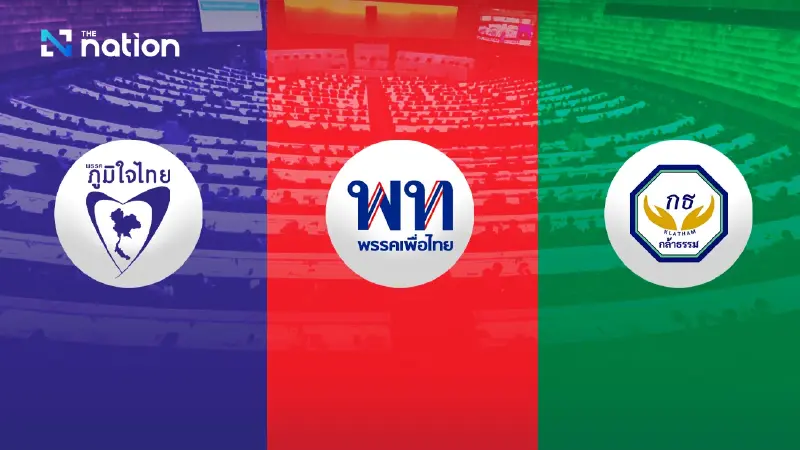


A “325” deal would pair Bhumjaithai with Pheu Thai and Kla Tham for a stable majority, with ministerial quotas estimated by MP-to-seat ratios
- The “325 formula” refers to a government-formation equation led by the Bhumjaithai Party (BJT), which would act as the core party with 193 seats.
- It would combine forces with Pheu Thai (PT), with 78 seats, and Kla Tham (KT), with 57 seats.
- If these three parties join together, the government would hold a House majority of 328 seats, which would be considered a highly stable government.
- The formula has been dubbed the “Bhumjaithai Plus government”, with Anutin Charnvirakul expected to lead the coalition formation.
- There has also been speculation about ministerial quotas under this formula, using an estimated ratio of around 9.5–10 MPs per ministerial post.
- Under this calculation, Bhumjaithai would be expected to secure around 21 ministerial posts, Pheu Thai around 7–8, and Kla Tham around 5–6.
Bhumjaithai becomes the No. 1 party
The February 8 election results are now only awaiting official certification by the Election Commission. Bhumjaithai’s MP tally—174 constituency seats and 19 party-list seats, a total of 193—has propelled it to first place. Even Anutin, the party leader, said he was surprised by the figure, calling it beyond expectations and a victory bigger than a “landslide”.
By now, it is clear that the equation for the next government will have the “blue party” as its core. The remaining question is how many votes Bhumjaithai can ultimately gather in the House to form a government.
Two coalition scenarios: “no red” vs “with red”
Under the first scenario, dubbed the “no red” formula, the coalition would comprise Bhumjaithai (193) + Kla Tham (57) + smaller parties, for a total only slightly above the 250-seat majority threshold. This is seen as a “knife-edge” majority.
The second scenario, the “with red” formula, is “blue + red + green”: Bhumjaithai (193) + Pheu Thai (78) + Kla Tham (57). This would produce a rock-solid majority of “325 seats”, not including smaller parties that might later be recruited as additional support.
Signals from Anutin and Pheu Thai
Attention has focused on signals from Anutin, who has projected a conciliatory leadership style. He praised “Dr Shane” Yodchanan Wongsawat, Pheu Thai’s prime ministerial candidate, saying: “I respect him. He has never spoken badly about anyone.”
As for ties between the “blue party” and the “red party”, Anutin said the possibility was “on his mind” in terms of inviting them into government.
When asked by the media whether Bhumjaithai and Pheu Thai had “played rough” against each other to the point of being seen as burning bridges, Anutin signalled that bridges can be rebuilt, quipping that there are five Thai–Lao friendship bridges already, and there will soon be a sixth.
This aligns with the stance of Pheu Thai leaders, who have said that the number-one party should have the right to form the government—another signal that political momentum may be leaning towards the “with red” scenario.
Ministerial quotas: the bargaining “cake”
In every coalition negotiation, an option that comes with opening a “join government” deal is the allocation of ministerial quotas among parties, used to secure agreement.
This is especially true for “Grade A” ministries, which can shape a party’s popularity and help it accumulate political resources. These become the most coveted pieces of the coalition “cake”.
There is also discussion of “outsider quotas” to project the recruitment of professional “gurus” into the executive branch, boosting legitimacy and credibility for the government at the same time.
At several major Bhumjaithai rallies, Anutin said clearly that if the party forms the government, there would be three deputy prime ministers for the economy: Ekniti Nitithanprapas (Deputy Prime Minister and Finance Minister), Suphajee Suthumpun (Commerce Minister), and Sihasak Phuangketkeow (Foreign Minister), who is also Bhumjaithai’s prime ministerial candidate. All would be in an Anutin cabinet for certain.
The strength — and the weakness — of a 300+ seat coalition
Under the conditions being discussed, Bhumjaithai is expected to lead a coalition with more than 300 seats. While that would be a strength in terms of stability, it could also bring a weakness: intensified bargaining within the coalition over ministerial chairs in “Anutin Cabinet 2”.
If the three-party “Bhumjaithai government” formula holds 325 seats, but the cabinet has only 35 ministerial posts (excluding the prime minister), dividing the total seats by the number of posts produces a rough ratio of 9.5 MPs per minister, typically rounded to “10 seats per minister”.
Based on that method, the estimated quotas would be: Bhumjaithai 193 seats = 21 ministers; Pheu Thai 74 seats = 8 ministers; Kla Tham 58 seats = 7 ministers.
Alternative: a two-main-party coalition with smaller parties
Under an alternative formula involving Bhumjaithai, Kla Tham and smaller parties—Thai Ruam Palang (6), Palang Pracharath (5), Setthakit (3), Ruam Thai Sang Chart (2), Puea Chart (2), Thai Sang Thai (2), and 10 one-seat parties—total support would reach 281 seats.
Using a calculation of roughly 8 MPs per ministerial post, the estimated quotas would be: Bhumjaithai 193 seats = 24 ministers; Kla Tham 58 seats = 7 ministers.
“Winning the whole province” rule of thumb
According to Bhumjaithai’s long-held practice, an MP tally that “sweeps a province” should be rewarded with at least one ministerial post. For larger provinces, or provinces seen as core Bhumjaithai bases, the reward might be “topped up” by another 1–2 posts.
In this election, Bhumjaithai reportedly swept MPs across as many as 20 provinces, up from eight previously, including: Phichit (3 constituencies), Phetchabun (6), Uthai Thani (2), Ang Thong (2), Sing Buri (1), Ayutthaya (5), Bueng Kan (3), Buriram (10), Surin (8), Yasothon (3), Amnat Charoen (2), Prachin Buri (3), Chanthaburi (3), Trat (1), Phetchaburi (3), Chumphon (3), Ranong (1), Phang Nga (2), Krabi (3), and Satun (2).
There are also “big house” areas where Bhumjaithai may not have swept the province, but may have pre-existing commitments with key “blue” figures that could still require ministerial rewards as part of political cooperation.
Even on a rough count, the allocation of Bhumjaithai’s own internal quotas alone could be difficult to finalise before the cabinet list is further screened through multiple steps of qualification checks. The article suggests the political “dust” is likely to swirl until the very last moment.
Meanwhile, coalition partners would also press for quotas: Pheu Thai, with 78 seats, would expect around 7–8 ministerial posts, while Kla Tham, with 57 seats, would expect at least 5–6 posts.
As coalition formation scenarios are floated, political bargaining is expected to intensify. The next step is to watch the political stage and the executive line-up of the “Bhumjaithai Plus” government under Anutin Charnvirakul, described as Thailand’s 32nd prime minister, and whether the blue-led government can complete a full term.
