
People’s Party leader concedes defeat, pledges stronger ground game
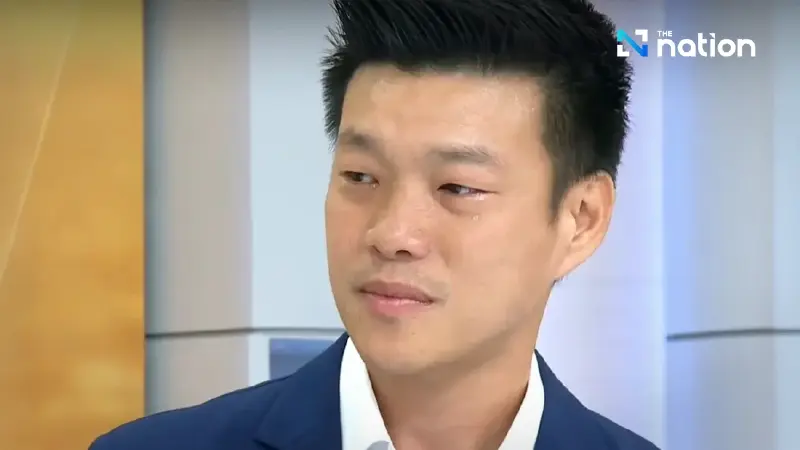


People’s Party leader Natthaphong Ruengpanyawut concedes election defeat, saying the party was outmanoeuvred on tactics and grassroots ground game—lessons it will use to fight on.
Natthaphong Ruengpanyawut, leader of the People’s Party, gave an interview on Tuesday ( February 10) on the programme News Workers’ Off-Screen Chat, hosted by Sorayuth Suthassanachinda, about the election result on February 8.
Natthaphong said that in this election the People’s Party communicated its messages fully—urging people to come out and change politics away from a quota-based system, away from parties owned by certain individuals, and away from big-money politics.
However, he said what the party could not match was tactics. The party accepts it was outplayed on that front, and will go back and do its homework on the issue.
On the nationalist trend, he acknowledged it played a part. In his view, it reflected local-level work—something many analysts had long pointed out: the party promoted a big-picture ideology, but its retail politics with local people was still not good enough.
He said the challenge was clear, and the party must build networks and develop tactics to win constituency seats.
He added that, having previously served as a constituency MP working on the ground, it is necessary to attend funerals and ceremonies and other community events, because constituency MPs must look after local people, listen to feedback, and show up for merit-making events and community occasions.
On the issue of selecting constituency candidates at short notice, Natthaphong said this was another lesson the People’s Party must learn. He insisted that for the next election the party will try to finalise candidates much earlier so they can begin groundwork in advance.
He said the party had tried to keep a balance in the past—wanting to stay open and avoid a “ticket system” that would shut out new faces seeking to enter politics.
Asked about results in areas where the party had previously swept entire provinces but did not this time—and where it even lost seats in some provinces—Natthaphong said the party must look district by district.
In some districts, support may have dropped—for example, in the case of Chutiphong Pipoppinyo, the Rayong constituency 4 candidate. If looking at total votes, the figure did fall, he said, but it is necessary to adjust for a significant decline in overall voter turnout.
As party leader, he said he did not believe that reduced votes for the party’s incumbent constituency candidates reflected public rejection of their work. He believed his colleagues had worked to the fullest, but other factors were at play, including rivals entering the race.
He said he would wait for the 100% result before drawing conclusions, and was ready to accept any reasons and all facts.
Asked whether, at this point, he could not match Thanathorn Juangroongruangkit, former leader of the Future Forward Party, and Pita Limjaroenrat, former leader of the Move Forward Party, Natthaphong said he could—in his own way.
He said he accepted such views and did not deny that some people might think or feel that way. From another angle, he thanked everyone for their encouragement. He said fellow party members had told him their work was a team effort, and that the outcome was not due to him alone.
He said he had messaged every former constituency MP from the party whose election results showed they might not make it. He felt sad, thinking of their faces and the fact he would not see them in parliament again.
He said it weighed on him, wondering whether, as party leader, he bore some responsibility—but every one of them replied that it was not about him. If anyone felt that way, he said, he was sorry.
“But this is not the moment for a party leader to announce a resignation, or to create uncertainty among people in the party. My duty now is to keep the party moving forward as steadily as possible. In the future, if someone is more ready than me, better than me, there is no issue at all,” Natthaphong said.
After answering the question, Natthaphong bowed his head and wiped away tears.
People’s Party braces for 44 ex-MP case
Natthaphong also spoke about the National Anti-Corruption Commission’s (NACC) unanimous resolution to find 44 former Move Forward Party MPs guilty of a serious ethics breach over their joint sponsorship and submission of a bill to amend Section 112 of the Criminal Code. The case is to be forwarded to the Supreme Court within 30 days.
Asked what the party would do if the court orders a suspension from duty, Natthaphong said that, for the remaining MPs—apart from himself—there is no need to resign, because their role as the opposition would not be significantly affected.
For him, however, the decision on whether to resign matters because it affects the position of opposition leader. The party is still discussing the issue internally and has not reached a conclusion.
He said that if he does not resign, the opposition leader post could become deadlocked. Under the constitution, the opposition leader must be the leader of the largest party in the opposition.
If he is ordered to suspend his duties, it would mean there is no opposition leader—affecting the formation of the opposition whip and the opposition’s role in nominating representatives to independent organisations.
He said the party needed to discuss the matter again, as it had not been fully settled, and would have to weigh up and assess how long the Supreme Court might take to deliver a ruling.
Asked whether it would be possible not to resign as an MP but to step down as party leader so that someone else could serve as opposition leader, Natthaphong said it was possible, but the thinking was not finalised and he wanted to complete internal discussions first.
As for who that could be, he said he did not want to name anyone yet, as it could be seen as “issuing a ticket” to a particular person. However, he said there were several capable figures among both party-list and constituency MPs.
He added that the party would consider all relevant elements, and would contest the legal issues and seek the Supreme Court’s discretion not to order any suspension. If no suspension is ordered, he said, the party can continue its work.
Pressed further on whether, if suspensions occur, the People’s Party could lose key figures who are prominent debaters and watchdogs, Natthaphong said there are still many others. He added that the opposition’s role is not limited to parliament; even if someone is ruled against, they could still serve as an adviser to a parliamentary committee.
Asked about reports that the party secretary-general, Sarayut Jailak, would definitely resign, and whether Natthaphong could take on the role, the People’s Party leader said he was not attached to positions and had no objection in principle.
However, he stressed that he would not decide alone and that the matter must be discussed within the party to reach a collective decision.
On whether the NACC’s resolution amounted to a major political storm, Natthaphong said he had anticipated it would be “this big” and that the party had prepared to handle it—adding that preparations were already in place.
