
‘Chonburi model’ shakes Election 2026 as public and parties press EC for transparency
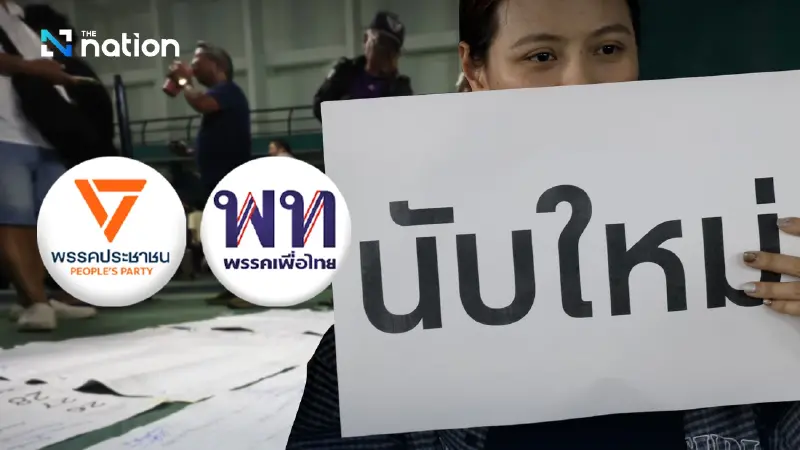


A “Chonburi model” row over ballot handling fuels recount calls from the People’s Party and Pheu Thai, as the EC insists procedures followed rules
- The public spotted what they saw as a lack of transparency in the ballot-box consolidation process in Chonburi, sparking the so-called “Chonburi model” and calls to scrutinise the Election Commission (EC).
- The People’s Party (orange) and Pheu Thai (red) have demanded the EC investigate alleged irregularities and conduct recounts in several constituencies.
- The controversy has shaken public confidence in the election outcome, even as the EC insists the process complied with regulations.
For the Election Commission (EC), it has gone well beyond a mere “stray-bullet” situation. Critics say it now resembles a “missile strike”, as the 2026 election has drawn fierce backlash and revived the trending question: “What is the EC even for?”
One key trigger for the current barrage of criticism is the unofficial election result (95% counted), which produced unexpected “upsets” in multiple constituencies. The “blue camp” surged to what some described as an almost “landslide”, winning 194 seats. The previous winner, the “orange faction”, secured 116 seats. The “red camp” suffered its heaviest blow, dropping below 100 seats with just 76 seats, while the “green camp”, the Kla Tham Party, rose to fourth place with 57 MPs.
However, suspicions were reported across multiple polling stations—from the counting after polls closed at 5pm on 8 February, through district-level tallying, to the transport of ballot boxes and election materials. Questions have persisted from 9 February to the present.
Reports of irregularities included claims that power went out at some polling stations—yet, mysteriously, electric fans were still running; that results written on boards did not match the tick-mark tallies; and that constituency totals exceeded the number of voters who turned out. In political shorthand, this has been dubbed “jumping ballots”.

The “starter” for the phenomenon was an incident in Thanyaburi District, Pathum Thani, Constituency 7, where students from Rajamangala University of Technology Thanyaburi entered a polling station and demanded a recount after citing alleged anomalies in the vote count. They said a black bag had been used to cover a CCTV camera—an incident they argued could have significantly affected the winning candidate’s score.
The Pathum Thani EC office and the central EC later said the case involved “fake news”. They argued that the recount did not materially affect the outcome: the same candidate remained the winner, and the tally changed only slightly—by one to two votes—without altering the result.
“We need to take a breath and ask for care in reporting these stories. Some say there were two counts—one result in the first round, then another party won in the second—with huge changes. That’s not true. I confirm clearly there was no change. Everything remained the same. Only some candidate numbers changed, depending on officials’ judgement on ballot validity, such as invalid ballots—about that. That’s it. The difference was just one to two votes. Nothing else changed the election outcome,” said Phasakorn Siriphokyaporn, deputy secretary-general of the EC, on 10 February.
But what was dubbed the “Thanyaburi model” spread like wildfire. By the evening of 9 February, large numbers of people followed ballot boxes for Chonburi Constituency 1, and found them consolidated at a badminton court at Chonburi Municipality. They claimed to have spotted suspicious signs that ballot bundles from different polling stations were not sealed in line with EC regulations. People began livestreaming from the scene, and the footage quickly went viral.
Crowds then surged to the site, demanding a recount through the night. Although the EC sent a deputy secretary-general as the “frontline” negotiator, the situation did not ease. The two sides faced off and kept watch over the ballot boxes throughout the night.
Beyond civic groups monitoring the counting and movement of ballot boxes, at least two political parties—the People’s Party (PP) and Pheu Thai—issued statements urging the EC to investigate alleged irregularities in multiple constituencies.

On 10 February, the People’s Party sent a special task force to file requests with the EC seeking recounts in 10 constituencies across 10 provinces:
- Khon Kaen, Constituency 3
- Lampang, Constituency 2
- Surat Thani, Constituency 1
- Chonburi, Constituency 1
- Nakhon Ratchasima, Constituency 13
- Chai Nat, Constituency 1
- Samut Prakan, Constituency 6
- Tak, Constituency 1
- Saraburi, Constituency 1
Pheu Thai, led by party leader Julapun Amarnvivat and senior figure Phumtham Wechayachai, called on the EC to urgently establish the facts over complaints that election management may not have been transparent. The party said multiple areas had been subject to complaints about the integrity and transparency of vote counting, and that it was compiling facts and checking data in detail across constituencies, based on evidence and within the legal framework.
From the “Thanyaburi model” to the “Chonburi model”, the controversy dragged on across days and nights until the afternoon of 10 February, when the EC held an urgent press conference to address the growing controversy.
Phasakorn Siriphokyaporn, deputy secretary-general of the EC, said the public may have misunderstood, because what occurred was the “box consolidation” process—commonly described as “merging boxes”—and that it complied fully with EC regulations. He said the official polling-station results are posted at the front of each polling station, in forms referred to in election terminology as Sor Sor 5/18 and Sor Sor 5/18 (MC.2), which are public and can be checked.
He also insisted—at least three times during the briefing—that changing the election results is impossible, because the Sor Sor 5/18 and Sor Sor 5/18 (MC.) forms have already been posted outside polling stations. Suspicious-looking issues during transport or during the consolidation process, he said, occur within the procedural chain.
He added that the full EC had resolved to send the deputy secretary-general in charge of investigations, along with a team, to conduct on-site checks in Chonburi. The EC also instructed the Chonburi provincial EC director to submit the province’s overall results for consideration, with all steps to be completed within two days.
“After the results are consolidated, there is a process called box consolidation—bringing ballot boxes from every polling station together into one box, so they can be stored securely, such as at a police station, district office, or another safe location, until the objection period has passed, which is two years. This is the process I want people to understand first,” he said.
On demands for a “recount” or for a “new election”, he said such action falls only under the authority of the full EC, and must be considered based on two possible triggers:
- A formal complaint, assessed using the complainant’s evidence along with the official polling-station record prepared by polling-station officials.
- Matters that come to the EC’s attention, or cases the EC initiates for inquiry on its own.
In either case, a resolution by the full EC is required—whether to order a new election, order a recount, or dismiss the complaint.
As for questions about why figures on the EC’s website ectreport69 did not match the numbers posted at polling stations—or why they sometimes rose or fell sharply, especially discrepancies between turnout and the winner’s total—Phasakorn said this relates to the nature of “unofficial” reporting. He urged people to understand what “unofficial” means: for speed, each polling station sends figures into the system via district-level subcommittees using the numbers from the Sor Sor 5/18 forms posted publicly. No one can change those posted results.
He said adjustments seen online occur because once district subcommittees receive the reported figures, they must verify facts—whether the numbers were entered correctly—by rechecking with polling-station officials. Data-entry errors can occur, he said, but they cannot alter the Sor Sor 5/18 results posted at polling stations.
“The most complete stage is the official election result announcement—what we call Sor Sor 6/1. That is when everything has been fully verified and is issued as an announcement, signed by the constituency election commission, which is why it is called official. You must understand that ‘unofficial’ may contain discrepancies. The reporting process must be screened and verified by district subcommittees before it can be confirmed as correct. I repeat: no one can change the results. Everything is posted publicly at every polling station. No one can do anything at will. Everything is within the legal framework. The EC is willing to be fair to all sides and will examine every issue that is questioned or misunderstood,” he said.
This, the report said, is the factual situation between civic groups and political parties who believe the 2026 election process showed signs of “abnormality” and have lodged objections—yet feel their concerns have not been addressed, fuelling the resurgence of the phrase “What is the EC even for?” and severely undermining public confidence in the independent body that has run elections for 25 years, since the 2001 election.
As for the organisation’s motto—“Honest, impartial, and lawful”—the report argued it has lost its credibility and impact.
