
Abhisit: Democrats no longer kingmakers in coalition talks
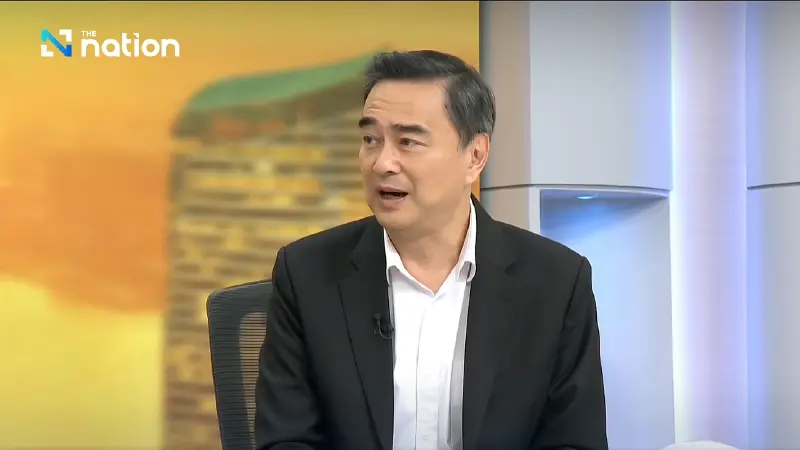


Abhisit says Democrats are no longer kingmakers after winning 22 seats, but will take coalition talks—under strict conditions and ethics red lines.
Democrat Party leader Abhisit Vejjajiva said his party is no longer in a position to “set the game” after securing only a small number of MPs, but signalled he is willing to take a call if Bhumjaithai reaches out to discuss forming a government—under strict conditions, including excluding the Klatham Party.
In an interview on the programme Kammakorn Khao: Khui Nok Jor, Abhisit addressed questions about whether the Democrats would clearly declare themselves an opposition party. He said he had not made such an announcement because, under the party’s system, that decision rests with the party’s executive committee and its MPs.

He said initial internal discussions were that the party would not sit idle and simply wait for a phone call, but if a call comes, it is ready to take it and will not “switch off the phone”. However, he stressed the Democrats would not “offer themselves” first. If the party enters talks, he said, it would be because others came to seek discussions.
Abhisit added that listening to an invitation is not the same as passively hearing it out, because the party must keep its word to the public about conditions for joining a coalition: there must be no Klatham Party, no “grey capital”, no domination or interference, and no agenda that creates division.
Asked whether a “spiritual leader” of Bhumjaithai would count as domination, Abhisit said nothing had reached that point, but he emphasised that running the country must not be subject to interference or domination. He said he could not speak in advance about specifics, but noted there is information about “grey capital”, and said any decision to join a coalition must also answer which policies can be delivered with confidence.
“I’m not scrambling for anything,” he said, adding that political parties must be ready to serve either as opposition or government. He described the Democrats as a small party with a clear stance. He said the party has not declared itself opposition because doing so could look unnecessarily confrontational, as there is not a problem “to that extent”.
Coalition maths and the weight of Klatham
Asked how he views the current government-formation equation, Abhisit said Bhumjaithai has enough seats to form a stable government. Even without Klatham, he said, it could still assemble more than 290 votes to form a government, while the opposition would have 210—making the gap significant.
He said the question then becomes why Bhumjaithai would want to bring Klatham in. In his view, it would be to prevent Pheu Thai from “stirring things up” or withdrawing. He said Klatham’s 58 seats carry more weight than the Democrats’ 22 in that balancing act.
He said Pheu Thai has 78 seats and that adding the Democrats’ 22 would still leave a coalition struggling, but adding Klatham’s 58 could more than offset Pheu Thai’s numbers. If problems arise, he said, Bhumjaithai would not be shaken. He also said Bhumjaithai does not need to rush because no other party is in a position to form a competing government, and even by staying put, it still holds the strongest bargaining power.
On earlier exchanges in which Klatham figures criticised the Democrats after the party said it would not join hands, and told them to “just wait and see”, Abhisit said it was not a problem, adding he also replied: “Wait and see as well—why isn’t everyone courting a party with 58 MPs?”
Ethics red line and scrutiny role
Asked about earlier election messaging that the Democrats would help “set the game”, Abhisit said that is not possible with only 22 MPs. However, he said the party will do its job, including scrutinising “grey capital”, opposing divisive policies, and beginning by filing to investigate ministers with ethics problems.
He said this is not about using the Constitutional Court mechanism to destroy or harass others or political opponents, but about using constitutional oversight tools: if wrongdoing is found, an investigation must be pursued.
“If someone comes to invite us into government and there are people who would be subject to an ethics petition, I will not join,” he said, adding the Democrats are ready to be a serious political force for scrutiny to raise political standards.
Outlook: numbers unlikely to change, warning on concentrated power
Asked to assess the political direction from here, Abhisit said that whether the election proceeds smoothly or even if it does not—given speculation that re-voting may be required—he does not believe the numbers would change enough to alter the government. As for whether the government will complete a full term, he said it could, if it does not create problems, act improperly, or “trip over its own feet”.
Asked about analysis that the government could survive scrutiny from independent bodies, Abhisit warned that such a situation could build negative sentiment. He said he does not object to a government having more than 300 votes, but if power becomes “absolute” and extends to the Senate, independent bodies and the courts, it is dangerous because it may be seen as overreach.
He said regardless of whether a government is conservative or otherwise, it should not be complacent. If it becomes arrogant because it has a lot of power, he warned, it could ultimately become a turning point that leads to its downfall.
