
Natthaphong blasts ‘five-cluster’ power grip for leaving people behind
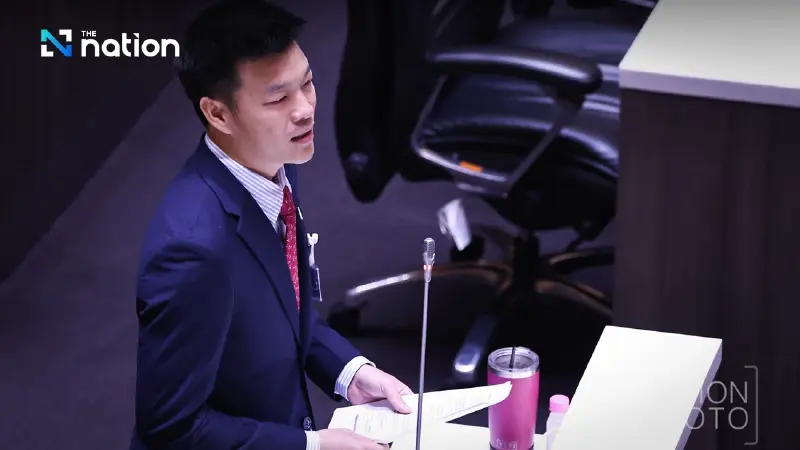


People’s Party leader Natthaphong Ruengpanyawut used a parliamentary debate to attack a “five-cluster” power structure, saying all 23 government policies leave the public out of the equation.
During Parliament’s session on the Cabinet’s policy statement on Thursday (April 9), Natthaphong Ruengpanyawut, leader of the People’s Party, raised questions over the “stability” of the current government led by Prime Minister Anutin Charnvirakul.
He argued that the government is not built on the interests of the people, but on a balance of power among five influential groups, or “five clusters”, that collectively dominate the upper house, the lower house and independent bodies.
A map of the government’s ‘five clusters’ of power
Natthaphong said the government is running the country by dividing power among five main groups:
- The party-switching political bloc: This refers to MPs from other parties who moved to Bhumjaithai in the last election, making it the party with the highest number of defecting MPs in the 27th House.
- The second-largest party with no bargaining power: Natthaphong said the second-largest party in the coalition had effectively “sold its soul” and had no bargaining power with Bhumjaithai, because the numbers in the House allow the leading party to replace it with opposition parties at any time if it threatens to quit.
- Small parties propping up the power base: These are the other coalition parties, which together hold around 20 seats and serve as a crucial force in weakening the bargaining power of the second-largest party, allowing the core party to pursue its political strategy more freely.
- The Joker card from the appointed chamber and independent bodies: Natthaphong said unelected members and independent organisations were being used as tools to control the drafting of a new constitution in line with the government’s wishes, attack opponents and protect allies. He cited the Election Commission’s endorsement of the result in Suphan Buri’s Constituency 2 despite questions over the vote count.
- The conservative bloc defending the old order: He described this as a group within the country that wants to preserve the old system and continues to shield the ruling camp, sending the message that “if you are on this side, nothing you do is wrong”.

Attack on 23 policy pledges ‘with no people in the equation’
Natthaphong also criticised the prime minister’s full set of 23 policy pledges, saying they reflected no shared political will among the coalition parties and contained no clear “national agenda”.
He said this was especially evident in the absence of any commitment to drafting a new constitution or protecting the public’s rights and freedom of expression in the policy statement.
He further argued that the government consistently chose to protect capital groups and its own allies before the people.
As examples, he pointed to the “fuel crisis”, saying the government had failed to regulate refining margins so that they reflected real costs, and the “PM2.5 crisis”, saying it had not pushed ahead with clean air legislation through mechanisms already in its hands, instead using those mechanisms solely to retain political power.

Call to end the patronage system
Natthaphong urged the prime minister and the Cabinet to show the political courage to do what is right and end a patronage system that profits from people’s suffering.
“Enough is enough with the patronage system... it is time to begin politics for the people,” he concluded.
