
Parole, but not a pause in politics: eyes on Thaksin as Pheu Thai prepares a new chapter
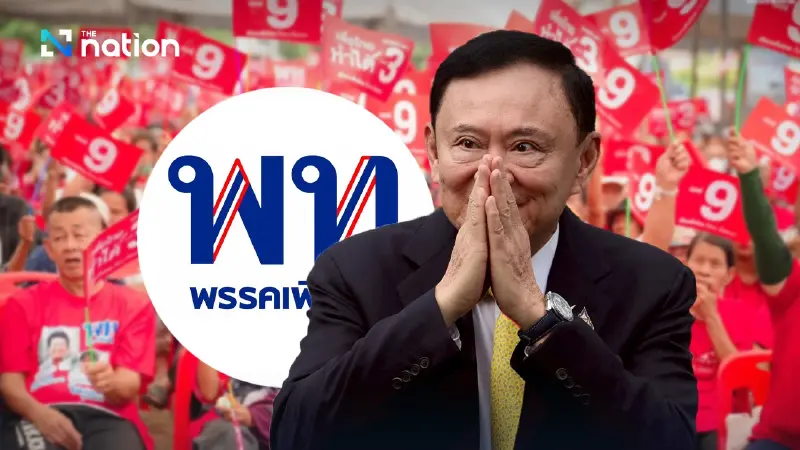


Thaksin Shinawatra is set for release on parole on May 11, but political attention is already turning to how he may reshape Pheu Thai from behind the scenes.
- Former Thai Prime Minister Thaksin Shinawatra is set to be released on parole on May 11, 2026, and will be required to wear an electronic monitoring device.
- Despite his release, Thaksin is expected to reduce his public political role due to parole conditions and a pending lese-majeste (Section 112) case.
- He will not pause his political involvement but will instead operate as the "supreme spiritual leader" and "true centre of power" for the Pheu Thai party from behind the scenes.
- Thaksin will guide the party's new chapter by advising his daughter, Paetongtarn Shinawatra, who will serve as the public-facing leader.
It is now clear that former prime minister Thaksin Shinawatra will be released after qualifying for parole on May 11, 2026, under a condition requiring him to wear an electronic monitoring device, or EM, until the end of his sentence.
The reason he qualified for parole is that Thaksin is 70 years old or over, has no more than one year left to serve, has undergone rehabilitation and behavioural improvement to the point that it is believed he can adjust his attitude and behaviour in a more positive direction, and has been assessed as posing a relatively low risk of reoffending.

That means the countdown is now on. In another 11 days, the “big boss” of Pheu Thai will regain his freedom outside prison, although he will still remain under probation for another four months. He is then expected to be fully free from the one-year sentence imposed on him on September 9, 2026.
This good news coincides with a major event for red-shirt supporters who back Pheu Thai and Thaksin on May 10-11, 2026, when celebrations are being prepared. According to details circulating among red-shirt supporters aligned with the Pheu Thai wing, a stage will be set up from 2pm on May 10 through to the evening, in anticipation of Thaksin’s release the following morning on May 11, when the former premier is expected to walk out of prison.

Suroj Chanthraphithak, a former presiding judge of the Court of Appeal, said he agreed with Thaksin’s parole because it adhered to principle, respected human dignity, citizenship within the state, and the principle of royal prerogative in legal tradition.
“What Prime Minister Thaksin has received under the rulings since 2006 has reflected an ethical standard more than a genuinely legal standard in substantive terms. Therefore, Prime Minister Thaksin should be given an opportunity by society, because he has respected the law and accepted its consequences.”
Suroj also said that, when former prime minister Thaksin heard the verdict on February 9, 2026 without fleeing the case, it reflected spirit and resolve. Therefore, Thai society should move beyond prejudice against him.
As for the political scenario, reports say Thaksin will spend some time with the Shinawatra family at the Chan Song La residence. After that, he is expected to find the right moment to allow Pheu Thai MPs to visit and offer support.
Regarding his public political role after May 11, 2026, Thaksin is expected to reduce his front-stage political profile and is unlikely to move immediately in public political terms, because he will still have to comply with the conditions of parole. He is therefore not expected to make many media appearances, unlike the period after he was previously staying at the Police General Hospital.
However, there are also voices within Pheu Thai, including former red-shirt leaders, who agree that Thaksin should scale back his political role and live a more normal life, resting for a time. They note that he is still not free from the burden of the criminal lese-majeste case under Section 112, linked to an interview he gave to a South Korean media outlet in 2015, in which he referred to the institution.
That case remains a lingering threat hanging over the red camp’s patriarch. If he were to return to public political activity and take on a front-stage role again, it could become a risky issue and potentially expose him to further punishment. The latest status of the case is that it remains at the appeal stage.
For that reason, stepping back temporarily from public-facing politics appears to be a choice the “big boss” will have to make, however reluctantly, both to restore faith in Pheu Thai and to protect his own freedom. That makes it necessary for him to stay behind the scenes instead.
Positioning himself as the supreme spiritual leader behind the curtain of Pheu Thai is therefore seen as a tactic by Thaksin to avoid becoming a lightning rod, while also drawing lessons from the past, when missteps in political manoeuvring caused him to lose the balance of power to the blue camp.

Thaksin’s role after parole is expected to centre on advising the second most powerful figure in Pheu Thai, Paetongtarn Shinawatra, the former prime minister, who is now the party’s main centre of power.
In effect, once Thaksin regains his freedom, Pheu Thai’s centre of gravity will have two moons at Chan Song La — the “big boss” and the “little boss” — both helping to guide the party’s direction as Pheu Thai begins to adjust to a new political scenario.
Under this arrangement, Thaksin will command the game from behind the curtain, while the “little boss” will remain in front to help restore ratings and drive politics within the party.

At the same time, Yodchanan Wongsawat, deputy prime minister and minister of higher education, science, research and innovation, will be tasked with producing visible results to help rebuild the party’s popularity.
So while Thaksin may be on parole, he is not stepping away from politics. He is only reducing his public role for the time being. At this moment, key figures, party leaders and Pheu Thai MPs all appear to recognise the same reality: he remains the party’s supreme spiritual leader and its true centre of power.
