
Doi Suthep Cable Car Proposed as Eco-Friendly Option to Boost Tourism
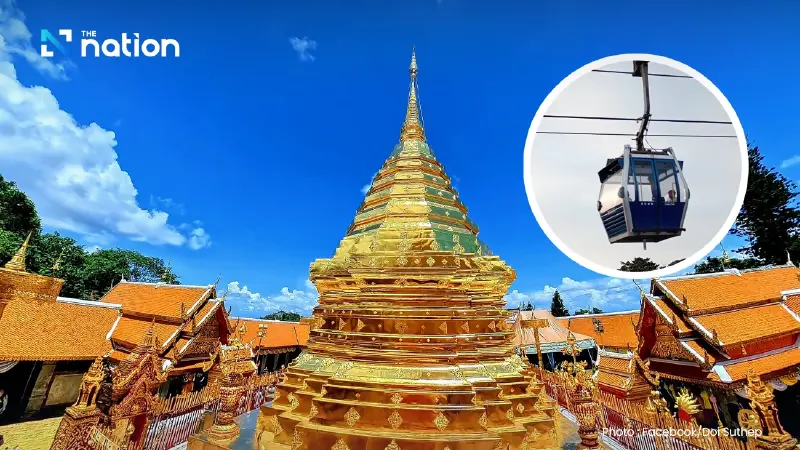


A 30-year controversy reignites as an Austrian firm proposes a new, eco-friendly cable car for Chiang Mai’s iconic mountain to boost tourism and cut emissions
- The long-debated proposal to build a cable car on Doi Suthep has been formally revived, with an Austrian firm presenting a plan that would cut the 30-minute journey to the temple to under 10 minutes.
- Supporters champion the project as a new tourist landmark that would reduce traffic and pollution, boost Chiang Mai's economy, and serve as a modern, sustainable transport solution.
- Opponents argue the cable car is a cultural blight that disrespects the sacred Wat Phra That Doi Suthep, raising concerns about environmental damage and the city's ability to handle an influx of tourists.
The controversial proposal to build a cable car up Doi Suthep, Chiang Mai’s iconic mountain and home to its most sacred temple, has been formally revived, sparking an immediate and familiar debate over balancing tourism revenue with local culture and environment.
The Doi Suthep Cable Car project has been discussed for three decades, consistently pitting supporters—who believe it would draw more tourists and be a new city landmark—against opponents concerned about environmental damage and perceived disrespect to the revered Wat Phra That Doi Suthep.
The latest push came in mid-June 2025 when Nicholas Prachensky, the Honorary Consul of the Republic of Austria in Chiang Mai, presented a concept for the cable car and an integrated urban mobility system to the Provincial Governor and other local leaders.
The Austrian firm Doppelmayr Group, established in 1893, proposed a route that would connect the mountain's foothills directly to the temple. The system promises a dramatic improvement in travel time and efficiency:
- Distance: Reduced from 11 km to just 2.2 km.
- Travel Time: Slashed from 30 minutes to only 9.8 minutes per journey.
Proponents argue that the new cable car, using modern, low-impact technology, would significantly reduce traffic and exhaust pollution on the mountain road.
They also highlighted non-tourism benefits, such as the ability to transport emergency patients, monitor wildfires, and facilitate rubbish collection.
The system is billed as a low-carbon, low-footprint solution that requires minimal construction time and avoids extensive deforestation.

Project advocates emphasise that cable cars are no longer just for tourist sites; they are a global mobility trend now used in urban centres worldwide, including London and Paris. They cited La Paz, Bolivia, which uses an extensive cable car network as its main public transit system.
Proponents argue the project is necessary because Chiang Mai is losing ground to regional competitors like Vietnam.
The cable car, they say, could become a new symbol of high-quality, sustainable tourism, enhancing the Doi Suthep-Pui National Park as a hub for outdoor activities like hiking, trail running, and mountain biking, while promoting the spiritual tranquillity of the summit.
Despite the focus on sustainability, the proposal has reignited deep divisions.
Supporters want a new landmark to generate income for Chiang Mai, but insist any plan must include robust systems for managing tourist numbers and providing adequate parking.
Opponents remain unconvinced that a cable car is needed, questioning whether the city could handle the resulting increase in visitors—specifically addressing waste management and community integration.
Crucially, they stress the cultural incompatibility of a large modern structure next to the ancient, sacred shrine.

Project representatives maintain that the cable car is the safest, most sustainable, and lowest-carbon transport option for moving large numbers of people up the mountain, arguing it would be less environmentally damaging than widening the existing road to four lanes.
They conclude that given the success of similar projects in Asia, now is the right time for the technology to be implemented in Thailand.
