
Iran war rattles tourism as airspace closures and higher fares threaten Thailand’s 36m visitor goal
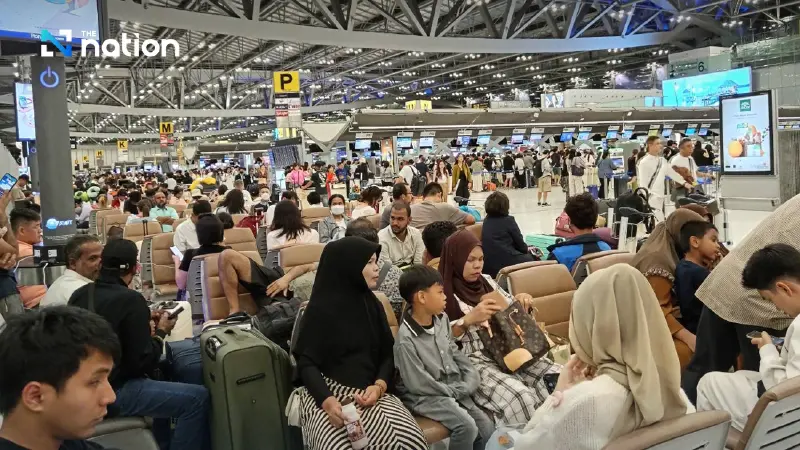


Escalating conflict involving Iran has forced airspace closures and flight disruptions across the Middle East, raising concerns over Thailand’s target of 36 million foreign visitors in 2026.
Renewed fighting in the Middle East has begun to ripple through the global tourism industry after the United States joined Israel in military action against Iran on February 28, 2026. Several countries in the region have since closed their airspace and cancelled flights, creating disruptions for international travel.

Thienprasit Chaiyapatranun, President of the Thai Hotels Association (THA), said the Iran conflict would inevitably affect Thailand’s tourism sector. Airspace closures and flight cancellations have left some travellers stranded in Thailand, unable to return home, while others have been unable to travel to the country in the first place. He said the full extent of the damage is still unclear and will need to be assessed after about a week.
“The main market affected is tourists from the Middle East,” he said. “We still do not know how long the airspace closures will last. Although this period is the low season for Middle Eastern travellers, there are concerns about whether arrivals will return to normal during their peak travel season between June and August.”

European tourists are also a concern because some travellers now have to change flight routes. Many flights previously transited through the Middle East, meaning new routes could increase ticket prices. While Europe’s peak season for travel to Thailand has already passed, Thienprasit said the Middle East tensions are unlikely to significantly affect the European market during the low season, with bookings still expected to remain higher than last year.
Tourists from other regions, particularly Asia, may also be affected, with around 10-20% potentially delaying trips due to safety concerns or the perception that global travel conditions are unstable. Thienprasit suggested that Thailand’s incoming government should consider domestic tourism stimulus measures to help offset potential losses.
“The biggest concern following the Middle East conflict is the possibility of terrorism spreading. If that happens, tourists of all nationalities may hesitate to travel anywhere,” he said. Tourism operators are therefore urging Thai authorities, including security agencies and immigration officials, to strengthen safety measures to reassure travellers.
Concerns over Thailand’s 36 million visitor target
Before the Iran conflict erupted, the Thai Hotels Association had projected that foreign tourist arrivals could exceed 36 million in 2026, supported by a strong recovery in the Chinese market. During the recent Chinese New Year festival, Chinese arrivals unexpectedly reached 30,000 per day, before easing to 16,000–17,000 per day over the following weekend—still higher than the daily average in 2025.
However, the Iran war represents an external factor beyond Thailand’s control, raising uncertainty over whether the country can still reach the 36 million visitor target this year.
Earlier, the Tourism Authority of Thailand (TAT) set an ambitious goal for 2026 to generate 3 trillion baht in total tourism revenue, an 11% increase from 2025. The plan includes attracting 36.7 million foreign visitors, generating 2 trillion baht in international tourism revenue, and encouraging 210 million domestic trips, producing 1 trillion baht in domestic tourism income.
In 2025, Thailand recorded 2.7 trillion baht in tourism revenue from 32.97 million foreign visitors, down 7.23% from the previous year. Although arrivals from nearby markets such as Malaysia and China declined, strong growth from long-haul markets—including Europe, the United States, the Middle East and Africa—pushed long-haul arrivals to a record 10.8 million. Meanwhile, domestic tourism reached 202 million trips, up 2.7%.

Centara confirms hotels operating as normal, closely supporting guests
Gun Srisompong, Chief Financial Officer of Central Plaza Hotel PLC., said Centara’s hotels and resorts are closely monitoring the current situation in the region and remain in ongoing discussions with local authorities. All of the group’s properties in the United Arab Emirates, Qatar and Oman remain open and are operating at full capacity.
“We are focused on ensuring that our guests and staff feel safe, comfortable and supported by the hotel,” he said.
In line with official guidance, guests who are unable to travel due to circumstances beyond their control will be supported with extended stays until they can continue their journeys. Centara teams are available 24/7 as needed, and the group remains committed to maintaining a safe environment and welcoming all guests during this period.
Plans to offset revenue impact
Gun added that all Centara properties in the Middle East continue to operate normally and their buildings have not been damaged. However, the situation has inevitably had a negative impact on tourism—both directly in the Middle East and indirectly on travel to other destinations.
This is because major Middle Eastern cities such as Dubai serve as key aviation hubs for connecting flights. With airspace closures, long-haul travellers—particularly from Europe—have had to reroute via alternative flight paths.
“In the short term, there will be stranded travellers. In Dubai, the government has provided support with costs. On the night of the incident, Centara Mirage Beach Resort Dubai recorded 100% occupancy,” he said.
Centara has prepared plans to look after in-house guests and generate additional revenue. Gun noted that the group’s investments and management portfolio are diversified across multiple regions, helping to cushion the impact when Middle East properties are directly affected. He added that Centara’s Maldives properties are also facing pressure from the recent rise in oil prices.
Minor Hotels says Gulf properties remain fully operational
Minor Hotels said it is monitoring the situation across the Middle East and coordinating closely with government agencies across the UAE, Qatar, Oman and other Gulf countries. All of its hotels in the region remain open and fully operational.
The company said the safety and wellbeing of guests, staff and partners remain its top priority, and it continues to implement all necessary measures to ensure its hotel environments remain safe and comfortable.
