
AOT plans major airport expansion to serve 180m passengers
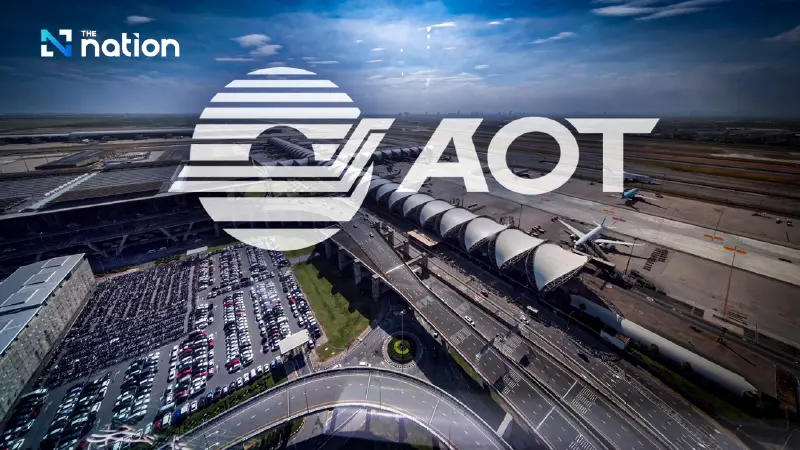


AOT is revising its 365-billion-baht airport expansion roadmap to lift annual passenger capacity across six Thai airports to 180 million by 2034.
Airports of Thailand Plc (AOT) is revising its development roadmap for the six airports under its management, with total investment estimated at more than 364.98 billion baht.
The new timeline is aimed at increasing annual passenger-handling capacity to 180 million by 2034, while upgrading services to international standards.
A major focus of the plan is Suvarnabhumi Airport, where AOT aims to raise capacity to 120 million passengers a year over the next decade through two key projects.
The first is the East Expansion project, with a construction budget of 13.52 billion baht, including 7% value-added tax. The project will expand passenger service areas, including check-in zones, passport control facilities and other spaces for airport users.
AOT is preparing to submit the project to the Cabinet for approval. Construction is expected to proceed between 2026 and 2030. Once completed, the expansion will lift Suvarnabhumi Airport’s capacity to 70 million passengers per year.

South Terminal plan awaits Cabinet approval
AOT is also moving ahead with the South Terminal development at Suvarnabhumi Airport, with estimated investment of 245.37 billion baht, including VAT and contingency costs.
The AOT board has already approved the draft Suvarnabhumi Airport development master plan for 2025. The plan is now under consideration by the Civil Aviation Authority of Thailand (CAAT) before being submitted to the Cabinet.

The South Terminal project is designed to increase Suvarnabhumi’s capacity to 120 million passengers per year and enable the airport to handle 120 flights per hour.
The project includes construction of a main southern passenger terminal covering 750,000 square metres, along with an automated people mover system linking passenger terminal areas.
The development will also allow passengers to access the airport from Bang Na-Trat Road and the motorway, in line with plans to expand passenger service areas.

AOT also plans to build a fourth runway on the eastern side of the airport. The runway will be around four kilometres long and is intended to support future growth in air traffic.
The new master plan also allocates space for additional airport activities, including an aircraft maintenance, repair and overhaul (MRO) centre, an expanded cargo area north of the existing facilities, and a General Aviation zone for private aircraft and other aviation services.
AOT said these additions would support Suvarnabhumi’s goal of becoming a more comprehensive airport, comparable with leading international aviation hubs.
The South Terminal project is expected to take 10 years, from 2027 to 2035, and will be divided into four phases. The first phase will cover design and ground improvement from 2027 to 2029, as the site is on wetland and requires time for soil settlement.
The initial phase is expected to require around 20 billion baht. Construction of passenger terminal buildings will then begin gradually from 2029, with work carried out in phases according to future passenger demand.

Don Mueang upgrade rises to 69 billion baht
AOT is also adjusting the third-phase development plan for Don Mueang Airport, with construction investment now estimated at 69.29 billion baht, including VAT and contingency costs.
The AOT board has approved changes to project details and an expanded investment framework. Detailed design work has been completed, and the project is being prepared for submission to the Cabinet for approval of changes to some elements.
The revision follows changes from the original plan approved by the Cabinet in November 2022, which had an investment budget of 36 billion baht.
The Don Mueang expansion is not a minor renovation, but a major infrastructure overhaul. AOT has updated the original plan, which covered 21 sub-projects, to better reflect current conditions and future demand.
If approved by the Cabinet, the project will move to the bidding process. Construction is targeted for 2028 to 2034.

The project aims to restore and increase Don Mueang’s capacity by another 15 million passengers, bringing annual capacity to 45 million. The airport will also be managed to handle up to 50 million passengers a year and 55 flights per hour, compared with its current capacity of 30 million passengers per year.
The plan includes construction of a new international passenger terminal, Terminal 3, covering 208,000 square metres. Current detailed designs show that Terminal 3 is 25% larger than the original concept, which has contributed to the higher investment cost.
AOT will also renovate Terminal 1 to support domestic passengers alongside Terminal 2. Other works include construction of a terminal for private jet flights, improvements to Cargo Buildings 1 and 2 to support 500,000 tonnes of cargo per year, and upgrades to traffic systems and related utilities.
In addition to the third-phase Don Mueang development, AOT is also pursuing a project to improve links with other public transport systems. This will be carried out through private-sector investment in a Junction Building, which will serve as a central connection point directly linked to the Red Line rail system.
The Junction Building will be located between Terminal 2 and the new Terminal 3.

Regional airport plans move forward
AOT is also progressing with development plans for Phuket Airport Phase 2, Chiang Mai Airport Phase 1 and Mae Fah Luang Chiang Rai Airport Phase 1.
These projects are currently in the design stage, which is expected to be completed by 2026. AOT expects to seek project approval by 2027.
Hat Yai Airport is currently undergoing a review of its master plan, which is expected to be completed by 2027.
Under the Phuket Airport Phase 2 plan, investment of around 10 billion baht will be used to expand the international passenger terminal and utility systems. The project will add capacity for 5.5 million passengers per year, bringing total capacity to at least 18 million passengers annually.
Chiang Mai Airport Phase 1 will require around 16 billion baht. The project includes construction of a new passenger terminal, renovation of the existing terminal, and development of road systems, utilities and other related infrastructure.
The Chiang Mai project will increase capacity from 8 million passengers per year to at least 20 million passengers annually.

Mae Fah Luang Chiang Rai Airport Phase 1 will require around 7 billion baht. The plan includes construction of a new passenger terminal, renovation of the existing terminal, construction of a car park building, and upgrades to roads, utilities and related systems.
The project will double the airport’s capacity from 3 million passengers per year to at least 6 million passengers annually.
Hat Yai Airport Phase 1, with estimated investment of around 4.49 billion baht, remains under master plan review.
AOT is also studying the investment feasibility of two new airports: Andaman Airport in Phang Nga and Lanna Airport. Once the feasibility studies are completed and approved, the projects will be prepared for submission to the Cabinet.
Together, the projects form AOT’s new roadmap for expanding Thailand’s airport network under its revised development timeline.
