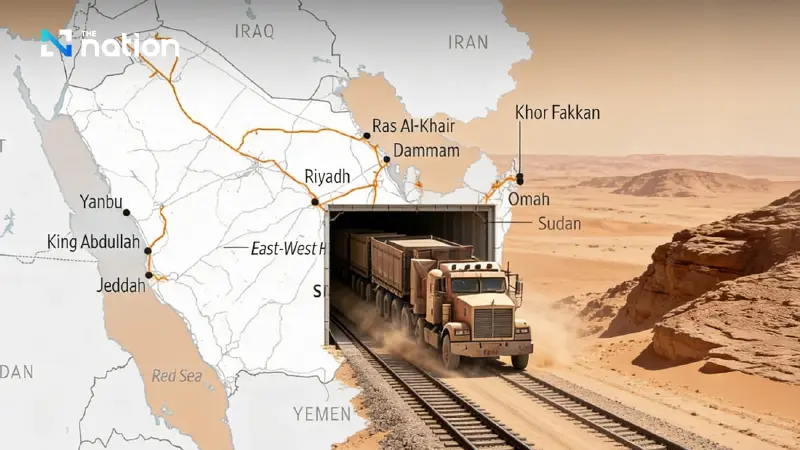
From sea to sand — Gulf logistics miracle keeps trade moving
SATURDAY, MAY 16, 2026
Play
Gulf states are using trucks, rail, pipelines and Red Sea ports to keep trade moving as war shuts the Strait of Hormuz
To bypass the disrupted Strait of Hormuz, Gulf states are establishing new overland trade routes across the Arabian Peninsula using massive truck convoys, rail, and pipelines.
Key commodities are being rerouted, with Saudi Aramco utilizing its East-West pipeline for oil and mining giant Maaden trucking fertilizer to Red Sea ports.
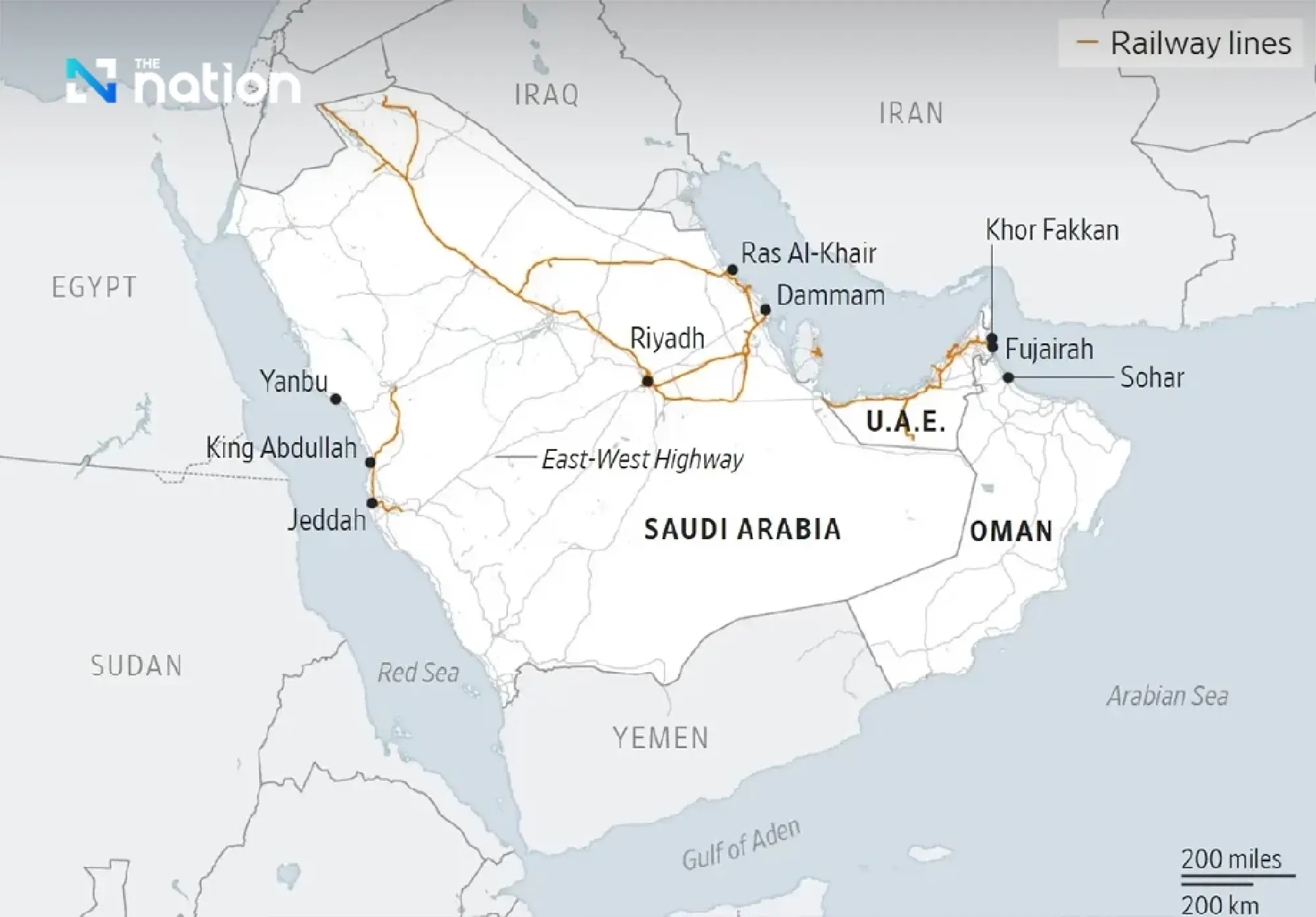
Alternative ports, such as Khor Fakkan in the UAE, have become critical emergency gateways, experiencing a dramatic surge in truck and container volumes to handle the diverted goods.
Gulf states are rapidly redrawing the region’s logistics map as the war in the Middle East keeps the Strait of Hormuz effectively closed, forcing companies to move goods across the Arabian Peninsula by truck, rail, pipelines and alternative ports.
What was once the world’s most critical maritime choke point has now pushed Saudi Arabia, the United Arab Emirates and Oman into building emergency overland routes through the desert. Convoys of heavy trucks are moving around the clock, carrying fertiliser, consumer goods, vehicles and raw materials that would normally travel by sea.
Trucks replace ships across the desert
Saudi mining giant Maaden has expanded its trucking fleet from 600 vehicles to more than 3,500 to move fertiliser from the Persian Gulf to Red Sea ports. Each truck is using two drivers so journeys across the desert can continue with minimal stops.
Maaden chief executive Bob Wilt said the arrangement is expensive and was never designed for a crisis of this scale, but it is helping reduce the impact of a global fertiliser disruption that threatens food supply chains and inflation in many countries.
Global shipping groups including Maersk and MSC have also begun using overland transport across the Arabian Peninsula, while UAE supermarket chain Spinneys has moved food products from Britain through Europe, Egypt and Saudi Arabia before reaching Dubai by truck, a journey taking around 16 days.
Rail is becoming part of the emergency response as well. Etihad Rail recently carried hundreds of Nissan vehicles from Fujairah on the UAE’s eastern coast to Abu Dhabi on the Persian Gulf, marking the country’s first rail shipment of cars.
Khor Fakkan becomes emergency gateway
One of the clearest shifts is taking place at Khor Fakkan port in the UAE. Once mainly a transshipment hub, the port has become an emergency gateway for the region, with truck movements jumping from about 100 vehicles a day to more than 7,000.
Weekly container volumes have also surged from 2,000 containers to 50,000 since the war began. The port operator had to hire 900 additional workers within two weeks and open new truck yards to handle the sudden surge in cargo distribution.
Farid Belbouab, chief executive of Gulftainer, compared the challenge to assembling an entire orchestra overnight and expecting it to perform a Mozart symphony immediately.
Oil moves through pipelines and alternative ports
Energy flows are also being rerouted. Saudi Aramco has increased its use of the East-West Pipeline, which carries crude to Yanbu on the Red Sea, while the UAE has stepped up crude exports through Fujairah.
Aramco said its first-quarter profit rose 26% year on year and 34% from the previous quarter’s profit of US$25.1 billion, beating analyst expectations as the East-West Pipeline helped the company bypass the Strait of Hormuz.
Aramco chief executive Amin Nasser said the pipeline, now operating at full capacity of 7 million barrels per day, had proved to be a vital artery for global energy supply and helped reduce the impact of transport restrictions in Hormuz.
Beyond emergency transport, Saudi Arabia is also using the crisis to accelerate a broader minerals strategy. The kingdom has ordered Maaden to expand production of phosphate, gold and aluminium, with investment plans worth up to US$110 billion over the next decade.
Maaden is working with MP Materials of the United States and the US Department of Defense on rare-earth extraction and processing, a move that could make Saudi Arabia an important part of Western efforts to reduce dependence on China for critical minerals.
The company is also a key force behind Saudi Arabia’s rise as the world’s third-largest phosphate exporter. Normally, phosphate is mined, processed into fertiliser pellets and shipped to global markets through the Strait of Hormuz.
With the maritime route under severe pressure, Maaden has had to build a backup path through the desert to keep exports moving. The biggest obstacle has not been the long overland journey itself, because Saudi Arabia already has cross-country highways, but the infrastructure at the destination. Red Sea ports were not originally designed to handle massive volumes of phosphate exports.
Maaden has therefore had to redesign large parts of its logistics system, from building prefabricated warehouses for fertiliser to installing special systems for transferring sulphuric acid, a corrosive chemical used in phosphate production, into stainless-steel tanker trucks.
The fertiliser issue is particularly important for food security. Earlier analysis warned that the effective closure of Hormuz could push fertiliser prices sharply higher, as the route handles a large share of global seaborne oil trade and more than a third of world urea exports.
A costly shock absorber for the global economy
Overland transport cannot fully replace maritime shipping, and it is more expensive. But for now, the new truck, rail, pipeline and port routes are acting as a shock absorber for the global economy, helping maintain some trade flows and preventing inflationary pressure from becoming even worse.
The Hormuz crisis has exposed a core weakness in the modern global economy: relying too heavily on a single route can leave entire supply chains vulnerable to war or geopolitical disruption. Gulf countries are therefore not only trying to survive the current conflict, but also building permanent backup systems so the world is less easily trapped by one blocked chokepoint.
At the start of the war, analysts at commodity research firm CRU questioned whether Saudi exports could still reach global markets. But in recent weeks, cargo-tracking data from Kpler showed phosphate products from Yanbu on the Red Sea had already reached Djibouti, Thailand and Argentina.
CRU analyst Peter Harrison described the emergency response as a “logistics miracle” for Saudi Arabia.