
Thailand Seeks Return to Global Stage as Foreign Minister Leads UN Push
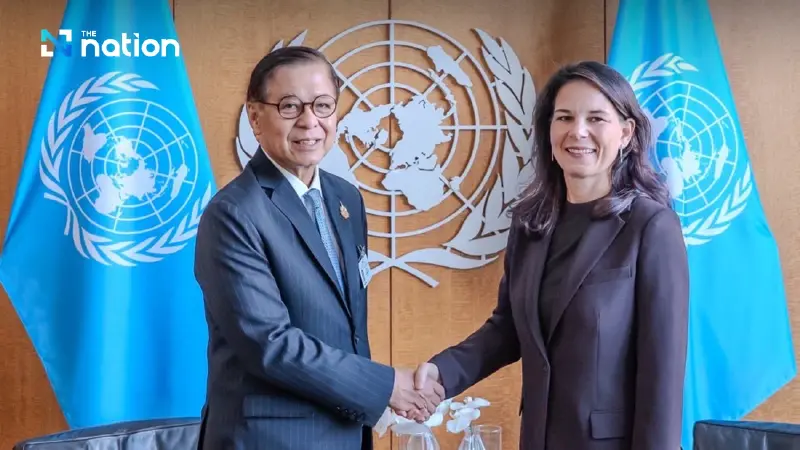


Foreign Minister Sihasak Phuangketkeow is using the 80th UN General Assembly in New York to reassert the country’s regional influence and secure crucial US trade ties
- Thailand's Foreign Minister is leading a delegation to the UN General Assembly in New York with the primary goal of reasserting the nation's relevance on the global stage.
- The diplomatic push involves articulating Thailand's official stance on major international and regional issues, including the situations in Myanmar and Thai-Cambodian border tensions, through a UN address and bilateral meetings.
- A key component of the mission is to foster economic cooperation by promoting trade and investment, specifically by engaging with the U.S.-ASEAN Business Council and the U.S. Chamber of Commerce.
Thailand is mounting a significant diplomatic offensive at the United Nations, with Foreign Minister Sihasak Phuangketkeow leading a delegation to the 80th UN General Assembly (UNGA80) in New York to place the nation "back on the global radar."
The high-level Thai mission, which includes executives from the Ministry of Foreign Affairs and the Ministry of Public Health, is participating in the UNGA80 High-level Week from 23–29 September 2025.
The core objectives are to articulate Thailand's vision on international affairs and to foster economic cooperation.

Diplomacy and Global Stance
The Foreign Minister, who arrived on 26 September, has two primary missions.
Firstly, Thailand aims to reassert its global relevance by clearly stating its position on major international principles, addressing issues both distant, such as the crises in Ukraine and the Middle East, and those closer to home, including the situation in Myanmar and tensions along the Thai-Cambodian border. This vision will be outlined in the Minister’s address to the UN General Assembly on 27 September.
Secondly, Sihasak has a packed schedule of bilateral meetings with key global figures, including the UN Secretary-General and the President of the UN General Assembly (PGA80), Annalena Baerbock.

During his meeting with PGA80 Baerbock, the Minister underscored Thailand’s commitment to UN priorities, including UN reform.
The PGA80 President commended Thailand's active participation, particularly its role as Chair of the UNGA80 Third Committee (Social, Humanitarian, and Cultural) and as host of ESCAP.
Regional Tensions and Russian Support
Sihasak also held meetings vital to Thailand’s regional security and international objectives:
Japan (Ottawa Convention Chair): The Minister reaffirmed Thailand’s commitment to push the mechanism of the Compliance Committee (OCC) to persuade Cambodia to halt violations of the Convention and restart joint humanitarian demining along the border.
Russia (UNSC President for October 2025): The Minister met with his Russian counterpart to stress Thailand’s commitment to a peaceful, bilateral resolution of the ongoing Thai-Cambodian border tensions.
Malaysia (ASEAN Chair): This discussion focused on regional cooperation, while meetings with the UN Special Representative on Myanmar focused on elections and enhancing social participation to achieve sustainable stability.
Regarding Myanmar, the Thai delegation emphasised adherence to the UN Charter and discussed efforts to promote stability and peaceful solutions, backed by ASEAN and regional partners.
Driving Trade and Investment
Beyond political diplomacy, a central mission for the Thai delegation is to promote trade and investment, particularly with the United States.
On 27 September, the Foreign Minister is leading the delegation at a reception with the U.S.-ASEAN Business Council and the U.S. Chamber of Commerce.
This provided a crucial platform to introduce the new government's policies, expand trade cooperation, and discuss mutual challenges, particularly the pressure from US reciprocal tariff measures amid geopolitical competition.
On 26 September, the Minister participated in a four-party consultation between the U.S., Malaysia, Thailand, and Cambodia.
This initiative, spearheaded by the US President, aimed to progress the outcomes of the recent Putrajaya and General Border Committee (GBC) meetings regarding the Thai-Cambodian ceasefire. The effort is viewed as a crucial first step in building trust between the two countries.
