
Over 100 Million Buildings Globally Face Flood Risk from Rising Seas
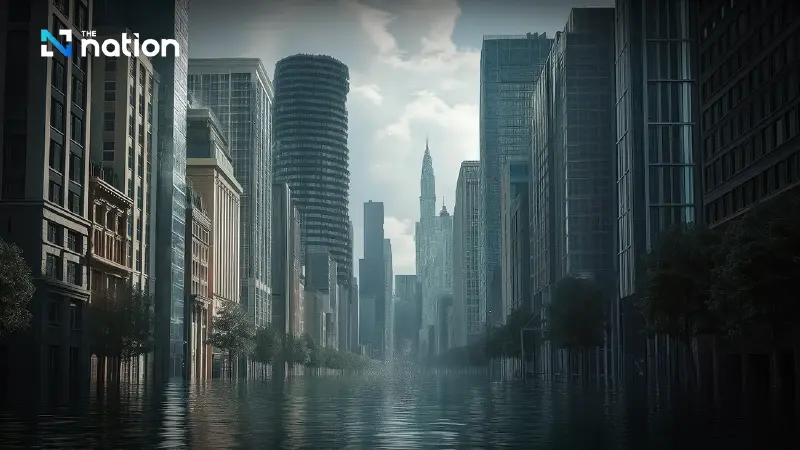


New research warns that unchecked emissions will submerge vast swathes of coastal infrastructure and communities, threatening global supply chains
- According to a McGill University study, over 100 million buildings globally are at risk of regular submersion from rising sea levels if the use of fossil fuels is not curbed.
- The risk scales with emissions: a modest 0.5-metre sea-level rise threatens approximately three million buildings, while a five-metre rise would endanger over 100 million.
- The threatened structures are concentrated in low-lying, densely populated areas and include critical infrastructure like ports, posing a major risk to the global economy and food systems.
- Researchers stress that while some sea-level rise is now unstoppable, its ultimate severity is still within human control and depends on future emissions levels.
More than 100 million buildings around the world are at risk of being regularly submerged by rising sea levels if the rapid consumption of fossil fuels is not curbed immediately, according to alarming new research from McGill University.
The study, published in the journal npj Urban Sustainability, assessed the long-term impact of sea-level rise on coastal infrastructure across continents, including Africa, Southeast Asia, Central America, and South America.
The findings, originally compiled by Krungthep Turakij's reporter Kritpol Sutheepatrakul, paint a dire picture for future coastal development.
Researchers used detailed satellite mapping and elevation data to estimate the number of structures that would be inundated by sea level increases ranging from 0.5 to 20 metres over the coming centuries.
Unstoppable, But Controllable
Professor Natalya Gomez, co-author and Canada Research Chair at McGill, stressed that while the consequence of global warming is slow and "unstoppable," the ultimate severity is still within human control.
"People often talk about sea-level rise in terms of tens of centimetres, but in reality, sea levels could continue to rise by several metres if we do not stop burning fossil fuels soon," Professor Gomez warned.
Even under strict emissions reduction measures, a modest 0.5-metre sea level rise—which is already widely anticipated—could submerge approximately three million buildings.
If emissions continue to fuel a rise of five metres or more—a scenario experts warn could unfold within a few hundred years—the number of buildings at risk climbs to over 100 million.
These structures are often concentrated in low-lying, densely populated areas, meaning entire communities, critical infrastructure such as ports and refineries, and irreplaceable cultural heritage sites are all under threat.
Threat to the Global Economy
The study highlights that the threat extends far beyond the coastline.
"We will all be affected by climate change and rising sea levels, whether we live near the sea or not, because we all depend on the goods, food, and fuel that pass through ports," said Professor Eric Galbraith, another co-author. "If these infrastructures are destroyed by high sea levels, it could cause severe damage to our interconnected global economy and food system."
Co-author Professor Jeff Cardille noted that some coastal countries are far more vulnerable than others due to the specific details of their geography and where their buildings are situated.
The study’s data, made publicly accessible via an interactive map on Google Earth Engine, is intended to serve as a vital tool for urban planners and policymakers.
It is expected to inform urgent climate adaptation strategies, including the construction of defensive infrastructure, revised land-use planning, or, in some cases, planned "managed retreat" from vulnerable coastlines.
SOURCE: Euro News, Phys, Technology Networks
