
Illegal gold mining devastates 875,000 rai of Peru’s Amazon rainforest
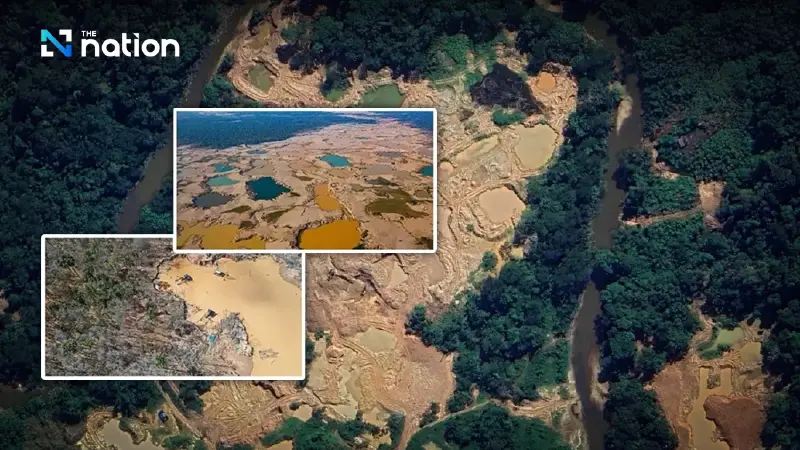


Illegal gold mining in Peru has destroyed over 875,000 rai of the Amazon rainforest, releasing toxic mercury into rivers and threatening local communities.
According to reports from the Monitoring of the Andes Amazon Program (MAAP) and Conservación Amazónica, a partner organisation in Peru, illegal gold mining has destroyed more than 875,000 rai of rainforest in Peru’s Amazon and continues to intensify, attracting foreign armed groups following record-high gold prices.
Since 1984, around 1,400 sq km of Peruvian rainforest has been cleared for mining. The activity is rapidly spreading nationwide, contaminating waterways as sluice boxes used in gold extraction release toxic mercury into the environment.

High-resolution aerial imagery has allowed MAAP to map excavation areas alongside deforestation for the first time, identifying miners and showing that the environmental crisis is moving northwards through Peru.
Gold prices have surged past US$4,000 due to growing global concerns over financial instability. Indigenous groups have warned that armed groups are increasingly destroying forests and polluting rivers in pursuit of precious gold, turning once-dense green rainforest into barren land, with grey soil and stagnant green pools.
Mercury accumulation in fish has serious consequences for local populations, causing neurological and developmental impairments, including congenital disabilities and learning delays, particularly in riverside communities in the Loreto region, where mercury levels average nearly four times above WHO recommendations.

MAAP analysis shows that 225 rivers and streams have been affected. Since 2017, 989 gold-mining sites have been identified in Loreto alone, with 275 new sites reported this year along the Nanay River, a major tributary of the Amazon, supporting dozens of indigenous communities.
Most mining sites are concentrated in Madre de Dios in southern Peru, but northern regions such as Loreto, Amazonas, Ucayali, Pasco, and Huánuco are now experiencing similar activities.
The report notes that although these mining areas are small, they can expand rapidly, reflecting a broader pattern threatening other parts of the Amazon rainforest.

MAAP reports show that the number of gold sluice boxes has increased along the Peruvian forest borders with Bolivia, Brazil, and Colombia.
With gold prices surging past US$4,000 per ounce, foreign armed groups from Colombia and Brazil have increasingly crossed into Peruvian forests, with local authorities doing little to stop them.
Meanwhile, the Andean Group, a political alliance of South American countries, has warned Peruvian authorities to take serious action against illegal mining, or risk facing economic sanctions.
Environmental activists are often targeted in the Amazon basin, and Peru is considered one of the most dangerous countries for opposing illegal mining and logging. Similarly, Colombia has had one of the highest murder rates in the world for several years.
Peru has made several attempts to control illegal mining and mercury use. In 2019, the government launched Operation Mercury, a military and police crackdown on illegal logging gangs, which significantly restored order to the forests. While much of the activity later shifted elsewhere, authorities announced a record seizure of illegal mercury, though local residents say law enforcement remains lax.
Sources: AP News, Earth, The Guardian
