
Thai MP Rome: 'True Strength is Courage to Disarm,' Hits at New Landmines
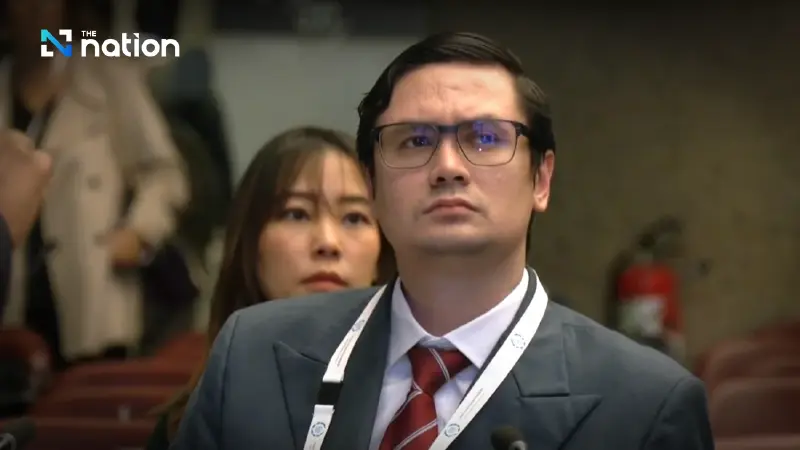


Rangsiman Rome delivers powerful plea for transparency and responsibility at IPU, contrasting the need for disarmament with the global cybercrime fight
- At the Inter-Parliamentary Union Assembly, Thai MP Rangsiman Rome asserted that true national strength is demonstrated by the courage to disarm, not by military armament.
- He issued a stark warning about the threat of "freshly laid" landmines in the region, which he stated betray the spirit of international treaties like the Ottawa Convention.
- Rome concluded with a call for nations to prove their strength by unearthing and removing hidden weapons to create a safer region, rather than deploying them.
Thailand’s delegate to the 151st Inter-Parliamentary Union (IPU) Assembly, Rangsiman Rome MP, used his address on 20 October to redefine global security, asserting that national strength must be measured by the courage to disarm rather than the ability to arm.
Speaking at the Panel Discussion of the Standing Committee on Peace and International Security, which focused on "Arms Control Policy and Non-Proliferation," Rome delivered Thailand's official stance, confirming its commitment to peace and non-involvement in an arms race with neighbouring countries.
"Arms control is not about counting weapons," he stated. "It is about counting lives—and ensuring that none are lost needlessly to negligence, delay, or indifference."
As a State Party to the Ottawa Convention on the Prohibition of Anti-Personnel Mines, the delegate highlighted Thailand's decades of effort clearing mine-contaminated lands, restoring safety and livelihoods.
However, he issued a stark warning to the assembly: "Some parts of our region still live with the shadow of landmines—not only from the distant past, but from freshly laid devices that betray the very spirit of the treaties we have all pledged to uphold."
Rome concluded with a moral call to action: "Our shared goal must be a region where no child walks in fear of hidden weapons... every State proves its strength not by how deeply it can bury instruments of war, but by how bravely it can unearth them."

Cybercrime Resolution
Thailand continued its offensive on transnational threats by leading a contentious drive to have its resolution on “Enhancing the role of parliaments in combating cross-border cybercrime” included as an emergency item for the General Debate.
The formal presentation of the emergency item will take place on October 21, the second day of the IPU’s General Debate (the first being October 20).
Rome’s proposal framed cyber scams as a major transnational crisis fuelling severe human rights abuses, including human trafficking, forced labour, and modern slavery—issues that directly challenge the IPU's humanitarian theme.

The initiative, however, faced immediate diplomatic headwinds:
China objected to the specificity of the language, particularly phrases like “forced labour,” requesting revisions and noting that such terminology could be detrimental to its national image.
Cambodia formally opposed the motion, arguing it diverted from the assembly’s main humanitarian focus.
Despite the opposition, the Thai motion gained significant backing at the Asia-Pacific Group meeting.

Australia voiced full support, stating that cybercrime affects citizens worldwide. The Philippines urged Cambodia to recognise the issue's urgency, and Malaysia also supported Thailand.
To resolve the dispute before the vote, the three opposing countries—China, Cambodia, and Thailand—volunteered to serve on a drafting committee to refine the resolution's final wording.
The General Debate is being held against a backdrop of 120 ongoing global conflicts and 310 million people in need of humanitarian assistance.
