
Thailand wins IPU vote to push global debate on scammers and cyber crimes
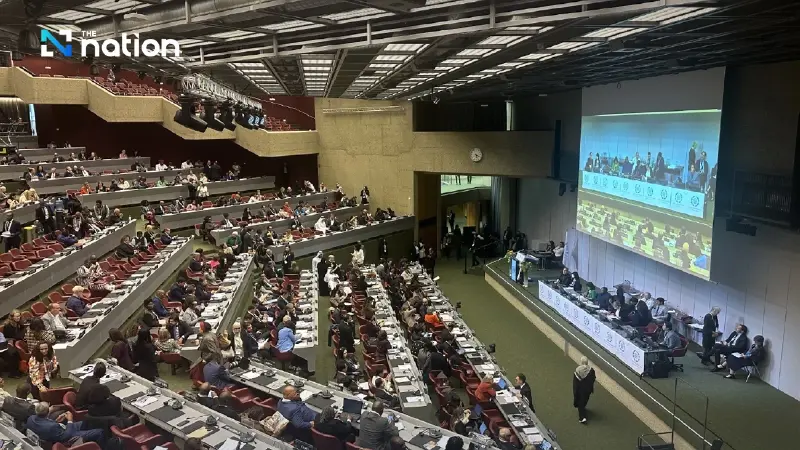


Thailand’s parliament scored a diplomatic win as the IPU voted to include its proposal on cybercrime and transnational scams as this year’s sole emergency agenda.
Thailand scored a diplomatic victory at the 151st Inter-Parliamentary Union (IPU) Assembly in Geneva, Switzerland, on Tuesday as its proposal to address transnational scams and cybercrime was overwhelmingly approved as this year’s sole “emergency item.”
The IPU Assembly considered several “emergency items” for inclusion in its agenda, focusing on issues that have recently emerged or are having wide-ranging global impacts. More than 100 member parliaments participated in the vote, which saw the Thai-led draft resolution on Transnational Organised Crime, Cybercrime, and Hybrid Threats to Democracy and Human Security receive over two-thirds majority support.
The success marks a historic moment for the Thai Parliament, as it managed to have a key national priority elevated to the global legislative stage.
Behind the win was the strong effort of the Thai parliamentary delegation — comprising MPs and senators led by House Speaker Wan Muhamad Noor Matha — who worked tirelessly to gather support from all regional blocs. The team also held negotiations to adjust the resolution’s wording and scope, broadening it beyond cross-border cybercrime and online scams to include organised crime that undermines democracy and human security.

This year, two emergency items were proposed for consideration:
- A global call for parliamentary solidarity and coordinated action on Madagascar, submitted by South Africa on behalf of the African group.
- Parliamentary action against transnational organised crime, cybercrime, and hybrid threats to democracy and human security, proposed by Thailand, Argentina, Chile, Poland, and Sweden, with support from the Latin American and Caribbean Group and the Twelve Plus Group.
The Madagascar motion received 743 votes in favour and 158 against, while Thailand’s proposal won 850 votes in favour and 200 against — comfortably surpassing the two-thirds threshold of 601 votes required for adoption.
Thailand’s motion will now stand as the IPU’s only emergency agenda item for 2025.
Notably, the Cambodian parliamentary delegation did not attend or participate in the vote.
MP Rangsiman Rome was the one who proposed Thailand’s draft resolution, together with its partner nations, and presented it before the IPU Assembly. In his address, he explained that the draft resolution covers organised crime, such as the recent assassination of a Colombian senator, as well as digital crimes, financial fraud, and cybercrime — all of which erode public trust.
He noted that the rise of scam centres across Southeast Asia has led to hundreds of thousands of victims being deceived, detained, and subjected to severe human rights violations, with financial damages exceeding US$15 billion.
“If we remain idle, these criminal networks will only continue to expand. Let us build seamless cooperation to confront them together,” Rangsiman told the Assembly.
Following the Thai MP’s presentation, his proposal received a round of applause from the delegates — no less enthusiastic than for the first proposal.

However, a representative from Russia opposed the Thai-led resolution, arguing that he did not believe the proposal met the IPU’s procedural rules, which state that emergency items must address issues of recent international significance. He further pointed out that member states had received the Thai proposal only three to four hours before the meeting, whereas the usual practice required submission at least 48 hours in advance. He stressed that his objection was based on procedure, not on substance.
The Chairperson of the Assembly responded by clarifying that, under IPU regulations, the decision on admissibility lies with the IPU Executive Committee, which had already met earlier that morning and given a positive opinion. The Chair added that Russia, if unconvinced, was entitled to vote against the motion.
The IPU Secretary-General later explained that, after due consideration, the Thai and allied proposal had indeed been deemed a newly emerging urgent matter.
Meanwhile, the Madagascar resolution called on parliaments worldwide to join forces in addressing the country’s urgent situation following a coup d’état that erupted after youth-led, Gen Z protests — a crisis involving humanitarian, political, and democratic dimensions.
In contrast, the Thai-led resolution on countering transnational threats and cybercrime focused on how parliaments should respond to modern challenges that endanger democracy and human security, particularly complex and cross-border crimes, including transnational organised crime, cybercrime, and hybrid threats.
