
Wan Noor and Rangsiman reveal how Thailand made history with IPU win on anti-scam and cybercrime motion
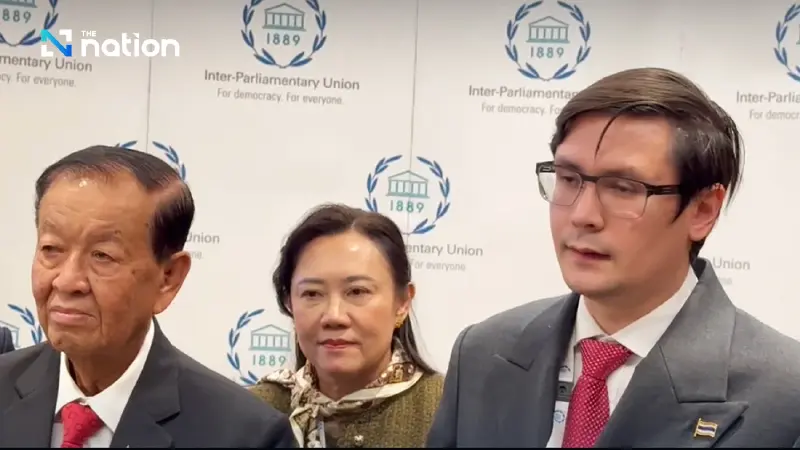


House Speaker Wan Noor and MP Rangsiman celebrate Thailand’s first-ever IPU victory after its anti-scam and cybercrime motion was adopted as an emergency item.
House Speaker Wan Muhamad Noor Matha, who led Thailand’s parliamentary delegation to the 151st Inter-Parliamentary Union (IPU) Assembly in Geneva, Switzerland, on Tuesday, expressed delight after Thailand’s motion titled “Parliamentary action against transnational organised crime, cybercrime, and hybrid threats to democracy and human security” was adopted as the sole emergency item at the assembly.
“This marks a historic milestone,” Wan Noor said. “The Thai-proposed motion on scam networks received more than two-thirds of the votes — nearly 1,000 in total — surpassing the other resolution. This issue represents one of the gravest threats to humanity today. Therefore, it is not only a victory for the Thai Parliament or Thailand itself but also a victory for people around the world. Thailand may be a small country, but this motion addresses a major global concern.”
He explained that the next step will be to formally draft the resolution, with an 11-member IPU committee established to complete it. Thailand has been selected as one of the committee members responsible for shaping the final version before it is presented for endorsement at the IPU’s closing session. Once approved, the resolution will be circulated to parliaments and relevant organisations worldwide for practical implementation.
“Thailand is not only working for its own country but also for the global community,” Wan Noor emphasised. “Scam operations have destroyed tens of thousands of lives, with victims being detained, forced into labour, and tortured. The financial losses amount to hundreds of billions of baht.”

The House Speaker also extended his gratitude to MP Rangsiman Rome of the People’s Party, who played a crucial role in championing the anti-scam initiative.
Wan Noor further shared that Thailand’s proposal had already gained strong backing from member countries during the ASEAN+3 informal meeting, which included China and Cambodia. He revealed that Cambodia had initially expressed support for the motion and even offered to co-sponsor it if accepted as an emergency item — yet, when the final vote took place, the Cambodian delegation did not participate.
“I believe Cambodia did not want the motion to pass,” Wan Noor commented. “If they truly supported it, they would have attended and voted. I cannot say what their exact reasoning was, but now that the motion has been adopted, Cambodia may face scrutiny from the international community — as it is widely known to be a major hub for illegal operations, including scam networks and call-centre syndicates.”
Rangsiman reveals how Thailand turned the tables to push ‘scammer’ motion into
Rangsiman Rome, a party-list MP from the People’s Party and a member of the Thai parliamentary delegation to the 151st IPU Assembly in Geneva, Switzerland, shared insights into how Thailand’s motion on combating scam networks and transnational organised crime won an overwhelming vote at the IPU and was adopted as an “emergency item” for the first time in history.
Rangsiman said that although Thailand had received strong cooperation — particularly from other Asian countries — winning a two-thirds majority vote was by no means easy.
He explained that the difficulty stemmed from the voting structure, in which countries are grouped by region — such as Africa, Latin America, and Europe — with each regional bloc carrying substantial voting weight. Europe, in particular, held the largest share of votes. Therefore, Thailand had to engage in intensive dialogue and negotiations with these countries to secure their support.
“We must thank Australia for its strong support. Australia acted as a bridge, helping us connect with European nations, especially Poland, which linked Thailand with other European countries such as Sweden, and even with Latin American nations,” Rangsiman said.
“Initially, Thailand focused solely on the issues of scam centres and cross-border cybercrime. However, we realised that to gain broader support, we needed to listen to and incorporate the priorities of other member groups. We found that Latin American and European countries were particularly keen on tackling transnational organised crime and drug trafficking networks. Upon reviewing these issues, we recognised that drug trafficking is also a major problem in Thailand, so we merged these concerns with our own and coordinated closely.”
He added that the Thai parliamentary secretariat team worked tirelessly late into the night, holding constant discussions and negotiations.
“It was not easy to merge three major issues from three continents into a single resolution. Although the main theme was shared, each region had different details and emphasis. The advantage, however, is that since the draft has already passed with a two-thirds majority and been adopted as an emergency item, it will likely make the drafting committee’s work easier, as we have already built mutual understanding.”
Rangsiman also questioned Cambodia’s absence from the crucial vote:
“Where did Cambodia go? Why didn’t they vote? Initially, they seemed to indicate they wouldn’t oppose it, but in the end, they disappeared. That’s unfortunate, because international cooperation is vital to effectively combat scam operations.”
He concluded that this achievement marked a historic milestone for Thailand.
“This is the first-ever emergency item proposed by Thailand to be successfully adopted by the IPU — and it received an exceptionally high number of votes. We had hoped for around 700, which would have been impressive, but we ended up receiving over 800 votes.”
