
Thailand Lays Out '3P' Fiscal Strategy at APEC Finance Meeting
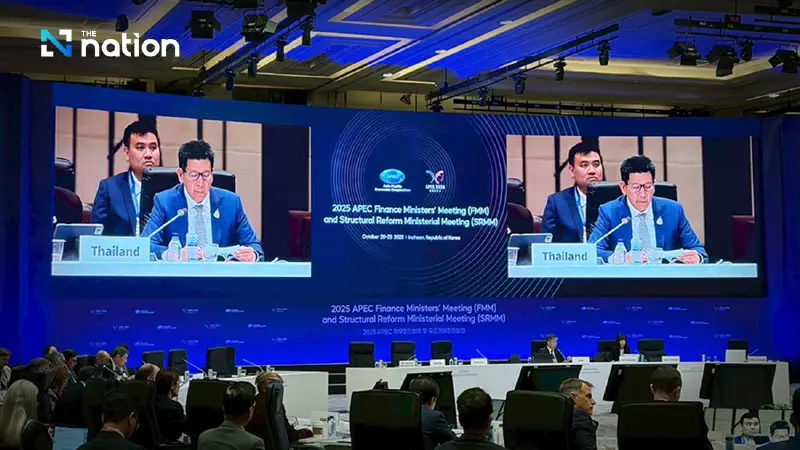


Deputy PM Ekniti Nitithanprapas Champions AI-Driven Financial Inclusion and 'Quality Spending' to Offset Fragile Global Outlook
- Thailand presented its "3P" fiscal strategy at the APEC Finance Ministers' Meeting to address global economic fragility and ensure sustainable growth.
- The first pillar, **Precision**, involves using technology and data to accurately target policies, exemplified by the 'Khon La Khrueng Plus' digital wallet stimulus.
- The second pillar, **Priorities**, focuses on strengthening the grassroots economy, boosting productivity, and investing in human capital with digital and green skills.
- The final pillar, **Partnerships**, aims to use Public-Private Partnerships (PPP) to mobilize private funding, increase efficiency, and reduce the government's fiscal burden.
Deputy PM Ekniti Nitithanprapas champions AI-Driven financial inclusion and 'Quality Spending' to offset fragile global outlook.
Thailand’s Deputy Prime Minister and Minister of Finance, Ekniti Nitithanprapas, participated in the 32nd APEC Finance Ministers’ Meeting (APEC FMM) in Incheon, South Korea, on Tuesday, where he presented Thailand's three-pronged fiscal strategy aimed at tackling global economic fragility.
The APEC FMM, held under the theme of “Sustainable Growth and Shared Prosperity in the Region,” saw ministers from 21 APEC economies exchange views on digital finance and fiscal policy.
Delegates expressed concern over the persistent global economic fragility, with the International Monetary Fund (IMF) projecting world growth for 2025 at just 3.2%.
Risks cited included high inflation, rising public debt, labour shortages, and geopolitical uncertainty, alongside structural challenges such as ageing societies and technological disruption.
In response to these challenges, the meeting discussed the necessity of using Artificial Intelligence (AI) and digital platforms to expand financial access, particularly for Micro, Small and Medium Enterprises (MSMEs) and low-income populations.
Ministers stressed that technological progress must be balanced with robust data protection and financial stability.

Ekniti highlighted Thailand's success with the PromptPay system, which boasts over 80 million accounts, and its regional expansion via Project Nexus.
He also promoted the ARI Score, an AI-powered alternative credit scoring tool developed in Thailand for its transparency and fairness, aimed at increasing financial inclusion for individuals and small firms.

Addressing the theme of Fiscal Policy for the Future, the Thai finance minister outlined the country’s three-pillar approach, known as the 3P principle, for ensuring long-term sustainable growth amid budgetary constraints:
(1) Precision: Utilising technology and data to precisely target policy. Ekniti cited the latest 'Khon La Khrueng Plus' stimulus, which used a digital wallet to register over 20 million people in one day for essential goods and services.
(2) Priorities: Setting clear strategic objectives focused on strengthening the grassroots economy, enhancing productivity, and investing in human capital—specifically through digital and green skills—to prepare the workforce for demographic shifts and AI challenges.
(3) Partnerships: Mobilising private sector funding through Public-Private Partnerships (PPP) to boost efficiency and reduce the fiscal burden, while rigorously maintaining fiscal discipline by upholding the public debt ceiling and keeping the budget deficit below 3% of GDP.

Ministers ultimately adopted the 2025 Joint Ministerial Statement, committing to the promotion of financial cooperation for sustainable growth and economic stability.
The statement incorporates the Incheon Action Plan to guide APEC policy over the next five years, prioritising resilient macroeconomic policies, sustainable fiscal measures, and supply chain security.
