
US and China call temporary truce in trade war after Trump-Xi meeting, analysts warn tensions remain
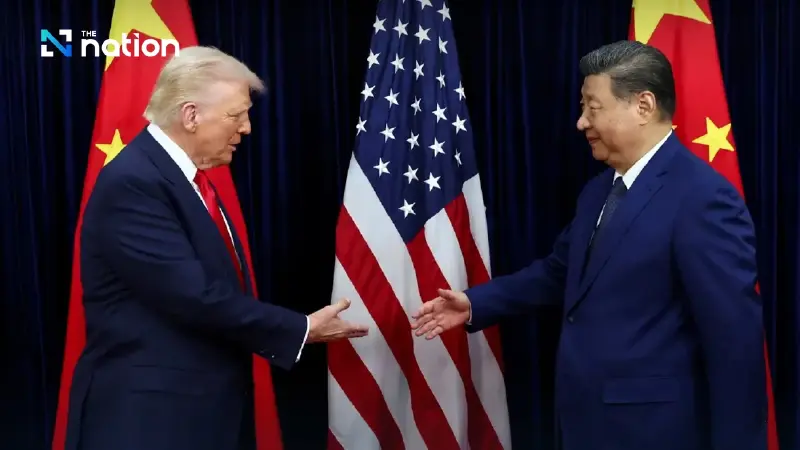


US President Donald Trump and Chinese President Xi Jinping agree to a temporary trade truce at APEC, easing tariffs but leaving deeper tensions unresolved.
The long-awaited meeting between US President Donald Trump and Chinese President Xi Jinping in Busan, South Korea, on October 30, 2025, marked the first face-to-face talks between the two leaders in six years. The 1-hour-40-minute discussion, held on the sidelines of the APEC Economic Leaders’ Meeting, has brought a temporary halt to the US-China trade war, though analysts caution that underlying tensions persist.
According to CNBC, President Trump described the talks aboard Air Force One as “amazing,” saying the two sides had “made several decisions.” He confirmed that the dispute over rare earth minerals had been resolved through a one-year agreement, which will be renewed annually.
Trump announced that tariffs on fentanyl-related imports from China would be cut from 20% to 10%, effective immediately, and that overall tariffs on Chinese goods would fall to 47% from 57%.
In return, the Beijing government has pledged to “work hard to curb fentanyl production” and to resume purchases of US soybeans and agricultural goods.
Trump said the two leaders did not discuss Taiwan, but revealed plans to visit China in April, while Xi is expected to make a reciprocal visit to the United States at a later date. China’s Foreign Ministry later confirmed that Trump’s visit will take place next year.

Analysts: progress exceeds expectations
Consultancy The Asia Group said the US decision to cut fentanyl-related tariffs addressed one of China’s “core concerns”, and reflected Washington’s belated recognition of China’s ongoing efforts to curb precursor chemical exports.
Meanwhile, Greenpoint Business Consulting commented that the meeting’s outcome “exceeded expectations,” attributing it to the personal diplomacy between the two leaders. The firm noted that the talks had not only averted an escalation but had produced more tangible progress than anticipated.
However, analysts warned that the trade conflict is far from over, as fundamental points of contention between the two economic powers remain unresolved.
Xi stresses coexistence, not confrontation
Before the meeting, both leaders struck a cordial tone, with Trump calling Xi “an old friend” and praising their “excellent relationship.” Xi, for his part, said that China’s pursuit of economic growth “does not undermine President Trump’s vision to make America great again.”
Tensions between Washington and Beijing have soared throughout the year. The latest flare-up occurred earlier this month when China imposed new restrictions on critical mineral exports, prompting the US to threaten a ban on software-related exports to China.
“It was an incredible meeting — a twelve out of ten. I decided to cut fentanyl tariffs because I believe they’re taking strong, genuine action,” Trump said aboard Air Force One as he departed Busan.
China suspends rare earth export controls
This month, China approved a one-year suspension of its rare earth export restrictions, a key leverage point in its trade relations with the United States. A statement from the Chinese Ministry of Commerce said that both sides agreed to cooperate on fentanyl control and expand agricultural trade.
However, the global stock market reacted cautiously to the ceasefire. Major Asian and European futures indexes fluctuated, while China’s Shanghai Composite Index opened lower after reaching its highest level in a decade, and US soybean futures fell flat.
According to Reuters, China’s decision to delay enforcement of its rare earth export restrictions was part of the agreement between Trump and Xi, though the earlier controls have already caused significant disruptions in global trade.
Rare earths—17 critical minerals essential in industries such as automobiles, aircraft, and weapons—have long been China’s most powerful bargaining tool. The export restrictions introduced this year allowed Beijing to tighten control over foreign buyers reliant on Chinese supply.
Following his meeting with Xi on October 30, US President Donald Trump said China had agreed to continue exporting rare earths, declaring that the issue was “resolved.” Shortly after, Beijing confirmed the one-year suspension of the export controls initially announced on October 9.
Nevertheless, China’s April export restrictions on seven specific rare earth elements remain in place, including on rare earth magnets, which are crucial for automotive, defence, and semiconductor manufacturing.
Jamieson Greer, the US Trade Representative, told reporters aboard Air Force One that China would not impose new rare earth export controls, though he did not specify whether the April measures would be lifted.
Those April restrictions, imposed just weeks before the meeting, had already led to supply shortages in the automotive sector, forcing several manufacturers to halt production at certain facilities due to the lack of raw materials.
Thailand imports rare earths for domestic processing and value-added industries
The Customs Department has released Thailand’s latest rare earth trade data as of October 27, 2025, showing activity across three main customs tariff codes:
1. Code 280530 (Rare earth metals, scandium, and yttrium):
- Imports were valued at US$75 million. During the first nine months of 2025 (January-September), exports rebounded to US$57.83 million, up 7.92%, while imports rose 48.55% to US$18.04 million.
- Top export markets: Japan (US$39.93 million, +6.69%), Vietnam (US$15.01 million, +13.68%), and the United Kingdom (US$1.47 million, +121.79%).
- Top import markets: Malaysia (US$7.52 million, -20.28%), Vietnam (US$6.51 million, +1,269.63%), and Estonia (US$2.21 million, +106.96%).
2. Code 284610 (Cerium compounds):
- No exports were recorded for the first nine months of 2025, but imports totalled US$478,291, up 19.08%.
- Main import sources: China (US$267,159, +51.72%), Japan (US$155,522, -15.86%), and the United States (US$20,786, +1,048.18%).
3. Code 284690 (Other rare earth compounds):
- During the same period, exports reached US$73,279, up 49.13%, while imports rose 47.20% to US$71.46 million.
- Export market: Malaysia (US$73,279, +49.13%).
- Top import markets: Malaysia (US$37.39 million, -12.33%), the United States (US$23.05 million, +38,827%), and China (US$5.35 million, +140.32%).
These figures underscore the growing role of Thailand’s upstream industries that support modern technologies such as electric vehicles (EVs), renewable energy, and AI server production.
Aditat Wasinon, Director-General of the Department of Primary Industries and Mines, stated that Thailand currently has no commercial rare earth mines, but imports raw materials for processing and refinement to create value-added products. Major processing plants include Sin Rae Sakorn Co. Ltd. (Prachuap Khiri Khan) and Ratanarungsiwat Co. Ltd. (Phang Nga), which serve as the country’s key mineral processing bases.
Another notable facility is Neo Magnequench in Nakhon Ratchasima, a subsidiary of Neo Performance Materials (Canada), which produces permanent magnets and intermediate rare earth materials used in EVs, wind turbines, and AI servers. This company exemplifies how imported minerals can be turned into high-value industrial products domestically.
Aditat added that the Thailand-US rare earth cooperation agreement, signed on October 26, 2025, marks a “significant starting point” for Thailand to gain access to advanced US mineral separation and processing technologies. The partnership covers exploration, processing, separation, and recycling.
He clarified that the agreement is not legally binding, but serves as a platform for technology transfer and new investment opportunities, in line with Thailand’s strategy to develop a “clean mineral” industry.
