
The Battle for Global Trade: U.S. Supreme Court Investigates Trump’s Tariffs, a Defining Moment for Presidential Power
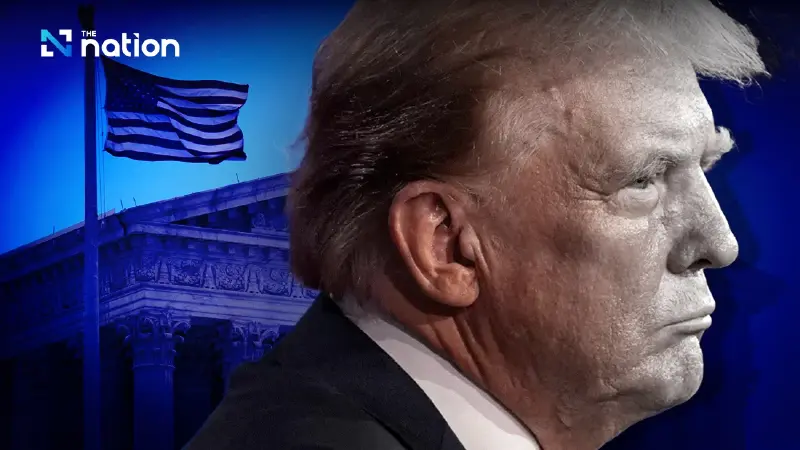


U.S. Supreme Court hears a crucial case on Trump’s tariffs, which could redefine presidential power over trade and bypass Congress
The “Trump Tariff Wave” has shaken global capital markets since the beginning of the year. Now, the tariff case filed by several businesses has entered the investigation phase in the U.S. Supreme Court as of Wednesday, November 5, which could set a new precedent on whether the U.S. president has the power to impose global tariffs “without Congressional approval” or not. Importantly, the Supreme Court’s decision could determine whether Trump’s tax policies can truly be halted if he loses the case.
The origin of Trump’s tariffs started when the president used his power under the International Emergency Economic Powers Act (IEEPA) of 1977, which was originally intended for national security threats. Trump invoked it, claiming the U.S. was facing a “trade emergency” due to a trade deficit exceeding $1.2 trillion and the spread of the fentanyl drug crisis, which he considered a national security threat.
Under this declaration, Trump’s administration began imposing tariffs on imports from several countries worldwide without first seeking Congressional approval, arguing it was an urgent economic crisis requiring immediate action.
However, the lower court ruled that President Trump "exceeded his authority," as the IEEPA does not grant the executive branch the power to levy tariffs, which, according to the U.S. Constitution, Article 1, Section 8, clearly states that the power to levy taxes and tariffs belongs to Congress, not the president.
Generally, tariffs are considered part of the legislative power, and any bills related to “government revenue collection” must always originate in the House of Representatives.
The Trump administration countered that these tariffs were meant to "regulate imports" for national security purposes, rather than for revenue collection, thus falling under “regulation” rather than “taxation.” As a result, Trump’s government has continued to fight the case, and the dispute has now reached the U.S. Supreme Court.
The core of the Trump Tariffs case lies in the interpretation of the term "to regulate importation," which seems straightforward but carries deeper meaning. The lower court emphasized that "regulating" does not equate to "taxing." If interpreted as allowing the president to unilaterally impose tariffs, it would transfer one of Congress’s most important powers directly to the president.
However, the Trump administration argues that the term “regulate importation” is broad and historically has been interpreted to include customs tariffs.
A number of critics disagree, warning that such an interpretation would entirely eliminate the limits on the president’s emergency powers under IEEPA. These critics, including Goldwater Institute, Cato Institute, and the Brennan Center, argue that if the Supreme Court agrees that tariffs can be considered part of "regulating imports," it would give the president permanent authority to set or change global trade policies independently of Congress, effectively dismantling the checks and balances established by the Constitution.
Trump’s government refers to the "emergency" in imposing these tariffs without Congressional approval, pointing out that IEEPA allows the president to act only when facing “abnormal and severe threats.” The central question for the Supreme Court is whether the chronic trade deficit can be considered such a “threat.”
Trump’s government argues that due to the modern global economy and supply chains, trade imbalances have become a true "risk to national security."
On the other hand, critics argue that while the economic issues are severe, they cannot be classified as "abnormal threats," and that interpreting them as such would essentially render the restrictions of IEEPA meaningless.
The final ruling from the Supreme Court may take several months due to the institutional structural issue at hand—balancing the power of the executive (president) versus the legislative (Congress) branches. It is expected that the ruling will take time, as these “big issues” typically require several months for final judgment.
Additionally, sources informed Reuters that while the court has expedited the proceedings and set hearings for November 2025, there is a high likelihood the ruling will not be issued until mid-2026 due to the complexity of the issues and the subsequent procedural steps, including potential returns to lower courts and reviews of refund claims, which could total billions of dollars.
In August 2025, the U.S. Court of Appeals ruled that Trump’s tariffs on imports from several countries worldwide were "illegal," as they were imposed using emergency powers that did not explicitly authorize the levying of tariffs. This ruling mirrored the U.S. Court of International Trade’s decision in May 2025, sparking renewed hope among the countries impacted by the tariffs.
The Court of Appeals ruled 7-4 in favor of the previous U.S. Court of International Trade’s decision, which stated that the IEEPA grants the president broad powers to address national emergencies, but these actions did not specifically include the power to impose tariffs. The Court of Appeals also ruled that the lower court should reconsider its decision and stop the tariffs entirely, rather than limiting them to the plaintiffs in this case.
The tariffs deemed illegal by both the lower and appellate courts include reciprocal tariffs and tariffs imposed on Canada, Mexico, and China in February 2025, but exclude sector-specific tariffs under Section 232.
Even if Trump loses the case, he can still raise tariffs
If the Supreme Court rules against Trump and orders the cessation of tariffs imposed under the IEEPA of 1977, Trump remains determined to maintain his stance. Speaking to the press aboard Air Force One on Sunday, he stated,
“If we don’t have tariffs, we don’t have national security. The whole world will laugh at us because other countries have been using tariffs against us for years, benefiting from us.” He added, “We’ve been taken advantage of by countries like China for years, but not anymore. Tariffs are essential to our national security.”
Meanwhile, U.S. Treasury Secretary Scott Bessent told Reuters that he expects the Supreme Court to rule in favor of the legality of tariffs under the IEEPA. However, if the court rules to “cancel” the tariffs, the government will turn to other laws, such as Section 122 of the Trade Act of 1974, which allows tariffs of up to 15% for 150 days to address trade imbalances.
Bessent further noted that Trump could still use powers under Section 338 of the Tariff Act of 1930, which allows tariffs of up to 50% on any country exhibiting “discriminatory trade practices” against the U.S.
“You can bet these tariffs are here to stay,” Bessent said.
For countries that have already negotiated trade deals to reduce tariffs with the Trump administration, Bessent warned, “You need to honour those agreements. If you got a good deal, stick to it.”
Currently, the Trump administration is already using other laws, beyond IEEPA, for some tariffs, such as Section 232 of the Trade Expansion Act of 1962, which allows tariffs for national security reasons on strategic industries such as automobiles, copper, semiconductors, pharmaceuticals, robotics, and aerospace.
Additionally, tariffs under Section 301 of the Trade Act of 1974 are being used to investigate and retaliate against unfair trade practices by foreign countries.
This means that even if Trump loses the IEEPA tariff case, his tariffs will not disappear entirely.
U.S. Democracy at a Crossroad
Currently, the U.S. Supreme Court’s nine justices have a conservative majority of 6-3, and the court has ruled in favor of Trump in several cases this year, often showing a willingness to accept broad executive powers, especially when national security or international affairs are involved.
For example, in April 2025, the Supreme Court ruled 5-4 allowing the Trump administration to re-deport Venezuelan nationals accused of being members of criminal gangs under the Alien Enemies Act, though it did mandate that detainees receive due process before deportation.
These rulings are not just affirming presidential discretion but also significantly expanding presidential powers in practice.
Regardless of how the Supreme Court rules, this case will become a defining moment in American governance, potentially reshaping the future of the U.S. political system. The decision could determine whether the Constitutional checks and balances remain intact or if the U.S. enters a new era of expanded presidential power.
