
GISTDA reports G4-level geomagnetic storm — strongest in years, but Thailand remains safe
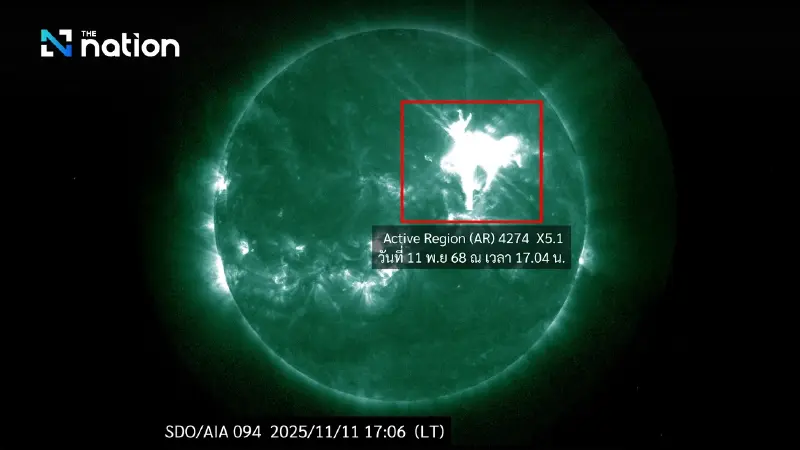


GISTDA confirms a G4 geomagnetic storm from an X5.1 solar flare; Thailand is safe but communication and power sectors worldwide remain on alert

The Geo-Informatics and Space Technology Development Agency (GISTDA) reported that on 11 November 2025, a powerful X5.1-class solar flare — one of the strongest categories — erupted from the Sun, releasing a massive coronal mass ejection (CME) directed toward Earth.
Using its JASPER space weather forecasting system, GISTDA confirmed that the CME reached Earth between 11–12 November, triggering a G4-level severe geomagnetic storm, stronger than earlier forecasts.
Global impacts
The storm may cause auroras visible as far south as 45° magnetic latitude, and could disrupt satellite communication, directional control, and orbital adjustments. High-frequency (HF) radio signals may experience temporary interference, and induced electric currents may affect pipelines carrying oil and gas.
Thailand unaffected but advised to monitor
According to GISTDA’s JASPER analysis, Thailand remains safe from direct impact because of its low-latitude position and magnetic shielding. However, sectors involving satellite communication, aviation, and energy systems have been advised to maintain close monitoring.
GISTDA stated it will continue to track the geomagnetic storm closely and provide timely updates should conditions change.
Understanding geomagnetic storm levels (NOAA G-scale)
Geomagnetic storms are classified into five categories, G1 to G5, based on their intensity:
G1 (Minor): Small effects on power grids and satellite orientation; auroras visible in mid-latitudes.
G2 (Moderate): Occasional voltage corrections in power systems; possible HF radio disruptions.
G3 (Strong): Manageable voltage issues, possible satellite charging, and GNSS accuracy reduction.
G4 (Severe): Risk of widespread electrical damage and significant satellite communication problems.
G5 (Extreme): Could cause serious global power and technology failures — such as the 1859 Carrington Event.
