
Japan’s daily earthquakes: life on the ‘Ring of Fire’ and the race to prepare for the next big one
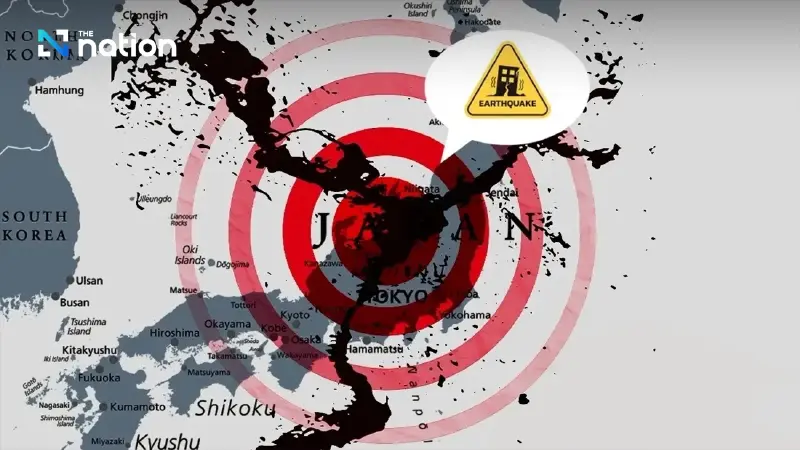


Japan, hit by about 1,500 quakes a year on the Pacific ‘Ring of Fire’, warns the chance of a magnitude-8 tremor has risen, even as it leads the world in preparedness
Japan is once again on heightened alert for major earthquakes, after a series of strong tremors forced authorities to warn that the probability of a magnitude 8.0 quake has increased.
The concern underscores a familiar reality: as a country sitting on the Pacific “Ring of Fire”, Japan endures frequent seismic activity and faces a constant risk of devastating quakes – yet it has also become a global leader in preparedness and early-warning systems.
New 6.7 quake off Aomori renews fears
On December 12, 2025, a magnitude 6.7 earthquake struck off the eastern coast of Aomori prefecture in northern Honshu, Japan’s main island. The epicentre was located at a depth of 20 kilometres beneath the seabed.
The Japan Meteorological Agency (JMA) issued a tsunami advisory, warning that waves of up to 1 metre could hit parts of the Pacific coast.
The tremor was the second strong quake in less than a week – on December 8, a magnitude 7.6 earthquake had already rattled the region.
Based on historical global seismic data, the Japanese government now says the probability of a magnitude 8.0 event in the coming week has risen by about 1%. The advisory covers a wide swathe from northern Japan down to areas near Tokyo.
That may sound like a small number, but scientists point out that a magnitude-8 quake releases around 32 times more energy than a magnitude-7, prompting authorities to treat even a 1% probability with extreme seriousness, even though no one can say exactly when – or if – such a quake will strike.
Professor Takuya Nishimura of Kyoto University’s Disaster Prevention Research Institute noted that a 1% chance is roughly ten times higher than the normal background probability of a magnitude-8 quake in this region.
For now, the warning does not require people to evacuate or halt daily life, but it is intended to prompt readiness and remind residents to stay prepared.
Life on the Ring of Fire
Japan’s geology makes large earthquakes virtually unavoidable. The archipelago lies on the seismically active Ring of Fire – where tectonic plates grind and subduct beneath one another – making it one of the most quake-prone countries in the world.
According to the University of Tokyo, Japan experiences around 1,500 earthquakes a year, an average of three per day.
The country has suffered repeated major shocks, including:
- The March 2011 Great East Japan Earthquake, the strongest in the nation’s history, which triggered a devastating tsunami and nuclear disaster.
- A magnitude-8 quake in 2003, about 80 km off the south-eastern coast of Hokkaido, which left tens of thousands of homes without power.
Japan’s Earthquake Research Promotion Centre estimates that the northern Sanriku coast has a 4–20% chance of experiencing a magnitude 8.0 or greater quake within the next 30 years. The last such event in the area was the Tokachi earthquake of 1968, measuring magnitude 8.3.
Given this history, seismologist Yoshihiro Hiramatsu, a professor at Kanazawa University, told Kyodo news agency that Monday’s strong quake may have altered stress balances in the crust, potentially becoming one of several factors that could lead to a larger event.
Powerful earthquakes can also come in succession. On March 11, 2011, the magnitude-9.1 mega-quake that devastated north-eastern Japan and killed more than 19,000 people was preceded just two days earlier by a magnitude-7.3 tremor.
“The fear of a major earthquake in Japan is very real,” said Professor Megan S. Miller of the Australian National University’s Research School of Earth Sciences.
A world leader in early warning and building safety
Because of this ever-present risk, Japan has become a global model in earthquake preparedness. According to experts and local media, the nationwide Earthquake Early Warning system for large quakes went fully operational in 2022.
While scientists still cannot predict the exact time, location or magnitude of a future quake, Professor Miller notes that Japan now has one of the most advanced early-warning systems in the world.
The government has installed hundreds of seismometers on land and seabed. When an earthquake occurs, instruments detect the initial waves within seconds. If sensors record shaking above a certain intensity – level 3 on the JMA seismic scale – the meteorological agency can issue an intensity report within about 90 seconds, giving people and infrastructure a brief but vital head start to brace, slow trains or halt sensitive operations.
Japan also continuously updates its building codes, tightening rules to make structures more quake-resistant and to increase accountability for builders.
Even so, Japanese authorities openly acknowledge that forecasts of very large earthquakes remain highly uncertain. An alert about a possible major quake does not automatically mean mass evacuation – but it is a reminder for a nation that lives daily with tremors that the next truly destructive event is not a question of “if”, but “when”.
