
Supachai Panitchpakdi warns of global fracture, US pushing allies to China
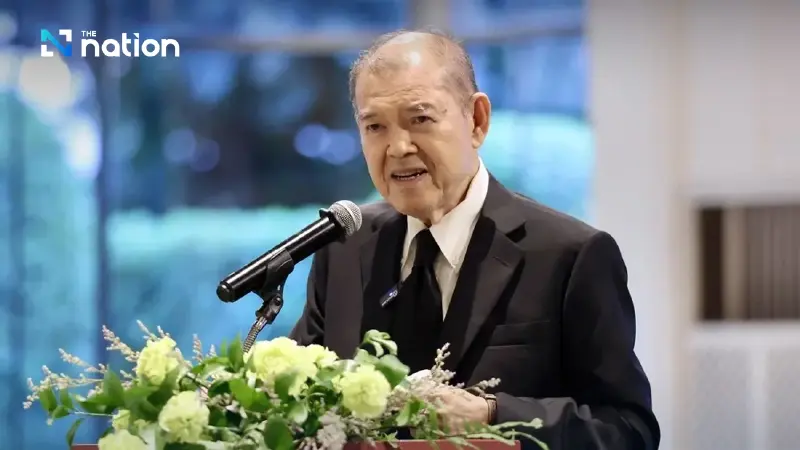


Supachai Panitchpakdi warns the world is drifting from a rules-based order, with US policies driving allies toward China. A shift in global power dynamics is underway.
Dr Supachai Panitchpakdi, former WTO Director-General, warned that the world is moving away from a rules-based system, with US policies driving allies towards China.
During the panel discussion titled "The Game Changer: Outlook 2026 & Beyond" on February 4, 2026, Dr Supachai Panitchpakdi, former Director-General of the World Trade Organization (WTO) and former Secretary-General of the United Nations Conference on Trade and Development (UNCTAD), issued a strong warning about the growing fracture in the global order. Dr Supachai described the current period not as a mere transitional phase, but rather a "rupture" of the world order that had previously been based on a set of internationally agreed rules.
He pointed out that, historically, the concept of a free market and liberal trade could only endure under a system governed by clear regulations. However, the world today has shifted into a multi-polar system without the accompanying multilateralism. This absence of shared governance creates a dangerous situation for medium and smaller nations that lack the bargaining power to counterbalance the major powers.
Dr Supachai explained that the most evident sign of this shift is the crisis of confidence in international organisations like the United Nations (UN) and even the WTO. Both organisations are facing existential crises. He referenced the confusion surrounding US President Trump’s proposal for a "Board of Peace," which raised questions about whether this new initiative was meant to replace the UN’s role in maintaining global peace and security.
Dr Supachai also focused on the growing trend of many nations, including important US allies, turning to China. He highlighted the shift in global diplomacy, where leaders from countries such as South Korea, Ireland, and even UK Prime Minister visited Beijing in January 2026, marking a diplomatic pivot towards China.
Dr Supachai observed that, while the US continues to push its allies away with aggressive policies, many nations are increasingly looking towards China, creating a scenario where "Make America Great Again" might inadvertently propel a "Make China Great" agenda.
However, Dr Supachai stressed that the current world order should not simply be abandoned but rather reformed. He suggested that, if a global agreement is unattainable, medium-sized nations might need to come together in a new form of cooperation called "plurilateralism" — a sub-group multilateralism that would allow nations to continue working under shared trade regulations without waiting for the big powers to come to an agreement.
He also noted that in the face of global fragmentation, countries like Thailand must stop pursuing erratic or directionless policies. Instead, Thailand should focus on forging alliances with other middle-sized countries that share similar ideals, such as the European Union (EU), Japan, and India, to create collective bargaining power.
Looking towards Asia, Dr Supachai highlighted the importance of Asian countries uniting to form new circles of cooperation. He cited the potential for the EU to strengthen ties with the Comprehensive and Progressive Agreement for Trans-Pacific Partnership (CPTPP), a trade bloc in the Asia-Pacific region, in order to uphold the global trading system without depending on any one superpower.
Dr Supachai further discussed the growing trend of using economic tools as weapons, a shift from the traditional separation between politics and economics. He noted that today, economic measures like tariffs, sanctions, and the manipulation of energy resources like oil and gas are increasingly used as instruments of political and security negotiations.
A particularly concerning example, according to Dr Supachai, is China’s management and control over rare earth elements, essential materials for missile production and high-tech industries. By wielding control over these crucial resources, China is gaining significant leverage over the United States and other countries, which could derail efforts to achieve the United Nations' Sustainable Development Goals (SDGs).
Turning to the geopolitical landscape, Dr Supachai pointed out the growing tensions in the Arctic. As ice melts and new shipping routes open, the region’s vast natural resources are becoming a contested battlefield. This competition, particularly between Russia, China, and the US, is creating a new front in the power struggle. China has already deployed three new icebreakers to the area, while the US and its allies have dramatically increased military spending, underscoring the growing urgency and competition for resources in the region.
Dr Supachai concluded by warning that, in a world facing these fractures, Thailand cannot afford to continue with policies that are directionless or inflexible. He stressed the importance of maintaining strong financial and fiscal discipline, particularly in avoiding the potential risk of a "bubble burst" in the global bond markets and technology sectors, as well as the growing public and private debt in the US and Japan.
He emphasised that financial discipline is not merely an option, but the only way to navigate through the upcoming financial storms. Without control over public and private debt, Thailand could face serious repercussions in the event of a financial crisis.
Dr Supachai also addressed the significant shift brought about by AI technology, which, despite being touted as a game changer, presents substantial risks. While AI has the potential to revolutionise business, he pointed out, citing MIT report, that over 80% of businesses adopting AI have yet to see significant profits, which highlights that investments in this technology do not guarantee immediate business success.
He suggested that the true role of AI should not be confined to commercial applications like content generation or writing reports. Rather, AI should be harnessed to solve complex global issues, such as public health crises, food security, and climate change.
Finally, Dr Supachai concluded by calling for urgent action on climate change. He stressed that this issue must no longer be treated as a secondary concern or a matter of corporate image. Climate change must be addressed as an immediate priority, as humanity and the global economy cannot survive amid escalating environmental degradation.
Dr Supachai’s message was clear: Thailand and its businesses must strive to remain aligned with global rules and systems, even as major powers seek to tear them apart. He stressed that survival in the new world order will depend not on the strongest, but on those who are most resilient and able to adapt to the shifting global landscape.
