
Tuvalu signs Climate Visa deal with Australia for relocation
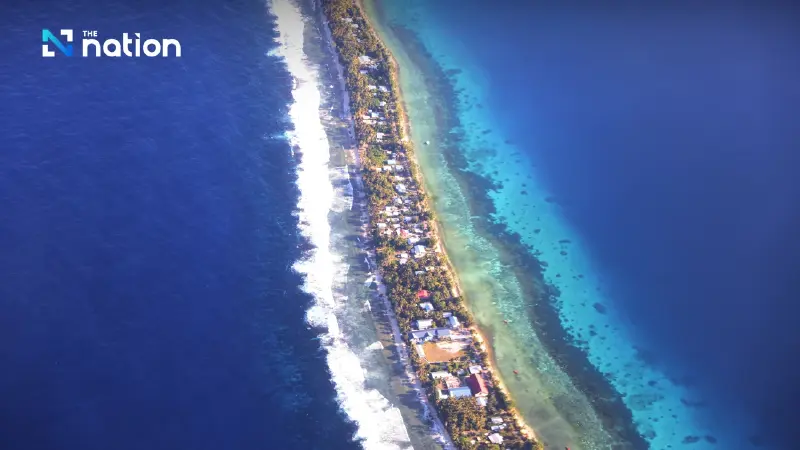


Tuvalu signs 'Falepili Union' with Australia, launching Climate Visa program to allow citizens to relocate with full rights to healthcare, education, and work
Tuvalu, a small island nation in the Pacific Ocean, is facing one of the world’s most severe climate change threats. Scientists have stated that the sea level in the region has risen twice as fast as the global average over the past four decades.
Tuvalu consists of coral islands and nine atolls, with the highest point of the country only 4.5 meters above sea level, and the average height of the land being just 2 meters. This geographical limitation means that the people of Tuvalu are forced to migrate as the sea level continues to rise.
Human-induced climate change has caused polar ice caps to melt and oceans to expand due to heat, raising sea levels. NASA data shows that in the past 30 years, the sea level around Tuvalu has increased by 15 cm, which is 1.5 times higher than the global average. Currently, two of Tuvalu's coral islands have already submerged almost completely due to rising sea levels and severe weather events like cyclones.
The Tuvalu government and scientists estimate that by 2050, half of the country’s capital, Funafuti, will experience regular flooding from tidal forces. If sea levels rise by 1 meter, most of the country will become uninhabitable.
It is predicted that by 2100, more than 90-95% of the country will be permanently submerged. This situation means that Tuvalu is likely to become the first country in the world to relocate its entire population.
Finding a way to survive flooding
To cope with the loss of its physical land, former Foreign Minister Simon Kofe announced plans to create the world’s first ‘Digital Nation’. The plan includes moving government services online and simulating the islands and the country’s culture in a virtual or metaverse world to preserve national identity and sovereignty, even if the physical land disappears.
“If our land is gone, we have no choice but to become the first digital nation in the world,” Kofe said at the COP27 conference.
Kofe also emphasised the importance of raising global awareness, stating, “Without global awareness and shared commitment to our well-being, soon other countries may have to follow us into the digital world when their lands are gone as well.”
Kofe confirmed that all the data he presented is supported by scientific evidence, and that creating a digital nation will represent Tuvalu’s sovereignty in case its constitution defines the status of the country as permanent, even if the land disappears.
In 2023, Tuvalu proactively amended its constitution to state that the country would remain in existence indefinitely, regardless of the impacts of climate change that cause the loss of land. The key challenge is that according to traditional law, a country must have clear components of population, territory, and government.
The purpose of this move is to maintain rights over maritime jurisdiction and natural resources, such as revenue from fishing licenses, which are a primary source of income for the country.
Climate Visa helps relocation
In August 2024, Tuvalu signed the “Falepili Union” treaty with Australia, under which Australia agreed to recognise Tuvalu’s continued sovereignty, even if the country sinks. Tuvalu’s Prime Minister, Feleti Teo, explained that the treaty is a legal commitment to protect the status of a country impacted by climate change. Australia also pledged to assist Tuvalu in security and natural disaster responses.
Under the treaty, the “Climate Visa” program was established, allowing Tuvaluans to migrate with dignity. This program permits 280 Tuvaluan citizens per year to receive permanent residency in Australia, with access to healthcare, education, and employment rights equal to Australian citizens.
In the most recent round of applications, 8,750 Tuvaluans registered, or more than one-third of the country’s total population of 11,000.
The first group of Tuvaluan immigrants arrived in Australia by the end of 2024, including Dr. Masina Matolu, a dentist who relocated to Darwin with her family. She said, “I’m very excited to go to Australia to help people, to serve, and to alleviate suffering.” She viewed it as a great opportunity to bring back knowledge and experience to help her home country in the future.
Kithai Haulopi, Tuvalu’s first female forklift driver, is also planning to move to Melbourne, with the attractive wages being the main incentive. She said, “The wages there are very good, which will help me support my family and send money back to help our country.”
Despite rising sea levels, Tuvalu’s total land area has increased by 2.9% over the past 40 years, according to studies by Professor Paul Kench, a coastal geomorphologist. This increase is attributed to natural processes where waves deposit coral sediments, contributing to land accumulation.
Professor Kench proposed that detailed studies on the island’s changes should be conducted to focus on adaptation strategies, rather than simply assuming that the islands will submerge.
Currently, the Tuvalu government continues to push forward with a sea reclamation project to expand the land area along the coastline, funded by the United Nations, offering hope for future habitation. Despite the challenges, the unity and resilience of the Tuvaluan people remain strong, symbolised by the national motto, "Tuvalu mo te Atua," meaning "Tuvalu is with God."
However, Tito Isala, who was involved in Tuvalu’s independence negotiations, disagreed with the idea of a digital nation, calling it "a surrender and an act of despair." He emphasised that many Tuvaluans do not wish to leave their homeland and believe that Tuvalu still has the potential to adapt naturally.
