
Ray Dalio says the post-1945 world order has “broken down”, warning of a new era of power politics
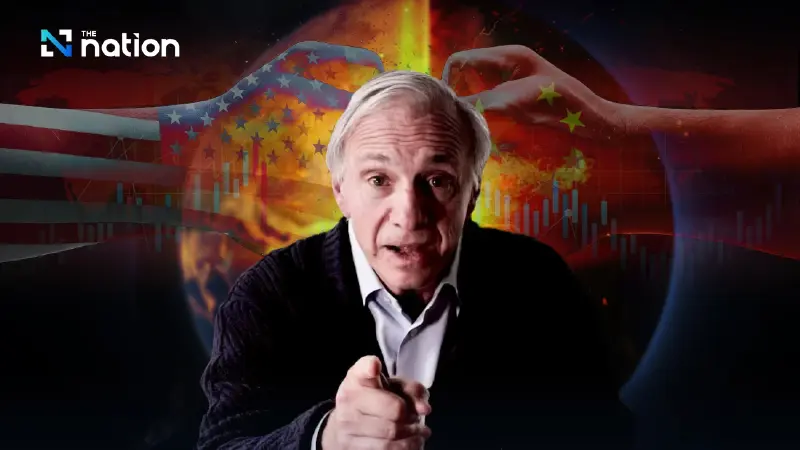


Investor Ray Dalio argues the post-1945 international order has collapsed, pointing to shifting alliances, rising great-power rivalry and a drift from rules to raw power, as discussed at the Munich Security Conference.
Ray Dalio, the founder of hedge fund Bridgewater Associates, has warned that the post-1945 international system has “broken down”, arguing that the world is moving into a more volatile era in which power matters more than rules, and where competition between major powers increasingly defines global politics.
In an essay published on February 14, 2026, Dalio said the mood at the Munich Security Conference underscored how widely leaders now see the old order as finished. He pointed to remarks attributed to German Chancellor Friedrich Merz that “the world order as it has stood for decades no longer exists”, alongside broader calls in Europe for deeper security preparation and a reassessment of assumptions that had anchored the post-war period.
Dalio also cited comments from US Secretary of State Marco Rubio describing a “new geopolitics era”, and argued that these signals reflect a structural shift rather than a temporary disturbance.
Dalio’s “Big Cycle” framing
Dalio placed today’s turbulence inside what he calls the “Big Cycle” of order and disorder—an idea he has explored in his writing about how countries rise, peak and decline. He said the world is entering a late-stage phase marked by “great disorder”, weakening shared rules and a growing belief that “might is right”.
His central claim is that international governance is inherently fragile because it lacks the enforcement mechanisms that exist within states. Domestically, rules are backed by lawmaking, policing and courts. Internationally, Dalio argues, institutions such as the League of Nations and the United Nations have struggled to keep major powers aligned because they do not possess superior power relative to the strongest countries.
The practical implication, in Dalio’s view, is that when disputes escalate among powerful countries, they are typically resolved through bargaining under pressure—or through confrontation—rather than neutral adjudication.
Five kinds of conflict to watch
Dalio describes what he sees as five broad categories of rivalry between states:
- Trade and economic conflict (tariffs, restrictions, tools to damage rivals economically)
- Technology conflict (limits on technology transfer and the securitisation of innovation)
- Capital conflict (sanctions, constraints on financial access, and coercive financial measures)
- Geopolitical conflict (territory and alliances settled through commitments and bargaining)
- Military conflict (direct armed confrontation)
He argues that these often overlap, and that tensions can intensify through the non-military channels before spilling into military risk if mismanaged.
A warning on escalation, and a note on strategy
Dalio’s message is not simply that conflict is rising, but that the incentives and structures shaping state behaviour are changing. He argues that countries should take power realities seriously, avoid sleepwalking into unwinnable fights, and choose negotiation or confrontation based on clear-eyed assessments of relative strength and long-term trends.
He also cautions against performative displays of power that provoke mirror responses and trigger arms-race dynamics, while acknowledging that credible deterrence can sometimes prevent escalation when paired with disciplined diplomacy.
Why Dalio says this moment feels different
Dalio’s essay links today’s geopolitics to a broader historical pattern: internal economic pressures, political polarisation and external rivalry can reinforce one another, making the international environment harder to stabilise. He uses World War II as a case study in how multiple cycles can converge—economic distress, internal conflict and external power competition—creating conditions for a major rupture and the emergence of a new order.
While Dalio’s framework is his own, the political rhetoric at Munich reflected a similar sense of transition. European leaders spoke openly about a harsher strategic environment and the need to rebuild trust and resilience as assumptions of the post-war era weaken.
Dalio’s argument has practical consequences: if rivalry increasingly plays out through tariffs, sanctions, technology controls and financial restrictions, businesses may face higher uncertainty around supply chains, market access, and cross-border capital flows. The more the world fragments into blocs, the less reliable “business as usual” becomes.
Dalio’s conclusion is that the end of the post-1945 order does not automatically mean catastrophe—but it does mean that governments, firms and investors should adapt to a landscape where stability is less assured, alliances are more transactional, and economic policy is more tightly entwined with national security.
