
Oil jumps above $100 as US-Iran war fears raise Strait of Hormuz supply risks
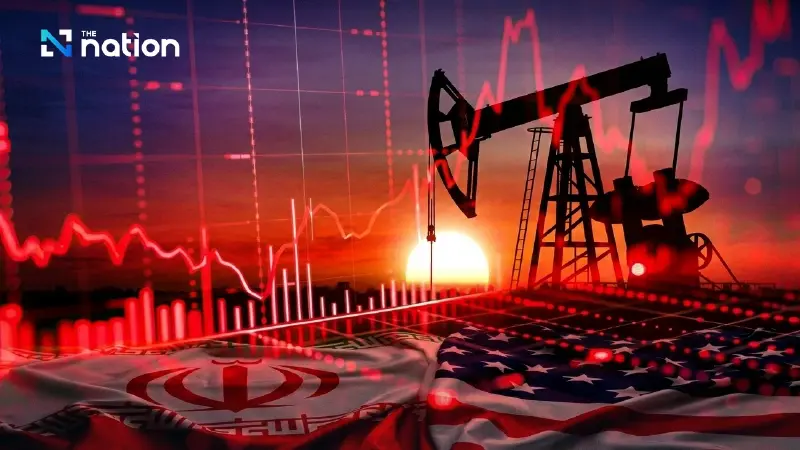


Oil prices hit their highest levels in nearly three years, breaking above $100 a barrel as the US-Israel conflict with Iran intensified, raising fears of tighter supply and disruptions to shipments through the Strait of Hormuz.
Global oil prices surged sharply in early-week trading after tensions from the war involving the United States, Israel and Iran escalated, stoking market fears of tighter oil supplies and risks to shipments through the Strait of Hormuz, a critical global oil transit route.
In Monday morning trading, Brent crude jumped by as much as $18.35, or about 19.8%, to $111.04 a barrel—its highest level since July 2022—before easing back to $107.07 a barrel, up $14.38 or 15.5%, at 11:14pm GMT (6:14am Thailand time).
US West Texas Intermediate (WTI) rose $15.27, or 16.8%, to $106.17 a barrel, after earlier climbing by as much as $20.34, or 22.4%, to $111.24 a barrel.
Before the latest spike, oil prices had already surged strongly over the past week, with Brent up 27% and WTI up 35.6%, reflecting growing market anxiety over intensifying conflict in the Middle East.
Tensions deepened further after Iran announced the appointment of Mojtaba Khamenei as the country’s supreme leader, replacing his father Ali Khamenei—a move seen as signalling that hardliners remain in control in Tehran as the war with the United States and Israel entered its second week.
Meanwhile, the Israeli military said it struck an Iranian military commander in Beirut, the Lebanese capital, on Sunday morning—an expansion of operations into a major regional centre—after several days of attacks that have left nearly 400 people dead.
Israel’s military also said it would eliminate anyone who assumes the role of Iran’s supreme leader, while US President Donald Trump said the war could end only when Iran’s military forces and leadership are eliminated entirely.
Analysts said that even if the conflict ends quickly, consumers and businesses worldwide may still face elevated energy prices for weeks or months, due to damage to energy infrastructure, disrupted logistics, and heightened risks to maritime transport.
Shipping data also indicated that Saudi Arabia, the world’s largest oil exporter, has increased exports via the Red Sea route. However, volumes have not been sufficient to offset reduced flows of oil that typically pass through the Strait of Hormuz, now under severe strain from the conflict.
