
Sihasak: Online scams are a security threat—losses exceed US$40bn a year in the region
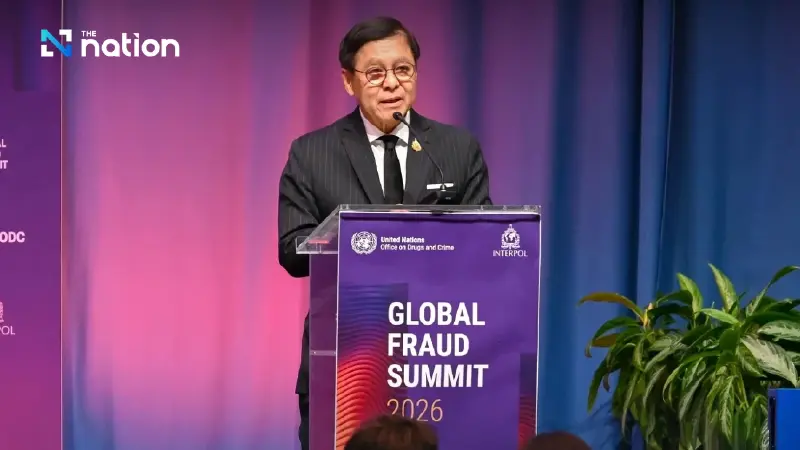


Foreign Minister Sihasak Phuangketkeow told the Global Fraud Summit in Vienna that online scam networks have become a security threat, causing more than US$40bn in losses a year in East and Southeast Asia and requiring stronger cross-border cooperation.
Sihasak Phuangketkeow, Thailand’s Minister of Foreign Affairs, arrived in Vienna, Austria, to attend the Global Fraud Summit at the Vienna International Centre (VIC) on March 16-17, 2026. The event is co-organised by the United Nations Office on Drugs and Crime (UNODC) and the International Criminal Police Organization (INTERPOL).
In his opening address to the plenary session, delivered under the theme “Scam centres: The rising sophistication and cross-border impact of fraud,” Sihasak said today’s security threats are no longer limited to conflicts between states, but also include transnational cyber-criminal networks.

He said online fraud is expanding rapidly, causing losses in East and Southeast Asia of more than US$40 billion a year (around 1.24 trillion baht), and is linked to human trafficking, forced labour and violence.
Sihasak said scam centres thrive through operations that cross jurisdictions and exploit gaps in international cooperation, with Southeast Asia both facing the challenge and standing on the frontline of solutions. He urged countries to demonstrate political will and strengthen cross-border collaboration.

He said Thailand is directly affected and has helped repatriate more than 13,200 trafficking victims from scam centres to their home countries—spanning more than 40 countries—since February 2025. He added that Thailand has designated the crackdown on cybercrime as a national agenda, established a national committee, strengthened online crime response centres, and expanded cooperation with international partners.
He said a recent joint operation involving Thai police, ASEAN partners, the United States and Meta led to the closure of more than 150,000 suspicious accounts, the arrest of key suspects, and the rescue of hundreds of trafficking victims forced to work in scam operations.
Sihasak stressed that tackling online fraud requires upgraded intelligence-sharing, cross-border investigations, and asset tracing to ensure the digital space does not become a safe haven for transnational criminal networks. He said Thailand stands ready to work with all countries to protect people from such threats.
‘Cooperation must come with responsibility’
Sihasak later spoke at a high-level special session on national commitments to fighting fraud, saying that cooperation must be matched by accountability, and that every country has a role in dismantling these networks.
“Countries that allow such criminal operations to take place must demonstrate the strongest political will and commitment to eradicate these problems, in the spirit of international cooperation,” he said.
He added that Thailand is ready to declare a national commitment to fight fraud in all forms—especially online scams—and to better protect victims, including preventing and suppressing coercion into criminal activity. He said Thailand would align its efforts with international obligations and domestic laws through measures including:
- Strengthening and enforcing anti-money laundering measures, including financial tracking, investigations, seizure, freezing and recovery of illicit assets.
- Improving data integration and the use of digital technology, including AI and advanced analytics, to boost fraud detection and trace financial transactions more effectively.
- Strengthening cross-border, cross-sector and cross-disciplinary cooperation by facilitating the exchange of information, intelligence and evidence.
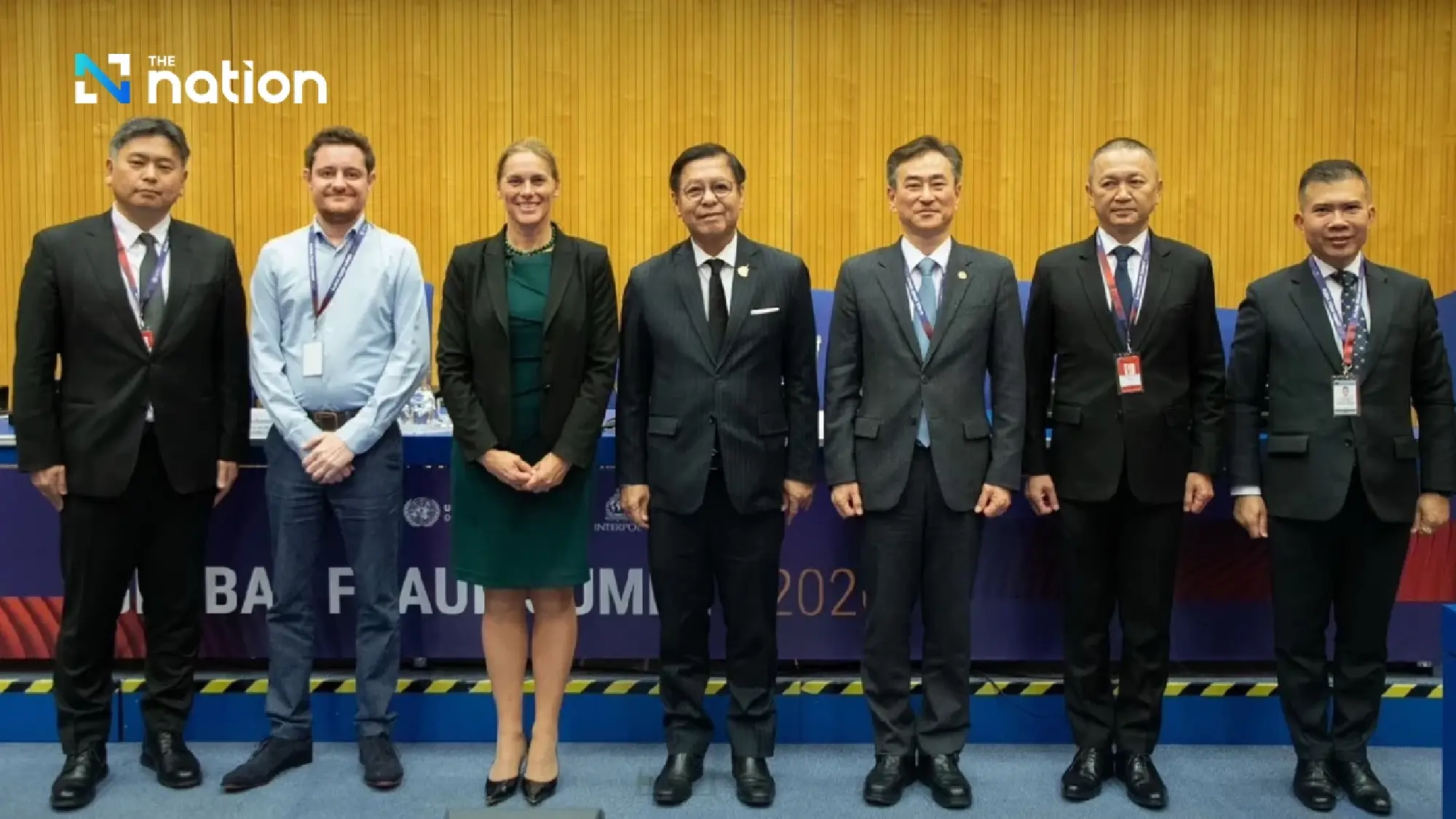

Spotlight on Southeast Asia’s scam-centre threat
Sihasak also opened a UNODC side event on “Intelligent threats with a global reach: The evolution of scam centres and cybercrime originating in Southeast Asia and targeting the world,” saying the region—home to many scam operations—has become both a frontline and a major victim of these crimes.
He said online scam crime is evolving rapidly, posing threats not only to economies and security, but also to human rights across multiple dimensions—making effective international cooperation essential.
He noted Thailand has made internet scam suppression a national agenda and, recognising the need for international collaboration, co-hosted an international meeting with UNODC in Bangkok on December 17-18, 2025 to raise global awareness and strengthen joint action.
Sihasak also endorsed two outcome documents from the summit: the “Call to Action on Combating Fraud” and the “Global Public-Private Partnership Framework against Fraud.”
After the meeting Sihasak said Thailand had underscored that fraud has become increasingly severe and is now a security threat, driven by online scams that every country faces—particularly in Southeast Asia, where losses are estimated at more than US$40 billion a year (around 1.24 trillion baht). He said it is also linked to human trafficking and forced labour, amounting to a form of modern-day slavery.
He acknowledged that Southeast Asia is on the frontline of this problem, and that Thailand has been used as a transit point for networks operating in neighbouring countries—though he stressed he was not referring to any specific country. He added that Thailand has also served as a place of temporary refuge after helping to repatriate more than 13,200 trafficking victims from scam centres to their home countries, covering 40 countries.
“The most difficult part is that this problem exists in the digital world, which spreads rapidly. Cyberspace has no system of good governance and lacks sufficiently robust and enforceable rules and laws. This is therefore a challenge for many countries, and no single country can solve it alone,” Sihasak said.
He added that another challenge is law enforcement across multiple countries where loopholes exist. He said there is no need to create new mechanisms, because frameworks already exist under UNODC, Interpol and ASEAN. The key question, he said, is how to ensure these frameworks work with unity and coherence. He also stressed that cooperation between governments and the private sector must go hand in hand.
Asked how Thailand had highlighted its leadership role at the forum, Sihasak said that if nothing is done, the issue will become a growing security challenge for many countries. He added that the problem is multi-dimensional—not only involving fraud and money laundering, but also human rights violations—meaning multiple agencies must be involved, and those responsible must keep pace with technology.
On cross-border gaps, he said these cases are transnational crimes and legal systems differ from country to country. Although many agencies and international organisations are trying to address the issue, efforts will not be effective if everyone works separately. The key, he said, is building unity and coordination among agencies, which is what Thailand came to emphasise at the meeting.
