
No Kings protests spread nationwide in third anti-Trump wave
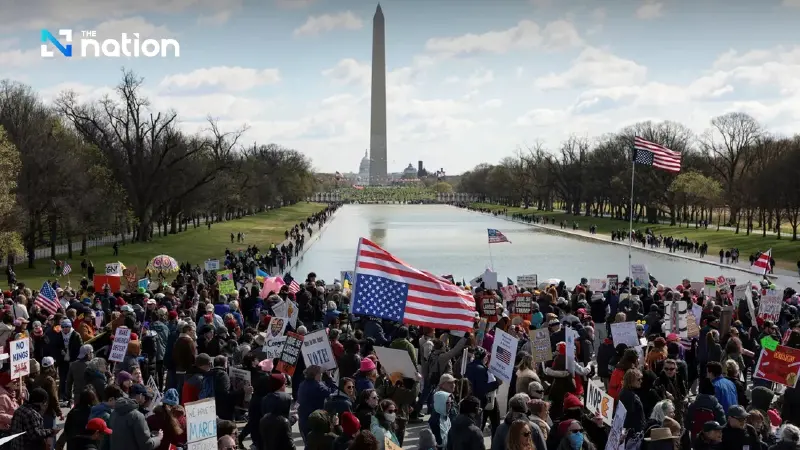


More than 3,200 events were planned across all 50 states as demonstrators denounced Donald Trump’s deportation crackdown, the Iran war and other policies.
- The "No Kings" anti-Trump movement held its third nationwide wave of protests, with over 3,200 events scheduled across all 50 states.
- The movement has expanded significantly beyond major cities, with nearly two-thirds of the rallies occurring in smaller communities and Republican-leaning states.
- Organizers cited widening opposition to Trump's policies, including his aggressive deportation campaign and the war in Iran, as key motivations for the protests.
- Major rallies in cities like New York, Washington, and Saint Paul drew large crowds and featured prominent figures such as Bernie Sanders and Robert De Niro.
Ahead of this year’s US midterm elections, the anti-Trump “No Kings” movement staged its third nationwide day of protests on Saturday, with organisers scheduling more than 3,200 events across all 50 states.
Organisers said the latest mobilisation reflected widening opposition to US President Donald Trump over his aggressive deportation campaign, the war in Iran and other policies.
They also said the movement was expanding well beyond major urban centres: nearly two-thirds of Saturday’s rallies were held outside large cities, representing a rise of almost 40% in smaller communities compared with the first No Kings mobilisation last June.
The two earlier rounds drew millions of people, organisers said.
That growth, they added, has become especially visible in Republican-leaning states such as Idaho, Wyoming, Montana and Utah, as well as in politically competitive suburban areas that often shape national election outcomes. Leah Greenberg, co-founder of Indivisible, the group that launched No Kings last year and helped organise Saturday’s events, pointed to strong increases in interest in places such as Bucks and Delaware counties in Pennsylvania, East Cobb and Forsyth in Georgia, and Scottsdale and Chandler in Arizona.
Saturday’s protests also unfolded as organisers urged action against the US and Israeli bombardment of Iran, now in its fourth week. In Washington, Morgan Taylor, 45, attended with her 12-year-old son and said she was furious over what she described as a needless war, arguing that the United States was not under attack and should not be involved.

On the National Mall in Washington, demonstrators chanted pro-democracy slogans and displayed anti-Trump signs.
In Chevy Chase, Maryland, elderly residents in wheelchairs gathered outside an assisted-living tower holding placards telling motorists to resist tyranny, back democracy and reject Trump.
In New York, police estimated that the turnout reached into the tens of thousands, with the crowd stretching for more than 10 blocks in midtown Manhattan.
Actor Robert De Niro, one of the organisers there, said Trump posed a level of danger to American freedoms and security unlike any previous president.
Among those marching in New York was Holly Bemiss, 54, who said she saw the rally as a continuation of the same fight her ancestors took up in the American Revolution: opposition to kings and support for freedom.
Minnesota, which has become a focal point in Trump’s immigration crackdown, hosted one of the day’s largest demonstrations.
A huge crowd gathered outside the state capitol in Saint Paul, many raising posters bearing the images of Renee Good and Alex Pretti, who were shot dead this year in Minneapolis by federal immigration officers.
Addressing the Minnesota rally, Governor Tim Walz, the Democratic vice presidential nominee in 2024, said those standing against Trump and his agenda represented the best of the United States.
Referring to criticism that protesters were radicals, Walz said they had been driven in that direction by compassion, decency, due process, democracy and the need to oppose authoritarianism.

Another speaker in Minnesota was Bernie Sanders, the Vermont senator and outspoken Trump critic who sought the Democratic presidential nomination in 2016 and 2020.
Sanders warned against allowing the country to slip into authoritarianism or oligarchy, insisting that power must remain in the hands of the people.
Musician Bruce Springsteen also joined the Minnesota event, performing “Streets of Minneapolis”, a song attacking Trump’s immigration crackdown and mourning the deaths of Good and Pretti.
Other major rallies took place in Los Angeles, Philadelphia and Dallas. In Dallas, thousands attended a protest that later saw confrontations between No Kings supporters and counterprotest groups, including one led by Enrique Tarrio, the former head of the far-right Proud Boys.
Minor clashes broke out after counterprotesters blocked roads, and Dallas police later made several arrests.
Chris Brendel, a protester in Dallas, said Trump had at least succeeded in one respect: mobilising his opponents.
He said he could no longer stay silent because of concern for his sons, their friends and the future they would inherit.
The protests came as Trump’s approval rating fell to 36%, the lowest level recorded since his return to the White House, according to a Reuters/Ipsos poll.
Republicans responded by condemning the demonstrations.
Mike Marinella, a spokesperson for the National Republican Congressional Committee, said Democratic politicians and candidates were backing what he called “Hate America Rallies”, arguing that such events amplified the far left and served as a source of direction for House Democrats.
The No Kings movement was first launched on Trump’s birthday, June 14, last year.
That initial mobilisation drew an estimated 4 million to 6 million people across roughly 2,100 locations nationwide.
A second wave in October attracted an estimated 7 million participants in more than 2,700 cities, according to a crowdsourced analysis published by data journalist G. Elliott Morris.
According to organisers, the October mobilisation was largely driven by anger over a government shutdown, an intensified crackdown by federal immigration authorities and the deployment of National Guard troops to major cities.

Reuters
