
Pakistan offers mediation as Tehran warns over US ground troops
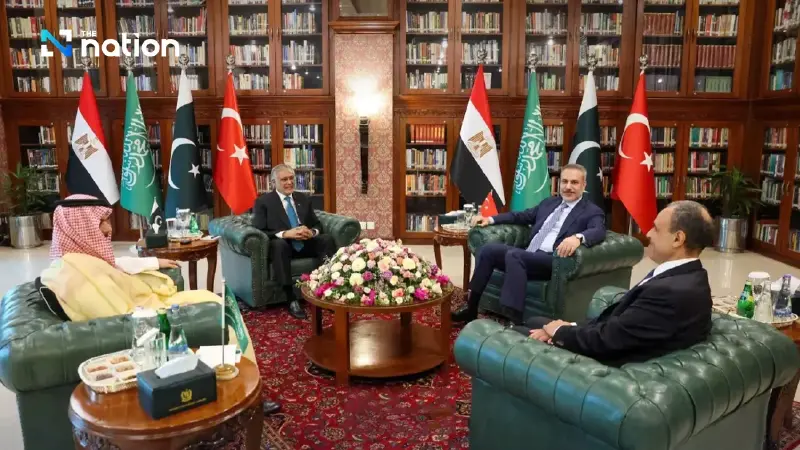


Islamabad says it is ready to facilitate US-Iran talks, while Tehran warns against any deployment of American ground troops, and the conflict enters a second month.
- Pakistan has offered to host and facilitate peace talks between the US and Iran in Islamabad to end the escalating conflict.
- Tehran has warned it will retaliate if the United States deploys ground troops, with Iran's parliament speaker stating the country is ready to respond.
- The warning comes as the US sends thousands of Marines to the Middle East, and the Pentagon is reportedly preparing for potential ground operations in Iran.
- It is not yet clear whether the United States and Iran have agreed to participate in the talks proposed by Pakistan.
The war centred on Iran showed no sign of easing on Sunday, with Israel reporting a new wave of strikes across Iranian territory, Washington sending Marines into the Middle East, and Pakistan offering to host talks aimed at ending the conflict even as Tehran warned it would retaliate if US troops were deployed on the ground.
Pakistan said it was preparing to facilitate “meaningful talks” in the coming days. After meeting regional foreign ministers, Pakistan’s Foreign Minister Ishaq Dar said the discussions had covered possible ways to bring the war in the region to an early and permanent end, including the prospect of US-Iran talks in Islamabad. He said Pakistan would be honoured to host and facilitate such talks in pursuit of a comprehensive and lasting settlement. It was not immediately clear whether the United States and Iran had agreed to take part.
The US State Department and the White House did not immediately respond to requests for comment on the possibility of talks in Pakistan.
Pakistan’s effort is complicated by the hardline positions set out by the United States, Israel and Iran over what would be required to bring the conflict to an end.
Earlier, Iran’s parliament speaker Mohammad Baqer Qalibaf accused Washington of signalling possible negotiations while at the same time preparing to send in troops. He said Tehran was ready to respond if US soldiers were deployed, and said in a message to the nation that Iran would never accept humiliation so long as the Americans were seeking its surrender.

Sources familiar with the discussions said initial contacts between Pakistan, Saudi Arabia, Turkey and Egypt had focused on proposals to reopen the Strait of Hormuz to shipping. Since the United States and Israel began attacking Iran on February 28, Iran’s effective blockade of oil and gas shipments through the strait has been spreading economic pain around the world.
As the conflict entered its second month, the fighting continued to intensify. Israel’s military said it had carried out more than 140 air strikes over the 24 hours to Sunday evening on central and western Iran, including Tehran, targeting ballistic missile launch sites, storage facilities and other locations.
Iranian state media said the strikes hit Mehrabad airport and a petrochemical plant in the northern city of Tabriz.
The director of the World Health Organisation said Israel’s expanding military operations in southern Lebanon had caused the death of yet another health worker after 51 had already been killed. Israel says Iran-backed Hezbollah militants use medical facilities for cover, which the group denies.
In southern Israel, a chemical plant near Beer Sheva was hit by either a missile or missile debris as Israel intercepted multiple salvos from Iran, prompting official warnings for the public to stay away because of hazardous materials. Another missile struck open ground near homes in Beer Sheva, which is close to several military bases, injuring 11 people.

The war has killed thousands and affected countries across the Middle East. Over the weekend, major aluminium plants in Bahrain and the United Arab Emirates were damaged by air strikes. An adviser to the UAE president said the country was seeking reparations from Iran for attacks on civilians and vital facilities, along with guarantees to prevent any repetition.
The conflict widened further on Saturday when Yemen’s Iran-aligned Houthis launched their first attacks on Israel, raising the prospect that they could also target and block a second critical shipping lane, the Bab el-Mandeb Strait. Israeli authorities said on Sunday that they had intercepted two drones launched from Yemen.
The United States has also reinforced its military presence in the region. The US military said Washington had dispatched thousands of Marines to the Middle East, with the first of two contingents arriving on Friday aboard an amphibious assault ship.
The Washington Post, citing US officials, reported that the Pentagon was preparing for weeks of ground operations in Iran, though it remained unclear whether President Donald Trump would approve such plans. Reuters has reported that the Pentagon has also considered military options that could include ground forces.
Trump is facing a stark choice between pursuing a negotiated exit or escalating militarily and risking a prolonged crisis that would likely weigh further on his already low approval ratings.
Washington said last week that it had presented a 15-point ceasefire plan that included reopening the Strait of Hormuz and restricting Iran’s nuclear programme. Tehran rejected that proposal and put forward alternatives of its own.
An Israeli official said Israel would continue striking Iran at what were described as military targets and had no intention of scaling back the campaign ahead of any possible talks between Washington and Tehran.
In Tehran, a building housing Qatar’s Al-Araby TV was hit on Sunday, according to the semi-official Mehr news agency. Camera operator Mohammadreza Shademan said a missile struck the building, the ceiling collapsed on those inside, and there had been no military target there.
The International Atomic Energy Agency said on Sunday that Iran’s heavy water production plant at Khondab, which Tehran said had been attacked on Friday, had suffered severe damage and was no longer operational. The U.N. nuclear watchdog added in a post on X that the facility contained no declared nuclear material.
The increasingly unpopular war has become a burden for Trump’s Republican Party. Demonstrators took to the city streets across the United States on Saturday to protest against the conflict.
US political figures offered differing views on both the likely duration of the war and its objectives. Speaking on Fox News Sunday, Republican Senate candidate Andy Barr said it would be a matter of weeks before all of the objectives were carried out and insisted there would be no occupation of Tehran.
Democratic lawmakers, however, said the strategy was failing, citing US casualties and Iran’s continuing attacks on nearby regions. Senator Cory Booker, a New Jersey Democrat, told NBC’s Meet the Press that the president was pushing the United States further and further into a conflict with no foreseeable way out.

Reuters
