
China's most powerful cargo drone completes maiden flight test
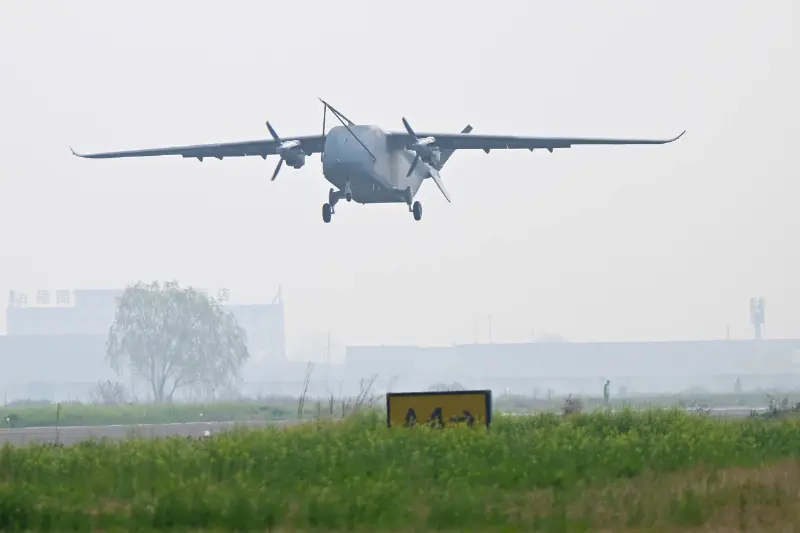


The Changying-8 prototype flew for 30 minutes in Zhengzhou, showing a 3.5-tonne payload, 3,000-km range and the ability to use short, rough runways.
- China's Norinco Luca cargo drone, also known as Changying-8, successfully completed its 30-minute maiden flight test in Zhengzhou.
- Billed as the world's most powerful cargo drone, it can carry a 3.5-tonne payload, has a take-off weight of 7 metric tonnes, and a range exceeding 3,000 kilometers.
- The drone is designed for versatility, able to operate from short or poorly conditioned runways and can be adapted for missions including cargo transport, emergency communications, and border patrol.
- Powered by two domestically built turboprop engines, the flight was handled by the drone's intelligent systems under human supervision, with all systems performing as expected.
China North Industries Group Corp’s Norinco Luca, billed as the world’s most powerful cargo drone, completed its maiden flight on Tuesday in Zhengzhou, the capital of Henan province.
Also known as the Changying-8, the prototype lifted off from Zhengzhou Shangjie Airport at 9.30am and stayed in the air for around 30 minutes before returning to the same airport. Norinco UAS, the aircraft’s developer and a Beijing-based subsidiary of China North Industries Group Corp, said post-flight checks on the drone’s flight control, avionics, electronic and power systems all delivered the expected outcome.
The company said the entire test was handled by the aircraft’s intelligent systems, while human controllers supervised the flight throughout.
The Norinco Luca measures 17 metres in length, has a wingspan of 25 metres and a take-off weight of 7 metric tonnes. It is designed to carry up to 3.5 tonnes, roughly the combined weight of 50 adults. In a single mission, it can transport more than 1,700 cotton coats or 700 disaster-relief tents over long distances. Its maximum range exceeds 3,000 kilometres, comparable to a nonstop flight from Beijing to Urumqi, the capital of the Xinjiang Uyghur Autonomous Region.
The drone can operate on runways of less than 500 metres and is able to use poorly conditioned airports, including those on plateaus and islands. It is fitted with an 18-cubic-metre cargo compartment that can be opened from both the front and rear, while turnaround time can be reduced to as little as 15 minutes, improving logistics efficiency.
For safety, the aircraft uses two domestically built turboprop engines and multiple backup protections in core systems such as flight control, navigation and power supply. It also has smart health monitoring and fault self-diagnosis functions.
Geng Jianzhong, the drone’s chief designer, said its modular design, high power supply, large payload capacity and standardised equipment interfaces allow ground crews to switch mission payloads quickly. That gives the aircraft flexibility for a wide range of uses, including cargo transport, emergency communications, weather modification, border patrol and electronic reconnaissance.
After the first flight, Geng said the company would focus on airworthiness certification, delivery and commercial operations, while continuing to develop safe, efficient and intelligent low-altitude transport solutions. He added that the company plans to build larger, smarter and more advanced drones based on this model, and also aims to develop unmanned helicopters with vertical take-off and landing capability to serve different scenarios and transport needs.
China Daily
