
Hollywood faces a massive tremor as once-thriving industry slumps
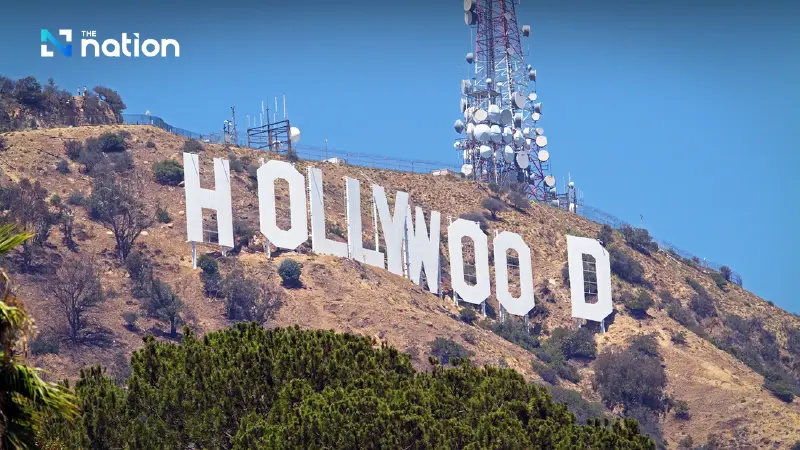


Hollywood is battling a severe crisis as film productions move abroad, streaming platforms cut budgets, and artificial intelligence threatens industry jobs.
- Hollywood is experiencing a major downturn with film and TV employment dropping over 30% as studios relocate productions to other countries for tax incentives and lower costs.
- Streaming services have significantly cut production budgets, shifting their focus from rapid subscriber growth to profitability, which has resulted in less content being created.
- The industry faces new competition from low-cost content on platforms like YouTube and TikTok, while media companies also divert massive budgets to expensive sports broadcasting rights.
- Artificial intelligence is a growing threat, with the potential to eliminate numerous creative and technical jobs and use actors' digital likenesses, a key issue in the 2023 strikes.
Once, Hollywood was the world’s most influential entertainment hub, producing films, series, stars, and pop culture exported to billions of viewers, while sustaining millions of jobs in Los Angeles.
Today, the land of dreams is facing a "major turning point" as studios slash production and shoots move out of the US to escape costs, while younger audiences increasingly turn to YouTube, TikTok, and lower-budget content. This has led many to fear whether Hollywood might be following in the footsteps of Detroit, a US city once made great by the automotive industry, before jobs and manufacturing bases gradually vanished.
The signs of this change are so severe that California congresswoman Sydney Kamlager-Dove recounted that during an acupuncture session, her acupuncturist anxiously asked her, "Can you bring the entertainment jobs back?"
This question may reflect a certain reality because, over the past few years, Hollywood has been losing jobs at a much heavier rate than many anticipated.
US Department of Labour data indicates that employment in the US film and television industry has "dropped by over 30%" from its peak in late 2022, encompassing actors, carpenters, costume designers, and hundreds of behind-the-scenes roles essential to the entertainment sector.
Noah Wyle, actor and producer of the medical series The Pitt, even told Congress that what is happening is "the near collapse of a once-thriving industry."
Shoots flow out of the US, UK, Canada, and Hungary, and become new bases
A major cause is that American film studios are increasingly relocating their shoots abroad, drawn by the UK, Canada, and Australia, which all offer substantial "tax incentives" to productions. Some areas can even rebate nearly half of a studio's production costs.

Even a non-English-speaking country like Hungary has become a new destination for Hollywood because labour and construction costs are much cheaper than in the US. As a result, numerous blockbuster films and major series projects are continuously flowing out of Los Angeles.
Consequently, film studios, trade unions, and film studio owners are trying to lobby the Trump administration and Congress to introduce a 15% national tax credit measure to pull production back to the US.
The concept is that if a 15% federal tax credit could be combined with state-level measures, which are typically between 20-40%, the US might have enough incentive to bring large-scale productions back to the country.
However, the problem is that while bringing productions back to the US would partially help, it cannot entirely solve the crisis. Another major cause is that entertainment companies themselves are "producing less".
Streaming stops burning money, enters belt-tightening era
The early 2020s were a golden age for television and streaming content production, known as "Peak TV". At that time, platforms like Netflix, Amazon Prime Video, Disney+, and HBO Max competed to "burn money" to rapidly accelerate subscriber numbers. The method used by every platform was to pour massive amounts of money into producing a vast number of series and films.
Various platforms needed a constant stream of new content to attract viewers and prevent members from cancelling their subscriptions. The more series they had, the higher the chances of drawing in an audience.
However, this model began to change in 2022 when Netflix's subscriber count fell for the first time in a decade, making investors realise that "having many subscribers does not always equate to making a profit".


Wall Street began losing patience with fast-growing streaming businesses that lacked clear profitability. Investors wanted entertainment companies to shift from "chasing subscribers" to "making actual profit".
When companies had to accelerate profitability, the easiest method was to slash production budgets and selectively invest in films that seemed genuinely profitable, no longer casting a wide net as in the past. Consequently, the impact reached numerous behind-the-scenes workers, from set teams and lighting crews to make-up artists and various technical departments, who form the core workforce of the entertainment sector.
The trade union IATSE, which represents a large number of behind-the-scenes workers in the entertainment industry, stated that last year, its members worked 36% less compared to 2022.
This figure is highly significant because IATSE members must work a minimum number of hours to qualify for health insurance. If work decreases, not only is income lost, but basic benefits like health insurance could also be reduced.
This marks a transition from an "era of burning money to build empires" to an "era of focusing on profit for survival" for giant film studios.
Hollywood is no longer competing with Hollywood
Another deeper problem is that the nature of entertainment is changing. In the past, if audiences wanted to watch on-screen content, the majority naturally came from Hollywood, whether films, series, or television programmes.
Today, however, audiences spend a vast amount of time on YouTube, TikTok, and Instagram. A massive volume of content is produced by small-scale creators, small teams, vertical drama crews, or content production companies that have "much lower costs" than traditional studios.
Many forms of content do not require unionised labour, large sets, hundreds of crew members, or Hollywood-level film funding.
This is a competition that directly alters the industry's structure because audiences no longer measure entertainment by its "production budget", but rather choose based on what is easy to watch, quick to access, and answers their emotional needs at any given moment.
Therefore, Hollywood is not just competing internally among major studios, but must also compete with creators worldwide who, holding just one mobile phone, can produce content that "steals the time" of audiences.
As audience time is hijacked by social platforms, massive budgets for films and series are increasingly called into question.
Sports steal budgets, films and series face a heavier squeeze
Another factor pressuring Hollywood is "sports". In an era where viewers are moving away from traditional television, sports, particularly the NFL (National Football League) and the NBA (National Basketball Association), have become invaluable assets for media companies, as they remain among the few content types that can still draw large, simultaneous live audiences.
For streaming platforms and traditional TV, sports broadcasting rights are thus a crucial tool for retaining audiences and boosting subscriber numbers.
However, the issue is that the prices of sports rights are "continually skyrocketing". When entertainment companies have to pour vast sums into purchasing sports broadcast rights, the remaining funds for producing films and series decrease.
This squeezes entertainment workers twice over: on one hand, jobs are moving out of the country; on the other, companies are producing less content because budgets are being diverted to sports and businesses that offer clearer returns.
AI: A variable that could both 'help' and 'destroy' jobs
Amid this crisis, "artificial intelligence" has emerged as another variable creating both hope and fear. From one perspective, AI might help reduce production costs, making content creation faster and cheaper. If costs fall significantly enough, the industry could return to mass production once again.
Yet, from another angle, AI could lead to the disappearance of numerous jobs, particularly those related to scriptwriting, graphics, special effects, editing, or even the creation of virtual sets and characters.
For many behind-the-scenes workers, the concern is therefore not just that there is no work today, but rather a future where certain types of jobs may never return.
AI might genuinely enable studios to produce more content, but greater production does not mean it will create jobs at the same level if technology replaces a large portion of the workforce.
This poses a major question for modern Hollywood: will technology help the industry recover, or will it accelerate the push of traditional workers out of the system?
From Black Mirror to the real world: 'AI stealing identities'
Back in 2023, Hollywood actors under the SAG-AFTRA union announced their first strike in 43 years, causing the US film and television industry to nearly grind to a halt. One of the most critical issues of that strike was "protecting workers from AI".
The actors' union stated that artificial intelligence was becoming an "existential threat" to creative professions, after negotiations with studios failed to reach an agreement on protecting actors from AI.
Duncan Crabtree-Ireland, chief negotiator for the SAG-AFTRA union, revealed a proposal from the studios that sent shockwaves through the industry. He stated that studios wanted the right to "scan the faces" of background actors, paying them for just one day's work, and then be able to own and use that person's digital likeness "forever" in any project, without requiring permission and without paying further compensation.
For many actors, this is no different from a nightmare, as it means that one day they might be replaced by their own "digital avatars", while studios could reuse their faces, movements, or voices endlessly.
This situation has led many to compare the real world with the famous sci-fi series "Black Mirror", specifically the season six episode "Joan Is Awful", which tells the story of an actress who discovers that a production company used AI to replicate her identity to create content without her knowledge.
In that story, Salma Hayek plays an actress who faces having her digital identity used without her consent. However, what once seemed like science fiction is becoming something entertainment workers view as "potentially happening for real".
Liam Budd of the British actors' union Equity stated that technology of this nature is already being implemented in various forms, whether in automated audiobooks, synthetic voiceover work, digital avatars for corporate videos, or even Deepfake technology in films.
He admitted that there is currently "fear spreading" among union members because many still do not understand their own rights in a world where AI is developing rapidly.
In the eyes of many creative workers, the problem does not merely lie with new technology, but rather the crucial question of "who will benefit" from AI.
Justine Bateman, an American director and screenwriter, stated bluntly that she does not think the entertainment industry "even needs AI". She views that technology should be created to solve problems, but in the entertainment sector, "there is no shortage of writers, there is no shortage of actors, and there is no shortage of filmmakers".
Bateman believes that the problem AI is truly solving is a "company problem" of wanting to increase profit margins.
"If you can cut costs by not paying a large number of people, you can please Wall Street and make the earnings reports look better," she warned, adding that if AI is used widely without restrictions, the entertainment industry could "collapse structurally".
This crisis is not just about stars, but the livelihoods of ordinary people
What is often overlooked is that the entertainment industry does not just consist of "famous stars" and "studio executives". Behind one film or one season of a series, there is a "large workforce" that relies on these jobs as their main income, from electricians, camera operators, carpenters, and sound engineers to set builders, make-up artists, wardrobe staff, drivers, caterers, and even equipment and location rental businesses.
When productions disappear, money not only vanishes from studio pockets but also vanishes from the local economy.
Restaurants that once sold food to crews, hotels that once accommodated shoots, and equipment rental companies that once had continuous work are all experiencing a chain reaction of impacts.
This is why even Congresswoman Kamlager-Dove's acupuncturist feels the crisis, because the entertainment industry in Los Angeles is not merely one business in the city, but a major artery sustaining a vast number of people.
Risking becoming the 'Detroit of the entertainment industry'
The scenario many fear most is unfolding in "Los Angeles", a city whose economy has long been tied to the entertainment industry.
If film and television production continues to move away, Los Angeles might still be the headquarters for giant entertainment companies, housing executives, finance departments, and marketing teams, but the "actual production work" might go elsewhere.
This picture makes many think of "Detroit" after the decline of the automotive industry.
Detroit remains a significant city in US automotive history, but when numerous factories and manufacturing jobs vanished, the city faced severe losses of employment, income, and its local economic base.
Hollywood's concern today is therefore not an exaggeration. If production jobs disappear, the city that was once the global entertainment hub might be left with only its reputation and headquarters, while its actual workforce, local businesses, and surrounding economy could gradually dry up.
Philip Sokoloski, Vice President of Communications at FilmLA, said, "I still don't think we've reached a point where it's too late to fix, but Detroit is an example of what happens when you have everything in your hands but fail to try to keep it. For California and Los Angeles, we have held the leadership of this industry for over a century."
Sokoloski added that although California is still the industry's number one production hub, the state's production share has dropped to only 20%, marking a 'record low'.
"Multiple generations helped build this industry with time, sweat, and dreams, but today we might be slowly losing it because California underestimated just how much other cities and countries want to pull jobs away from Hollywood," Sokoloski concluded.
